Sunday, May 06, 2007

Invitation to join Carbon Farmers of Australia

Colleagues,

"There is a tide in the affairs of men,*
Which, taken at the flood, leads on to fortune;
Omitted, all the voyage of their life
Is bound in shallows and in miseries."

*And women.

The time has come to act on our beliefs. With no promotion, we have made 2 sales of soil carbon in a test marketing exercise. These are the only transactions in which money has changed hands for soil carbon credits in Australia to date. They prove that soil carbon can be traded and that a market exists for it.

In the absence of a standard methodology for direct measurement of soil C sequestration, but in the expectation that one will emerge within the next 3 years, we have developed "Provisional Carbon Credits" which rely on proxies and imputations to indicate carbon sequestration. The simple offering we make is 2 tonne CO2 per hectare (0.6t C) per year in soil where there has been a change in land management since 1990 (the Kyoto cut off date). The change in land management can be till to no till, crop to pasture or set stocking to grazing management. We are basing the amounts very conservatively on the attached indicative data, sourced from AGO and peer-reviewed sources. One of the authors of the AGO's Technical Report 43, a very prominent government scientist whose permission I do not have to name, for obvious reasons, is satisfied with the 'realistic' nature of our offering.

These "farm soil credits" are called 'provisional' because that is what they are: provisional until a direct measurement/full value methodology is available to us. When this happens, we would expect that the much higher figure for soil C sequestered would be revealed in the hectares already 'sold'. The space originally allocated would then be scaled back to represent 2 tonnes CO2 and the balance of the space released so that the soil C it contains can be traded. In this way neither the original buyer nor the landholder are disadvantaged. But it allows trading to start - which is important for the mission of the Carbon Coalition: achieving trade in soil C and engaging as many hectares as possible in the C sequestration that the planet needs urgently.


We have been working with soil authorities on a visual audit regime which they can administer. It is a simple five dimensional score card, covering groundcover, ploughing, controlled traffic, perenniality and biodiversity. A weighting factor is applied by region (plains, slopes and tablelands) to make allowances for temperature and rainfall. It is still being refined and will be presented at our next summit meeting between soil scientists and growers, to be held on 14 June at Orange, at the University. You are invited.

WE have packaged the CO2 for the 'Voluntary Carbon Market' - the retail market that exists outside the regulatory framework that is required for policing the need to reach mandatory abatement targets. Buyers in the voluntary market are volunteering to contribute towards the effort to redeem the planet in its climate crisis and care about where the carbon offsets come from. They look for a bundled offering: CO2 + cause + good works. In the trade it is called "gourmet carbon". The 'feel good' factor is critical. Brand X credits are not attractive to this market. Companies buy voluntarily to make a contribution and to make a statement about themselves. (Our first sale was a subscription for 2 tonnes/month from Pancake Parlor, a chain in Victoria. They are promoting the soil C story in their restaurants. See the Coalition blog.) People attracted to the soil story, people who want to encourage farmers and rural communities, and those interested in promoting regenerative farm practices will be attracted to our offering.

The core target audience we have selected is 'baby boomer grandparents' who a quietly desperate about climate change, can see no leadership or reassurance in the political sphere, and who fret that they won't be there to protect their grandchildren when things get out of hand. We are anticipating that they will welcome an opportunity to make a real impact on CO2 levels now by investing in healthy soil's powerful capacity to sequester. (There will be many other markets we haven't anticipated.) We will be relying on publicity to drive traffic to our website.

The amounts we are charging are based on the standard market voluntary one-off purchase price of $30/tonne CO2. We are charging $59/2tonnes CO2 and $46/2tonnes/month as a subscription (2 tonnes being the estimated emissions by an individual per month). The price of CO2 on the European market was 0.5 euros (80¢) when I looked just now, and US$3.75 on the Chicago Climate Exchange, or AUD$4.56. That's the commodity market, which serves the mandatory, 'grudge purchase' buyer. (The CCX takes 30% out of that price for soil credits traded for admin and auditing.) Long term predictions have the price up near €20.

We are bundling into our offering a contribution to the work of the Carbon Coalition to finance the unpaid activities - research, conferences, lobbying, presentations, travel, administration - that is required to achieve our goals. Now is not the time to take the foot off the accelerator. While success seems closer, and there are several groups trialling direct measurement methodologies, none are guaranteed of acceptance by the AGO and IPART (the weights and measures authorities). If the past is a guide, every obstacle will be placed in their way. Simply demonstrating soil C sequestration may not be enough. Public pressure must be applied, and a flourishing voluntary market is the best sort of pressure to apply.

The final "split" will be negotiated once we know audit and admin costs. But be assured, maximum return to the landholder is our basic principle.

We are inviting growers to register their interest at www.carbonfarmersofaustralia.com.au.

What does all this commit you to? Nothing. You can decide when you will be involved. You are not expected to put all your hectares up for 'sale' in one lot. Best to be flexible. For one reason, the prices could fluctuate wildly. For another, a new model could be approved which delivers higher prices immediately. We can envisage growers being involved in a number of schemes simultaneously. We are recommending 5 year contracts to give maximum flexibility... because 2012 is the beginning of Kyoto 2, which will most likely have emissions from agriculture as a category for capping. (We believe this will largely affect traditional tillers, those applying nitrogenous fertilizers, and those overgrazing. Methane is problematic - apparently termites emit more methane than livestock. But we'll see.)

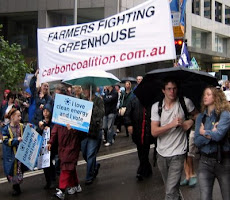
You will find the website we intend to promote at http://adoptafarmerfightinggreenhouse.blogspot.com. The eventual address will be www.adoptafarmer.com.au - following on from our successful adoptasheep exercise. Although it is a personal appeal to the reader in the introduction, it is delivered on behalf of "Carbon Farmers".

If you have any advice or observations, please make them.

Onwards!

Michael

PS. We are still tinkering with the sites.

Tuesday, May 01, 2007

Carbon Farmers of Australia makes historic first soil credit sale


The first money changed hands for soil carbon in Australia on the 6th of March, 2007. Samantha Meadmore-Jewel, Organic Food Research and Development Executive for The Lovely Pancakes Restaurant Group, made the first ever purchase of Australian soil credits on the 6th of March when she bought Australian Farm Soil Credits from Carbon Farmers of Australia.

We have since made other sales, but we especially celebrate this first - through our online site http://carbonfarmers.blogspot.com - because it made history. It proved the naysayers wrong. It started the ball rolling towards soil sequestration and struck a blow against global warming... And it has shaken up the market. It has been since the 6th of March that the momentum has been building.


The Pancake Parlour’s plans to use the involvement with soil sequestration have expanded to form a campaign on the subject involving an educational program via the tables of the 10 The Pancake Parlour outlets in Victoria. For parents with small children, colouring sheets with comic strip format explanations for parents on the flip side, feature simple explanations and diagrams introducing difficult topics such as global warming and photosynthesis… they are brilliantly designed.


For the customer who is interested there are web links listed to follow via The Pancake Parlour website if they should wish to also sponsor the Carbon Coalition and a 3 page leaflet of extensive information taken from Dr. Christine Jones’, soil ecology notes with her web address to further get all the information they want. There will be a poster and eventually table cards will be positioned for a short time to further direct the less child oriented customers. This will surely impact the weekly 25,000 customers that visit The Pancake Parlours and spread the word about soil C and Climate Change.

Congratulations Lovely Pancakes. A true leader. Lovely!


Monday, April 30, 2007

The markets for soil carbon

There have emerged 2 distinct markets for soil carbon in Australia:

1. The Mandatory Corporate Market - companies purchase to offset their emissions in order to meet a mandatory cap, such as is imposed by the Kyoto Protocol or a scheme such as the Greenhouse Gas Abatement Scheme in NSW. As a commodity market, it doesn't matter to the purchaser where the offsets originate.
2. The Voluntary Market - individuals, governments, NGOs and corporations who purchase for reasons other than meeting mandatory targets, such as combating climate change, encouraging environmentally-friendly behaviour, assisting third world communities, etc. The action is defined as voluntary so long as the credits will not be used to meet a regulatory target. They are purchasing a branded product, packaged and bundled with more attributes than simply being a commodity carbon credit. The action is defined as voluntary so long as the credits will not be used to meet a regulatory target.

There are two more dimensions in the market:

1. The wholesale market:large volumes of offsets made available by operators who can demonstrate that they have prevented emissions by developing renewable energy projects or who can demonstrate that they have 'sequestered' CO2.
2. The retail market: companies and organisations that invest in offset projects and then sell off portions of the emission reductions in relatively small quantities with a mark-up.

Mandatory purchasers can choose a particular type of wholesale offsets (eg. foregone vegetation clearing) for image reasons. Eg. coal miners and power generation companies are known to favour environmental projects.

The image/"meaning behind the source"/emotional content of an offset - such as a solar energy project in a underdeveloped country - can add make it more valuable to the buyer. By 'bundling' benefits into the offset package, promoters can create what is called 'gourmet' carbon. Naturally these offsets can command a higher price.

The retail market is currently quite small, but is growing rapidly. Several service providers have reported a doubling of sales each year for the past two years.

Standards, protocols, and verification methods used to regulate mainstream carbon
offsets include:

1. CDM/JI Standard – set by international regulatory authorities
2. The Gold Standard – created by consortium of NGOs for energy projects
3. The Climate, Community, and Biodiversity (CCB) Standards – created by
consortium of NGOs and private sector for land-based sinks projects
4. Self developed standards – created by individual providers

The majority of retail providers adopt self developed standards and
verification procedures, rather than following the CDM and Gold Standard guidelines.
Voluntary markets are largely unregulated. 'Voluntary markets can maintain environmental integrity without the precise quantification, unambiguous ownership requirements, and in-depth M&V protocols required of compliance markets," says Dr. Mark Trexler whom we met in Washington last October. "The voluntary market has the flexibility to encourage innovation. It may be able to provide the most benefit to small-scale projects and technologies that the regulatory market tends to overlook (either because the projects fail to meet a required threshold or because they are too small to bear the high transaction costs often associated with regulatory offsets)," he says. Dr Trexler is the president of Trexler Climate + Energy Services, Inc., an energy and environmental policy consulting firm based in Portland, Oregon.


Prices vary enormously, from US$5 - US$35 or more per tCO2e. Brokers generally charge a 7.5% commission. Websites generally have a carbon calculator, where individuals can calculate emissions from flying, driving their cars, or their total yearly emissions.

"Sustainable development benefits of projects on offer from retail providers vary from projects with little benefits to local communities, to projects in which communities are key participants, to projects that address biodiversity and communities," says Nadaa Taiyab of the International Institute for Environment and Development. The majority of retailers appear to focus on forestry projects.
"Buyers if voluntary offsets are not buying a ‘product’ so much as they are giving to a cause. The calculation of carbon emissions is simply a way of defining the size of their contribution," she says. They are paying for a service: not just the offset, but also access, convenience, and quality assurance.

Carbon Farmers of Australia is operating firmly in the voluntary market, selling gourmet carbon.

FACTS ABOUT VOLUNTARY CARBON MARKETS

√ The first voluntary transaction occurred in 1989 when US power company AES Corp. invested in agroforestry projects in Guatemala.
√ The start-up capital needed to register a project for the mandatory compliance carbon market can be beyond many projects. Voluntary projects avoid these bottlenecks.
√ The market for voluntary offsets is estimated to have doubled between 2006 and 2007 to 100 million tonnes.

(See Bayon, R., Hawn, A., Hamilton, K., "Voluntary Carbon Markets", Earthscan, 2007)

Friday, April 06, 2007

NFF comes up trumps on trading


The National Farmers' Federation has come out against a carbon tax and in favour of soil carbon credits.

In a submission to the Prime Minister's taskforce on emissions trading, president David Crombie said the NFF favoured a national emissions trading scheme. Farming had the potential to sequester emissions, he said. Carbon sequestration could be done through management of livestock, fertilisers, vegetation and soil.
Mr Crombie also opposed a carbon tax. Any additional impost on farm inputs and outputs would increase production costs and make agriculture less competitive in overseas markets, he said.

Mr Crombie pinged the Prime Minister for his boasting claim that Australia would meet its Kyoto obligations.** The NFF said farmers' efforts in curbing land clearing had enabled Australia to largely meet its commitments under the Kyoto Protocol. He said that these emission cuts were valued at $500 million* but the cost had been borne by farmers — an "enormous inequity", he said. Farmers also planted 20 million trees each year. Any policy should provide "full recognition of this annual contribution by the farm sector", he said.

The NFF also took aim at 'forests' or tree plantations. Mr Crombie said limits should be placed on carbon offsets for large-scale tree plantations in high rainfall areas. Any developments should be subject to full planning consent, including water impacts, he said.


*Carbon trading industry sources have valued the foregone clearing at $1.8billion.

**This is not true. Demand for energy has pushed Australia well past its target emission limit which itself was set very favourably by the Kyoto negotiators seeking to get Australia to support the scheme.

Sunday, April 01, 2007

Carrying the flame to Grafton far away

Louisa and I got back late yesterday after travelling 10hours by road (with an hour stop in Armidale to watch the Autumn Festival Parade and an hour in Tamworth to buy groceries). We had attended the most invigorating Landcare Farming Forum, put on by the Northern Rivers Catchment Management Authority and Landcare. We spoke on the topic "Future trading in soil carbon" and attracted a fair crowd, given there were 3 other streams going on, one of them featuring Allan Yeomans whose book Priority One is os justly famous. The highlight of the event was the key note speaker Dr John Williams, Commissioner of Natural Resources in NSW. He spelled out in simple terms the links between man and nature, and at one stage I heard him say the words, that setting the planet to rights is a journey that starts in the hearts and minds of the each one of us. Profound words.
John WIlliams, Commissioner for Natural Resources met Coalition member Craig Carter who had delivered a paper on Natural Sequence Farming. Craig's weirs leak.Dr Williams was chief of CSIRO Land and Water until 2004. Later that day, during a panel session, he said that my contention that soil carbon is hard to measure was not right. It is easy to measure for trading. I should have added the words "economically". But it was heartening to hear the Commissioner make an empassioned plea for farmers to be rewarded for storing soil carbon. Another highlight was hearing Gary Zimmer, a biological farmer from Winsconsin, USA. Gary is an educator and consultant and farmer. He says he doesn't expect you to remember much of what he has to say. He just wants to "spark" you up to want to learn more, and this he does. Gary speaks at the speed of sound - some of his words leave his mouth so quickly they reach you ears well before words he said before them do... if you get my drift. He is full bottle on soil chemistry, and how. Gary Zimmer has the gift of the gab and great information to go with it.

But he's not just all left brain. He has that special right brain intuition that few others have - Christine Jones is one - of just feeling that a farm is in synch or not, no matter how good or bad it appears. His was a special session and he is a special man. Other highlights for me were Cam McKellar's presentation on his biological farm near SPring Ridge. (I've asked Cam for one of his photos.) And Dr Lukas van Zweiten who prefaced his presentation on biochar with the immortal pronouncement that Australian soils are too buggered (my words, not his) to store much carbon (hence we must buy char) which raised my hackles, but we chatted later and he promised to send me some information. The New England looks a picture and we yearn for it still (we met in Armidale and lived there for several years). There's plenty of soils carbon growing under the pastures northeast of Armidale, I'll bet.
It was great to see Sally Wright in action. Every CMA should be trying to poach her.

Thursday, March 29, 2007

$90/tonne for soil carbon, reports Farm Weekly

Breaking Rural News : AGRIBUSINESS AND GENERAL
$90/tonne for carbon
Australia
Thursday, 29 March 2007

It was champagne all round when Carbon for Life founder, Christine Jones, launched the Australian Soil Carbon Accreditation Scheme in Katanning, WA, last week.

The scheme enables WA farmers to be paid when they increase their soil carbon.

The pilot program is the first of its kind in the Southern Hemisphere.

It will allow WA Northern Agricultural region and south coastal region farmers to register up to four 20ha so-called Defined Sequestration Areas (DSA) on any portion of their properties.

The area will be soil tested each year for an initial three-year period.

Farmers will be paid $90/tonne annually and retrospectively for the increase in their soil carbon.

The soil test involves taking 110cm cores for testing and a 0.15pc increase in soil carbon would be equivalent to adding 23.1t/ha of carbon, earning a healthy $21.19/ha per year.

Farmers are well aware from soil tests that a good organic carbon measure is a sign of healthy soil.

So any measure to increase soil carbon would have two beneficial effects.

The concept of using soil as a carbon sink has not been accepted on an official level, even though it is potentially the largest sink in the world that can be easily accessed by direct human action.

Many traditional forms of agriculture result in a loss of soil carbon, and it would seem that an acceptance of soil as a carbon sink would also require the carbon loss to be included in Australia’s greenhouse calculations.

The scheme is the result of a private arrangement between Carbon for Life and Rio Tinto Coal, which will provide funding for the initial three years of the trial.

Christine Jones said under the current pilot project, one landholder can have up to four DSAs on their property if they would like to experiment with different soil building techniques to a maximum of 80ha.

“It would only require a 1pc increase in soil carbon on 15 million hectares of land to sequester 8GT of carbon dioxide in the soil, which is equivalent to the greenhouse emissions for the entire planet,” Dr Jones said.

“To pay farmers to sequester this carbon at the rate of $25/t of carbon dioxide would cost $200 billion.

“That might sound like a lot of money but in the corporate world, it is peanuts.

“With a mere $200b, we could reverse global warming in a matter of years and markedly improve soil productivity at the same time.

“It’s not about money — it’s about managing money to manage the carbon cycle — for the future of us all.”

* More information: www.amazingcarbon.com

SOURCE: Farm Weekly, WA, March 29.

Monday, March 26, 2007

Inaugural Scientists/Farmers Soil Carbon Summit

[Dr Brian Murphy presents the current science about soil carbon to the first gathering of scientists and landholders on the subject that we are aware of. Brian's presentation was 'amazing', said one farmer.]
[The meeting area at the CMA Dubbo was barely big enough for the crowd, including landholders Michael Day, Eric Harvey, Angus Maurice, Robert Goodear, Maree Goodear and Colin Seis.]


The summit titled "Practical Ways of Getting Incentives to Farmers Storing Carbon in their Soils" had its origin in a meeting between the Carbon Coalition, leading Department of Natural Resources soil scientist Dr Brian Murphy, and Central West CMA Soils Specialist John Lawrie. The gap between what farmers expect of scientists and vice versa dominated the conversation. Four months later, on 22nd March 2007, the great experiment was staged. Would exposure to each others' issues and agendas lead to solutions for both sides? Yes.

"The main objective is to discuss how the Central West CMA can help facilitate payment of funds to encourage farmers to increase the storage of carbon in their soils," said John Lawrie in his introduction. "We believe that practices that our best farmers are now using including no-til farming, control traffic farming, cover cropping, pasture cropping and advanced methods of stock grazing management are having beneficial effects on the health of our soils and maintaining or increasing levels of carbon in the soil."

"We also hope to develop simple pragmatic methods of assessing the quantity of carbon that can be stored using these improved management systems. We hope that we can come up with some management principles that we can use to develop suitable incentive benchmark payments to farmers while better measurement practices are being developed.
For example. we would like general consensus from soil scientists and farmers that more carbon can be stored in the soil incrementally if the soil is not plowed; burnt; stubble left ungrazed; pasture cropped; cover cropped etc. This will help us provide guidelines to brokers who have access to carbon sequestration funds and are developing projects to distribute this funding to worthy farmers. It would also be useful if we can come up with a method for working out the magnitude of increases in carbon that are possible in differing climatic zone and soil types in our catchment."

There followed Michael Kiely's presentation on the critical role of soil in the climate change issue. "I feel like President Kennedy must have felt when he asked the scientists to put a man on the Moon to deliver a 'shock and awe' message to the Russians. 'The moon's up there. We're down here. We just pop a guy up there... It can't be that hard.'" But the science of accurately measuring soil carbon is hard, because soil carbon is mercurial, fluxing in and out of soil with night and day, rainfall events, etc.

Brian Murphy's presentation which was an eye-opener for the landholders present. His presentation held landholders spellbound.

Greg Chapman then gave an amazing presentation on "Pragmatic ways of monitoring carbon stored". He is the leader of the NSW Department of Natural Resources's soil mapping and soil information program and has wide experience in soil survey, land evaluation and the identification of soil limitations to land use. He described a system of national protocols for long term monitoring of our soils, that drills down to the individual property.

The meeting then mapped out a continnuum of soil management practices that could be given values for a proxy trading system. It was decided to meet again 3 months later. Meanwhile an action team will work up the recommendation.

The meeting ran overtime, such was the enthusiasm of the attendees.

Friday, March 23, 2007

Christine Jones launches Australian Soil Carbon Accreditation Scheme

Soil carbon 'goldmine' for WA farmers

Farmers participating in an innovative WA soil carbon pilot project will receive $25 per tonne for carbon dioxide sequestered as organic matter in their soils.

Dr Christine Jones, CEO of Carbon For Life Inc, launched the Australian Soil Carbon Accreditation Scheme (ASCAS) at the 'Managing the Carbon Cycle' Workshop in Katanning 21-22 March.

"The Chicago Climate Exchange in North America has been trading in soil carbon with farmers in Canada, North America, Mexico and Brazil since April 2005" Dr Jones said.

"It's time for Australian farmers to be rewarded for improving their soils"

Every 2.7 tonnes of carbon sequestered in the soil is equivalent to 10 tonnes of carbon dioxide taken out of the atmosphere. Farmers participating in the ASCAS project will receive 'Soil Credits' worth $25 per tonne for this carbon dioxide.

Under the $1.3m ASCAS project, soil carbon levels will be measured under regenerative agricultural regimes across the continent, from the South Coast of Western Australia to North Queensland. The pilot trials in WA will be run in conjunction with the Department of Agriculture and Food (SCRIPT Soil Health Initiative), Evergreen Farming Group and the Northern Agricultural Catchments Council.

Project partner, DAFWA Senior Development Officer Tim Overheu, says landholders in the past have done little soil testing on a regular basis. "Historically they have known little about what is happening below the soil surface; instead focusing on the plant growing above it" he said.

"As a generalisation, the majority of landholders have a low understanding of 'cause and effect' of soil quality management and soil health".

According to Dr Jones, soil carbon sequestration can be relatively rapid under innovative regenerative management regimes.

"Organic carbon (such as humus) has many benefits in soils, making effective carbon management the key factor for productive farms, revitalised catchments and a greener planet."

"The ASCAS model will create a collaborative and progressive market-based instrument to help address a wide range of environmental issues" Dr Jones said.

"The establishment of this validated soil carbon trading model will be a first in the Southern Hemisphere - placing Australia among the world leaders in soil carbon trading development".

Tuesday, March 20, 2007

Re-Register NOW for the Carbon Coalition

You may no longer be registered with the Carbon Coalition, due to computer melt down. If you did NOT receive the CCNewsletter3/07 today, you will need to re-register. Apologies.

Donate today! Support the Carbon Coalition

The work of the Carbon Coalition has been entirely voluntary for the past year.

The Convenors have funded:

• lobbying,
• outreach,
• speaking engagements,
• website activity,
• blogging,
• research,
• overseas study tour,
• attending conferences to make contacts,
• appearing before official enquiries…

Please see the attached activity sheet. The time involved has grown to consume time previously devoted to income-producing activity. We can't go on this way. We need to professionalise the operation. Get serious or get out.

We believe the mission of the Coalition is too important to wind down at this important point.

We are on the point of creating the soil carbon market in Australia, We are enrolling landholders for trading.
But the challenges we have coming up include:

1. Being fobbed off with Federal Government Stewardship Payments instead of carbon credits. These are a poor substitute for three reasons: i. it puts you in the hands of the public servants; ii. They could never be as lucrative; iii. They represent handouts, not payments for produce. We believe the Howard Government is implacably opposed to soil carbon credits. (Leopards don’t change their spots.)
2. Missing out on offsets when on-farm emissions are measured/estimated and landholders are required to buy credits to offset CO2, methane, nitrous oxide etc.
3. Put an end to the myth about Australian soils and carbon.
4. Force the hand of the regulators (IPART) by forming markets.
5. Promote the notion of Carbon Farming among business as usual growers.
6. Maintain pressure for Australia to join Kyoto.
7. Protect landholders from exploitation by unsympathetic middlemen and opportunists.
8. Teaching landholders about the carbon trading markets.

We need your help…

We need your help to achieve the goals of the Coalition:

• Making the family farm more economically viable
• Strengthening rural communities
• Restoring the ecological health of farmland
• Reducing the extremes of Climate Change

What we need resources for…

• Website development
• Membership database system
• Maintenance of blogsites
• Publicity
• Management
• Lobbying government and officials
• Building links with big business
• Research
• Conferences
• Subscriptions
• Travel/Acc

There is so much more we can do… getting Members involved in our activities is FIRST AND FOREMOST… but it takes time and time is always short when you’re short of money.

WHAT CAN YOU DO?

There are many ways you can help:

• You can send a cheque to the Carbon Coalition Against Global Warming C/- MB & AL Kiely, “Uamby”, Uamby Road, GOOLMA NSW 2852

• You will find a “Donate” button on the website (www.carboncoalition.com.au) and on the blogsites.

• You can buy Australian Farm Soil Credits from http://carbonfarmers.blogspot.com

• You can engage CarbonCreditedBrands by visiting http://carboncreditedhowto.blogspot.com

Your contribution is an investment in the greatest opportunity to solve the problems of declining land health, declining economic health, and declining personal health in agriculture.

Thank you for being part of this historic moment.


Michael, Louisa & Daniel Kiely
Convenors

PS. Please pass this email letter on to others you may know who would be interested.

NB. YOUR TAX DEDUCTION: The Carbon Coalition is not registered charity. It is operating as a not-for-profit carbon trading consultancy and information service. You "Donation" is a voluntary 'fee'. Once you have made a contribution, the Coalition invoices you for CARBON ADVISORY SERVICES (which is a legitimate part of our activities) and your receipt can be used for deduction.

Latest Coalition Newsletter

Carbon Coalition Against Global Warming
Newsletter March 2007


Please pass this letter along to your contacts. We are building out database of supporters and need your help. Thank You!

_________________________________________

IN THIS ISSUE:
A Year On… Soil C on the Map
Still Seeking Scientific Measurement
Debunking the Soil C Myth
First Soil C Sales
We Make A Market
Register NOW to Sell your Soil C
Initiative: Soil-C-Central
Donations Needed
12 Month Activity Report
List of Coalition Blogsites
Soil C Can Be Measured For Trading

Greetings! It’s been a long time…

Sorry it’s been a long time between drinks. We have been incredibly busy, what with the drought and climate change issues and Coalition work. We hope you have been able to stay in touch via the blogsites. A major computer crash disappeared your contact details until earlier today when we were able to reload a list that is a little shorter than it was, but most of you are still there. If you know of someone who was on the Coalition list, please ask them if they received this and, if not, ask them to register again, please.

Happy Anniversary!

Last month we passed our first year as an organization. At the end of this newsletter is an Activity Report which touches briefly on the work of the Convenors, the Advisory Council, and Members.

We’ve come a long way from where we were a year ago. For most of the time since February 2006, we have been dismissed as lunatic fringe dwellers pushing an impossible dream and creating unreal expectations among landholders. All that has changed…

Soil Carbon Credits on the radar

• This week – only 3 days ago – the Carbon Coalition presented the soil carbon case to a press conference at Parliament House in Sydney, the event organised by the NSW National Party to launch its soil carbon trading policy. The Coalition provided the substance for that policy. The NSW Nats are the first political party to adopt the Coalition’s position.

• Two days ago the NSW Farmers’ Association passed a motion that commits it to seeking incentives for curbing emissions. Earlier in the NSW Election campaign President Jock Laurie called for a carbon trading scheme for soils. The Coalition has briefed Jock several times in the past 12 months, and also briefed the Wellington Branch members who originally took the motion to the State Conference.

• In the previous month, Australian of the Year Tim Flannery made a statement supporting the soil carbon trading concept after receiving briefing material from the Coalition via another Coalition – Patrice Newell’s Climate Change Coalition, which is standing 21 candidates for the NSW Upper House.

• Carbon Coalition Convenor Michael Kiely and CC Member Bruce Ward are standing for the CCC as a platform to promote Carbon Farming and Soil Carbon Trading. Tim Flannery has endorsed the CCC and greeted the founding of the Carbon Coalition with a public endorsement back a year ago.

• Also in February, the NSW Commissioner for Natural Resources John Williams came out in favour of soil carbon credits at $25/tonne. The Coalition has made another friend.

• More recently, the Federal Shadow Minister for the Environment Peter Garret said: “Why did Campbell hate you?” when the Convenors introduced themselves at Rockhampton Airport last Saturday, after delivering a 4 hour seminar on carbon trading to an RCS gathering in Yeppoon. Mr Garrett indicated he read our blogsite regularly. “I keep up with your stuff…” (Campbell was the former Federal Minister for the Environment, Senator Ian Campbell, who refused to meet with us and fobbed us off with meaningless letters stating implacable resistance to carbon trading. We blogged his demise only two days before the Garrett meeting.) We also met Kevin Rudd at the same time and registered the Coalition with him.

• Rod Rush put together a brilliant briefing paper to present to the Federal Minister for Agriculture, then the climate sceptic Ian MacFarlane (which was ignored and dismissed.) Rod’s work was so useful we were able to use it as the Coalition’s submission to the National Emissions Trading Scheme enquiry. Thanks Rod. (The Coalition’s 2 submissions were the only ones dealing with agricultural issues.)

• Late last year, in December, Bruce Ward and Tony Lovell arranged for the Coalition to present its argument to the NSW Premier’s Advisory Panel of Climate Change. Many opportunities have arisen as a result.

• Earlier, in November, at Christine Jones’ Carbon Forum in the ACT we were able to present the Coalition’s position to MP for New England Tony Windsor who subsequently asked the Prime Minister a question in Parliament which flushed the PM out on carbon markets.

So, important people are now talking about soil carbon credits. Thank you to everyone who opened doors for us: Mark Roberts, Hamish Munro, Christine Jones, Rod Rush, Maartin Stapper, all the good folk at the Central West CMA, John Lawrie, Tom Gavel, Col Seis, David Marsh, Angus Maurice, Rick Maurice, Jane Wilson, John Muller, John Williams, Bruce Ward, Tony Lovell, Tom Green, and all the people who invited us to speak at gatherings across the nation. (Many names have been missed here. Apologies.) A special thank you should go to Rhonda Willson for a large donation towards Christine Jones’s research into the measurement issue.

'NEVER DOUBT THAT A SMALL GROUP OF THOUGHTFUL, COMMITTED CITIZENS CAN CHANGE THE WORLD; INDEED, IT'S THE ONLY THING THAT EVER HAS.'”
Margaret Mead

SOIL CARBON CAN BE MEASURED FOR TRADING

The Holy Grail… Measurement


So we had two goals: 1. Establish the soil carbon market. 2. Gain access to the top value market. The biggest barrier is to be found with the scientists. Conventional wisdom says soil carbon is too “slippery” – or subject to flux – to measure definitively. We despaired recently when speaking to one of the leading soil scientists and he told us that the more they studied soil carbon the harder and more difficult it is to pin down. Remember this: in any conversation about measuring Soil C for trading, if you hear the word “accuracy” it spells doom. Based on a paper by Dr Brian Kimble of the US Dept of Ag, we advocate moving in the opposite direction: away from precision and towards practicality. (A short section of Dr Kimble’s paper is attached to this email.)

‘Remember this: in any conversation
about measuring Soil C for trading,
if you hear the word
“accuracy” it spells doom.’


We know of at least 4 or 5 trials that are underway to prove up MMV systems (Measurement, Monitoring, Verification). We wish them the best because we need a system, and we will rejoice the moment IPART (Independent Pricing and Regulatory Tribunal) approves a system.

The Coalition (including several leading ‘carbon farmers’) will be attending a ‘summit’ with a group of prominent soil scientists on 22 March, 2007 in Dubbo. The Coalition will be seeking a practical solution and hopes this meeting is a watershed in the journey towards full value/direct measurement soil carbon trading.

CCX order for 25000 acres


While we were in the USA in October, we managed to secure the first order for Australian till to no till soil. The only technical detail we needed to fulfil was to provide “peer reviewed data” that validated the 0.5t/acre/year rule of thumb US farmers were trading under. While this sounds like an easy task, we ran into a wall of costs and confusion. We need to be able to pay for a scientist to extract the necessary data from the Australian Greenhouse Office data sets.

The Coalition has no financial resources (especially after funding the USA trip and most speaking engagements to date). So we will be embarking on a fundraising campaign to overcome this frustrating blockage. This issue will also be raised during our ‘summit’ with the soil scientists.

Soil scientists can save the world


This is the title for a new blogsite: http://soilsscientistscansavetheworld.blogspot.com/

It appeals to soil scientists to help solve the greenhouse gas emissions overload problem by contributing to a practical measurement solution. We are hoping to use every means to engage soil scientists to broaden their paradigm and help us develop a means for trading.

A major breakthrough


The biggest blockage to our progress is the officially-sanctioned myth about Australian soils that surfaced in the Australian Greenhouse Office and has since been promoted by the Australian Farm Institute. The AGO states: "Typically Australian soils have a poor capacity to store large quantities of carbon." This generalisation was based on the data sets developed over 10 years for the Carbon Accounting scheme.

Executive Director of the Farm Institute, Mick Keough, elaborated on the myth: “The bulk of Australian farms may not operate as carbon sinks, due to the age of the soils." This myth is promoted by the Institute in the form of papers by John Carter, MSc., former AGO scientist and currently Principal Scientist, OLD Department of Natural Resources and Water.

The myth carries the weight of science because it is based on ‘the data’. But if ‘the data’ was so reliable, why has the NSWDPI launched a set of trials to test soil carbon performance under various pasture management approaches in the last month?

Answer: There are gaps in the data sets. Gaps so big you could drive a carbon trading scheme through them. Working through the AGO Technical Reports, we noticed that what the data covered was largely business as usual land management – which we know is carbon depleting. There was little, if any evidence of ‘carbon farming’ techniques being included in the studies. This is understandable. Regenerative (soil C promoting) techniques were less familiar 10 years ago, and in all the Technical Reports, the scientists complained that they were constrained by time and resources from filling gaps in their data sets.

This is a major breakthrough for the Coalition.

The AGO is not aware of this deficiency in the data upon which public statements have been based. In the Coalition’s position paper, Rod Rush reports: “At the wind-up sessions of the Australian Greenhouse Office (AGO) in the middle of 2006 the CSIRO Land & Water project leader on soil carbon stated that it just was not possible to sequester carbon in soils at the rate necessary for it to be of advantage as a part solution to the problems of global warming. However, when the practices of “regenerative” agriculture were explained to him, and later to his successor, they expressed surprise and interest in conducting research into the contention that soil carbon levels can be raised, and raised quickly. There is currently no funding available for this project and to succeed in raising the required funds, years of prejudice have to be overcome.”

Coalition opens the Carbon Trading Register


The books are open for landholders to register their soils for soil carbon trading. The Carbon Coalition has several initiatives currently underway to generate demand for Australian Farm Soil Credits. A form will be posted on the website (www.carboncoalition.com.au) shortly. Please encourage your contacts to register. The more numbers we have a landholders demanding to be given access to trading, the more ‘weight’ we will carry in our battle with myths and prejudice. And the more likely we will attract support from buyers.

You can register two levels of involvement:

1. Growers who have soils on which land management has changed since 1990 (the baseline date used under the Kyoto Protocol):

• from till to no till cropping
• from cropping to pasture
• from set stocking to grazing management

2. Aggregators who can organise groups of growers into pools for trading purposes.


Creating demand for Australian Farm Soil Credits


The Convenors of the Carbon Coalition have launched two initiatives to generate orders for Australian Farm Soil Credits:

1. CarbonCreditedBrands: a service for corporates that guides them through the process of becoming carbon neutral and brings their customers, staff, suppliers, etc. with them on the journey. After the company’s emissions have been audited and all efforts made to bring them down by power savings, etc., the company chooses ‘abatements’ or ‘offsets’ (credits). The range of options includes Australian Farm Soil Credits.

2. Adopt A Farmer Fighting Greenhouse: a retail enterprise selling Australian Farm Soil Credits on the “voluntary” market for abatements. This is the fastest growing market overseas. “Voluntary” means the credits cannot be used to meet mandatory caps. They are chosen largely by consumers to offset their lifestyle emissions and by companies seeking to make a contribution to the battle against climate change. Voluntary Credits are usually bundled. Ours include Provisional Carbon Credits, a contribution to environmental restoration on farmland, and a contribution to the work of the Carbon Coalition in spreading the soil carbon message far and wide. Soil Credits offer the buyer unique benefits.

The first orders for both offerings have been received during a test marketing phase.

We hope to reduce the leakage of value to middlemen by offering growers the opportunity to have a share in the trading company.

But how will you measure it?


A ‘voluntary’ market product is often bundled with a donation to a cause. The precision required to sell a bare tonne of carbon is not required by the buyer. The AUSTRALIAN FARM SOIL CREDIT is based on the following indicators:

1. The history of soil management for the plot in question.
2. The history of soil management for the entire property.
3. The training record of the land manager.
4. The land management techniques used on the entire property.
5. The imputed increase in soil carbon in the plot in question over the period since the change in land management.
6. Membership of Carbon•Farmers™, a group of conservation land managers who are also actively working to restore the natural resource base.

AUSTRALIAN FARM SOIL CREDITS are Provisional Carbon Credits. They are set at a very conservative rate of 2 tonne per hectare where land management has changed since 1990 (the baseline date used under the Kyoto Protocol):

• from till to no till cropping
• from cropping to pasture
• from set stocking to grazing management

Each category represents an amount of greenhouse gas emissions not released, as well as an amount of soil carbon stored.

These categories are based on estimates published by the Australian Greenhouse Office: "The review clearly indicated that the introduction of a cropping phase into uncleared land or a well-established pasture with high plant biomass, reduced soil carbon density by 10 to 30 t/ha in soils to 30 cm depth... Likely changes in soil carbon densities associated with changes in soil tillage practices are of the order of 5 to 10 t/ha when they occur..." (National Carbon Accounting System, Technical Report No. 43, January 2005.) Our estimates are also informed by K.Y. Chan’s work on soil carbon levels under different land management methods in NSW which revealed that soil carbon levels were 2 to 2.7 times higher in pasture soil than in cropped soils, and significantly higher in minimum till than in conventional tillage soils. (Chan, K.Y. “Soil particulate organic carbon under different land use and management,” Soil Use and Management (2001) 17, 217-221.) Eminent soil C expert Professor Rattan Lal says: “Conversion from conventional till to no-till farming reduces emission by 30 to 35 kg C/ha per season. (“Soil Carbon Sequestration Impacts on Global Climate Change and Food Security,” Science, Vol 304, 11 June, 2004)

Once the science catches up, the surface area will be rescaled to meet the amount 'measured' in the soil below. Provisional Carbon Credits allows the Soil Storage of CO2 to start.

Initiative: Social-C-Central

Soil-C-Central is a MegaWeb site dedicated to Soil Carbon. It aims to provide landholders and those who advise them a central source of information about Soil C.

Its content will include: news; upcoming events, conferences and courses; new research findings and papers; new research studies and timetables for results; new websites; and new newsletters and publications.

The Soil C Library: will include Bibliographies - lists of publications; Academic papers; Articles; Interviews; Links; Websites; and Blogs.

A Soil-C-Community will be encouraged as a place where scientists, agronomists, and landholders and anyone interested can swap information and discuss issues. It might include Profiles of Members (voluntary); Notice Boards; Chat room; Online events; “Webinars”; etc.

This promises to be a great addition to the Coalition’s work, but there’s a cath… it will cost money.

Do you support the work of the Carbon Coalition?

The work of the Carbon Coalition has been entirely voluntary for the past year.

The Convenors have funded:

• lobbying,
• outreach,
• speaking engagements,
• website activity,
• blogging,
• research,
• overseas study tour,
• attending conferences to make contacts,
• appearing before official enquiries…

Please see the attached activity sheet. The time involved has grown to consume time previously devoted to income-producing activity.

We believe the mission of the Coalition is too important to wind down at this important point. The challenges landholders have coming up include:

1. Being fobbed off with Federal Government Stewardship Payments instead of carbon credits. These are a poor substitute for three reasons: i. it puts you in the hands of the public servants; ii. They could never be as lucrative; iii. They represent handouts, not payments for produce. We believe the Howard Government is implacably opposed to soil carbon credits. (Leopards don’t change their spots.)
2. Missing out on offsets when on-farm emissions are measured/estimated and landholders are required to buy credits to offset CO2, methane, nitrous oxide etc.
3. Put an end to the myth about Australian soils and carbon.
4. Force the hand of the regulators (IPART) by forming markets.
5. Promote the notion of Carbon Farming among business as usual growers.
6. Maintain pressure for Australia to join Kyoto.
7. Protect landholders from exploitation by unsympathetic middlemen and opportunists.
8. Teaching landholders about the carbon trading markets.

We need your help…


We need your help to achieve the goals of the Coalition:

• Making the family farm more viable
• Strengthening rural communities
• Restoring the ecological health of farmland
• Reducing the extremes of Climate Change

What we need resources for…

• Website development
• Membership database system
• Publicity
• Management
• Lobbying
• Research
• Conferences
• Subscriptions
• Travel/Acc

There is so much more we can do… getting Members involved in our activities is FIRST AND FOREMOST… but it takes time and time is always short when you’re short of money.

WHAT CAN YOU DO?


There are many ways you can help:

• You can send a cheque to the Carbon Coalition Against Global Warming C/- MB & AL Kiely, “Uamby”, Uamby Road, GOOLMA NSW 2852

• You will find a “Donate” button on the blogsite (http://carboncoalitionoz.blogspot.com), the website (www.carboncoalition.com.au) and on the other blogsites.

• You can buy Australian Farm Soil Credits from http://carbonfarmers.blogspot.com

• You can engage CarbonCreditedBrands by visiting http://carboncreditedhowto.blogspot.com

Your contribution is an investment in the greatest opportunity to solve the problems of declining land health, declining economic health, and declining personal health in agriculture.

Thank you for being part of this historic moment.


Michael, Louisa & Daniel Kiely
Convenors

PS. Please pass this email letter on to others you may know who would be interested.

NB. YOUR TAX DEDUCTION: While we cannot offer tax deductibility as a CHARITY, we can arrange a deduction for you by the following means: 1. You make your contribution. 2. The Coalition invoices you for CARBON ADVISORY SERVICES (which is a legitimate part of our activities) and your receipt can be used for deduction.


Carbon Coalition Against Global Warming
Activity Report
February 2006-February 2007


February, 2006 - Launched Carbon Coalition at Central West Conservation Farmers’ Association conference.

Established blog site carboncoalitionoz.blogspot.com – posted 127 reports in 365 days

Established web site – carboncoalition.com.au – collected 600 email contacts in 12 months

April, 2006 - Recruited Coalition Council members as advisory board: David Marsh, Rick Maurice, Col Seis, Angus Maurice.

Reguler press releases to national and rural media. Interviews with media.

April, 2006 - Gain support from Tim Flannery, Author, The Weather Makers

Add extensive “Library” of scientific papers and links to website and blogsite.

26 May, 2006 – Form alliance with Peter Andrews, Natural Sequence Farming

27 May, 2006 - Make presentation at Manning Landcare event, Gloucester NSW

2 June, 2006 - Brief NSW Farmers’ Association, Jock Laurie and David Ayrs, Sydney NSW

Write “Open Letter to Soil Scientists” for Australian Farm Journal

5 July, 2006 – Brief Central West delegation to NSW Farmers’ Association Conference, Wellington NSW

14 July, 2006 – Presentation for CWCMA at Mudgee Small Farm Field Day

19 July, 2006 – Make presentation to Baradine Landcare Group, Baradine, NSW

July, 2006 - Make presentation to Land Management Workshop, Cobar Field Day

15 August, 2006 - Brief National Farmers’ Federation, David Crombie and Dr Vanessa Findlay, Canberra ACT

2 September, 2006 – Make presentation to Gulgong Anglican Church Men’s Meeting, Gulgong NSW

USA 3 week fact finding mission
18/19 September: Washington DC – attend 2006 Global CO2 Cap-And-Trade Forum
21/22 September: Bozeman, Montana - Big Sky Carbon Sequestration Partnership Phase 2 Project Management Plan Workshop
25 September: College Station, Texas - Professor Bruce McCarl, Department of Agricultural Economics, Texas A&M University
27 September: Albuquerque, New Mexico - Peter Holter, Holistic Management International
28 September: Albuquerque, New Mexico - Southwest Carbon Sequestration Partnership Phase 2 Project Management Plan Workshop
29 September: Swanton, Vermont - Address Farmers' gathering organised by Coalition member Abe Collins from Vermont.
1 October: Columbus, Ohio - Professor Rattan Lal (or colleague), Ohio State University
3 October: Chicago, Illinois – Mike Walsh, SVP, Chicago Climate Exchange

Susan Capalbo, Director, Big Sky Carbon Sequestration Partnership.
Pamela Tomski is Associate Director responsible for outreach and education, Big Sky Carbon Sequestration Partnership.
Dave Brown, Technical Lead, Terrestrial Sequestration with Big Sky.
Michael Bowman, Director, 25:25, a movement that aims to have 25% of America's fuel needs supplied by farmers in 25 years.
Ted Dodge, Director, National Carbon Offsets Coalition which brokered the first carbon credits paid to US farmers In Montana and Kansas.
Professor Bruce McCarl of Texas A&M University, climate economist on the Inter-Governmental Panel on Climate Change.
Dr Rattan Lal, author of a small library of books and papers, co-author of many others, Professor of Soil Physics at the School of Natural Resources at Ohio State University, Columbus Ohio.
Dr Klause Lorenz, Senior Research Fellow, the School of Natural Resources at Ohio State University, Columbus Ohio.

Launched Carbon Coalition in USA - Abe Collins, Carbon Farmer and Convenor, Swanton, Vermont.

Attended and addressed 2 day Phase 2 Workshop in Albuqurque, New Mexico of the Southwest Regional Partnership.
Met with Head of Partnership, Dr Brian McPherson, from the New Mexico Institute of Technology in Socorro.
Met with Dr Joel Brown and Dr Jay Angerer, the 'soil carbon sequestration' experts with the Southwest Partnership.
Met with Peter Holter, Holistic Management International.

Secured first order for 25,000 acres Australian soil (till to no till) from CCX.

23 October, 2006 – Make presentation to Kingaroy Carbon Forum, Kingaroy QLD

Submission to Commonwealth Minister for Environment, Sen. Ian Campbell via Parliamentary Secretary Greg Hunt, MP.

Coordinated 8-farm application for CWCMA Round 5 funding for carbon farming soil trials.

4 November, 2006 - Attended the “WALK AGAINST WARMING”, the International Day of Action on Climate Change on Saturday, Sydney NSW

4 November, 2006 - Briefed Federal Shadow Minister for Environment, Anthony Albanese MP

13 November, 2006 – meet with NSW President Soil Science Society re peer reviewed data for CCX and Summit of scientists and Practitioners

25 November, 2006 – Make presentation to Cobar/Nyngan Landcare group

11 December, 2006 – attend National Emissions Trading Summit, Sydney NSW

29 December, 2006 - Submissions (2) to National Emissions Trading Scheme Inquiry, Sydney NSW

Second Submission to Commonwealth Minister for Environment, Sen. Ian Campbell

22/23 November, 2006 - Speak at 2006 National Carbon Forum Canberra ACT

Organising Summit between Soil Scientists and Practitioners (March 2007)

Briefed Tony Windsor, MP, Canberra ACT (subsequently asks PM a question in Parliament)

13 December, 2006 - Briefed NSW Premier’s Advisory Panel on Climate Change, Sydney NSW

19 December, 2006 - Briefed NSW Farmers’ Asociation’s Jock Laurie. Subsequently calls for soil carbon credits.

Briefed NSW National Party MPs responsible for natural resources management election platform, Sydney NSW

Stand for NSW Legislative Council elections for Climate Change Coalition as soil carbon advocate.

Presented at Managing Under Changed Climactic Conditions Conference, Bathurst NSW

9 February, 2007 - Address South Australian No Till Farmers’ Association, Tanunda, SA

13 February, 2007 – Met with Peter Holter and Judy Earl, Holistic Management International

14 February, 2007 - Briefed NSW Department of Primary Industries Farm Management Climate Change Risk Management Steering Committee, Orange NSW

Carbon Coalition Blogsites

• Carbon Coalition Against Global Warming

http://carboncoalitionoz.blogspot.com/

The best way to combat Global Warming short term is to reward farmers for cultivating deep-rooted perennial grass species and crops that can lock up vast amounts of carbon in the soil.

• Carbon Credits Government Watch

http://carboncreditsgovernmentwatch.blogspot.com/

A shift in the Bush Administration's attitude to Carbon Credits is the key to the Australian farmers getting access to carbon credits for carbon sequestered in agricultural soils. As the pressure builds on President Bush, so the possibility of soil carbon credits comes closer to reality for Australian farmers. And with it, the possibility of regenerating our natural resources and saving the nation billions of dollars.

• FAQ Soil Carbon

http://faqsoilcarbon.blogspot.com/

Basic facts and frequently asked questions about carbon in soil, soil carbon sequestration and carbon credits

• Buy Carbon Credits from Carbon•Farmers

http://carbonfarmers.blogspot.com/

Soil Carbon Credits are the only weapon the world has to defeat Global Warming. Only soil can do the job. Soil Carbon Credits encourage "Carbon•Farmers" to farm for maximum Carbon lockdown. Carbon•Farming is in harmony with nature. An Australian Farm Soil Credit from a Carbon•Farmer is so much more than a carbon credit.

• Diary of a Carbon Farmer

http://envirofarming.blogspot.com/

This is the diary of an Australian family who escaped from the city, joined a farming community, and learned to love soil. Carbon Farming is about growing soil carbon - the first link in our food chain. The topsoil is where God's creation is taking place, at every moment. Carbon is the building block of life. By growing it we can restore ecosystems to health. At the same time we can remove Carbon Dioxide from the atmosphere and store it as Carbon in the soil.

• Soil Scientists Can Save The World

http://soilsscientistscansavetheworld.blogspot.com/

How soils and the scientists who study them are the key to meeting the challenge of Climate Change and reversing environmental degradation over most of the Earth's surface.

• Soil Carbon Submission

http://soilcarbonsubmission.blogspot.com/

NATIONAL EMISSIONS TRADING TASKFORCE - Submission written by Rod Rush on behalf of the Carbon Coalition Against Global Warming. A Response to the Discussion Paper on a Possible Design for a National Greenhouse Gas Emissions Trading Scheme

• Forests kill communities

http://forestskillcommunities.blogspot.com/

Plantation tree farms - misnamed "forests" - are sucking the life out of rural communities and devastating local economies while damaging the biological communities they invade and robbing wildlife of habitat. Tax- and carbon credit-driven schemes for making city investors rich are threatening to create ghost towns in diversity deserts.

• John Howard On Carbon Credits

http://howardoncredits.blogspot.com/

This speech appears here in full until we can produce an edited version. It is valuable because it gives the reader an insight into the Prime Minister's strategy and could provide clues to achieving the Carbon Coalition's Vision by means other than a frontal attack on an immoveable object.

SOIL CARBON CAN BE MEASURED FOR TRADING
The Case for Averaging Soil C Sample Values to Enable Trading

Flux and soil variability are commonly used by opponents to trading in soil carbon. But one important US scientist argues for sanity to prevail: "It is often pointed out that soils have a large amount of variability, but with knowledge of soil sciences and landscapes, variability can be described and sampling protocols can be developed to deal with this," writes Dr John Kimble in a paper published this year*. "One reason I feel people say that soils vary and SOC cannot be measured is that we soil scientists focus on showing variability, not on showing what we know about the variability. In soils we can go to a 100m2 field and sample every square meter and look at the differences we find. But if you sample every tree in a large area you would see a similar variability." Dr Kimble works for the US Department of Agriculture, National Resources Conservation Service, National Soil Survey Centre, Lincoln, Nebraska. "We too often focus on this [variability], worry about laboratory precision and field variation and do not look at the real world where most things are based on averages and estimated data. We tend to focus on finding variation and not on using our knowledge of soil science to describe what we know. All systems vary, but in soils we focus on a level of precision and accuracy that may not have any relevance to the real world because we can take so many samples and look at the variation."

*Kimble, J., "Advances In Models To Measure Soil Carbon: Can Soil Carbon Really Be Measured?", in Lal, R., Cerri, C., Bernoux, M., Etchevers, J., and Cerri, E., eds., Carbon Sequestration in Soils in Latin America, Food Products Press, Birmingham, NY, 2006

Monday, March 12, 2007

NSW Nats make history on soil carbon

I felt like Alice in Wonderland. I was in a room full of National Party MPs and they were talking soil carbon credits like seasoned Carbon Coalition members. I've always liked the Nats as people - they aren't oily like the Libs who smarm and charm and say whatever they think you want to hear. Nats don't care what you think. They stand by what they are: royalists, traditionlists, anti-greenists, pro-development, and normally anti-conservation.

But the whiff of cash can turn an eco-trog into a green frog-lover. That's the beauty of soil carbon credits. They turned the NSW Nats into greenies. The Carbon Coalition in the form of Michael Kiely and Bruce Ward supplied all the data used for the Nat's new soil carbon election platform.

The Carbon Coalition congratulates the NSW Nationals!

Nationals aim to store carbon in soil

March 12, 2007 - 1:29PM

The NSW National Party will spend $3.6 million developing methods to store atmospheric carbon in soil if the coalition wins government at the March 24 election, Nationals leader Andrew Stoner says.

He says the Nationals will use the funds to distribute information about carbon storage to NSW farmers and to pay for the necessary research into the current levels of carbon in soils around the state.

"This is the most significant policy that's been put forward by any political party to actually reduce the atmospheric carbon and do something positive about climate change," Mr Stoner told reporters.

Enabling carbon storage in soil would greatly reduce the levels of carbon dioxide in the atmosphere, and increase the health of agricultural soils, he said.

"The potential to lock up literally billions of tonnes of carbon dioxide, it's there, and country NSW and farmers hold the key," Mr Stoner said.

"It's a win, win, win. It's a win for the farmer, it's a win for the environment, and it's a win for our rural economies."

A market could be developed for trading soil carbon credits, Mr Stoner said, while an increase in soil carbon would mean farmers would spend less on nutrients for their pastures.

Nationals MP Rick Colless, himself a farmer who is already using carbon storage methods, said an increase in the level of carbon in soil increased water retention, reducing the effects of drought and also reduced erosion and salinity.

© 2007 AAP

Sunday, March 04, 2007

Senator Campbell "BONED": it could be his nick name

The day the Stern Report was released, Senator Ian Campbell tried to laugh it off by flippantly referring to SIr Nicholas Stern as "Nick", "Old Nick" and other references that were aimed at trivialising his message and reducing the gravity of his warning by reducing his standing as an economist. Stern's was not the first dire warning by an eminent ecconomist, but it carried weight because of who Stern was and is. And the Howard Government sent a minor actor to shut him down. Sir Nicholas Stern was the Chief Economist and Senior Vice-President of the World Bank from 2000 to 2003, and is now the chief government economic advisor in the United Kingdom. Senator Campbell is a backbencher in a government that is proving itself wrong for the times in every way it possibly can."Old Nick's inclined to make dire predictions" was the tenor of the Senator's remarks. Howard's team of climate change deniers use the Bush Administration's playbook to denigrate scientific and expert reports. President 29% Approval once dismissed a key US Government EPA report, that the Administration failed to intercept and rewrite as they did with others, as 'just soemthing done by bureaucrats'. Senator Ian Campbell has written several times to the Coalition in response to our appeals for a hearing on the soil carbon issue. We didn't get to 'nick name' status.

PS> "Boned" was the Sunday Telegraph's headline today. Strangely, that News Limited paper still features regular columns by climate sceptics. Very democratic.

A BIG THANK YOU To THE SCIENTISTS WHO STOOD UP TO BE COUNTED

"Pastures can support rich growth of carbon credits," says the headline on the University of New England "NEWS" site (http://www.une.edu.au/news/archives/000710.html)

Then came the welcome news: "University of New England researchers have backed calls from the NSW Farmers Association for the introduction of a carbon credit trading scheme." The scientist 'outing' himself in this instance is Dr Wal Whalley, an Honorary Fellow in Botany at UNE. But even this was going a bit too far, and he qualified it with the old scientists' chestnut: "... scientific and economic know-how is not quite ready for the widespread use of such a scheme." Won't he get a surprise when we start trading next week without all that scientific palaver?

He says: "more work is needed on the details of measuring and trading these offsets to carbon emissions for the benefit of farmers." This in effect means nothing will ever happen. Why?
Because the more they learn about soil carbon the harder it becomes to pin it down scientifically. (The latest news from the laboratory comes to us via a senior soil scientist in the DNR who played a key role in the AGO work.) We know it's there. We just can't say how much right at this moment. It's a question of flux. Soil C is mercurial. It dances in and out. But we know there's lots there. And we also know a lot of other things about it, such as what the ground cover looks like, what the soil smells like, how it reacts to large downfalls of rain, and to no rain, what the bug life is like in the first 10 cms, what the general biodiversity situaiton is like, etc.

The Carbon Coalition says hair-splitting scientific accuracy is not required. What we need is a simple basis for trade - an agreement between two people as to what something is worth.

"It amazes me that we are still at this kindergarten stage with the science. Trying to find more accurate ways to measure is not the path to success," says Michael Kiely, Convenor of the Coalition. "The answer lies in estimates and indicators and averaging such as is done with everything else. Read the AGO's technical reports upon which all generalisations about Australian soils are based. They are full of surmises and estimations to bridge knowledge gaps."

Dr. Whalley was made a Member of the Order of Australia (AM) on Australia Day this year for his work on native grasses and grassland ecology. He says it is a "myth" that carbon credit trading schemes merely involve the "locking up" of forests. "Grasslands – and using grasslands for grazing – can provide more effective soil carbon storage than trees, as grasses have small, fibrous roots and quickly put carbon back into the soil," he said. "Through modern methods of grazing management and/or pasture cropping you can quickly increase the amount of organic matter in the soil. This is good for the grazing animals, the pasture and the soil."

"If the carbon credit trading scheme devised is simply with trees," he explained, "the science is easier because the estimation of the amount of carbon tied up in forests per year is relatively easy and commonly accepted. We don't know much about the measurement and forms of carbon increases in soils and grasslands, but our vast pastures and grasslands can probably lock up much more carbon than all our forests or plantations."

"Without standardised measurements of carbon increases, a widespread carbon credit trading scheme cannot exist, as there wouldn't be a fair way to work out the compensation amount*. I hope that research will yield results within the next few years." Can the world wait that long? Stern says we have 9 years, and many others agree with him. The polar bears. Keep your mind on the job. Their Arctic home is melting at 3 times the rate the experts thought. A lot of people care about polar bears.

In the same report we have news of further delaying tactics. One of Wal's colleagues "said that the other area in need of considerable research was an understanding of the nature of offsets, the potential products, and how to value and trade them across markets." When you see the words "considerable research' read "lots of time and money". Gentlemen, the enemy is at the city walls.

Markets do not need research studies or governments to tell them how to form. Free enterprise is just that. Two parties doing a deal. All that is needed is sufficient information to satisfy the buyer. Capitalism. Transactions based on perceived value.

"There is not a clear understanding as to exactly how these contracts would be entered into." Piffle. The market for the commodity already exists. This product would sit alongside them. And they would find their place by trial and error. There is scope for 'gourmet' bundles for the voluntary market. There is a world wide shortage of tradable carbon. Everyone in the business knows that. You have to get down off your camel to find these things out, though.

Well done, Wal. You supported us during the dark days. Now get down off that camel and help us make a market.

FOOTNOTE; *For those of you actively applying your minds to this conundrum, there is a line of enquiry you can follow that has yet to be exhausted. For what purpose do people buy carbon credits? There are many uses. But one of them is not to speculate in their value increasing, as you would with shares. (Who decides the value of shares and how?) In many cases it is to offset emissions which themselves are a vague estimation. EG> The methodology (widely used) put forward by the World Resources Institute enables the auditor to estimate the annual power usage of an office-based business by a formula based on floorspace. I don't get it. We've got to be 150% accurate with soil carbon but not with that end of the transaction process that decides how much soil carbon you need to buy to do the job. I don't get it. When I hear that a major energy company applies a margin of error to its estimates of fugitive emissions (go and look it up) of between -50% and +100% in order to operate in the real world, I can't help thinking there is a conspiracy against soil carbon. First among the soil carbon sceptics (we will never let them forget it) and then among the believers who cursed us with best wishes in the search for an accurate solution. But back to the speculation about motivation for buying carbon credits. Polar bears is one reason.

PS> UNE PRO Jim Scanlon wrote the original report that I have liberally plundered for this post. Thanks Jim.

Thursday, February 22, 2007

Tim Flannery supports soil carbon credits

ABC TV LANDLINE
Interview with Professor Tim Flannery
Reporter: Sally Sara
First Published: 11/02/2007

SALLY SARA: we've had a lot of talk in the past week about carbon trading, what sort of opportunities do you see there for farmers in Australia?


PROFESSOR TIM FLANNERY: Carbon trading represents one of the great opportunities for farmers in Australia. But what we really need in order to maximise that opportunity is some good government policy. We also need a proper accounting system for carbon. One of the great opportunities in Australia is sequestering or storing carbon in the soil, and unfortunately that carbon is not so readily visible and measurable. It would be a great help if the Federal Government put some effort into trying to develop a proper accountable scheme for measuring that carbon so we could take an opportunity for trade, because without that accountability no-one's going to pay to have their carbon sequestered.


SALLY SARA: Using the bush for carbon credits, does that mean locking up land? Some people fear that’s what it will mean.


PROFESSOR TIM FLANNERY: Not at all. What it means is a creation of a carbon bank on your farm, and that carbon bank may be in the soil. You may decide to sequester it through better management practice that enhances the fertility of your soil and the carbon that is locked up within it. You may decide to grow perennial vegetation rather than annual grasses that again sequester carbon in the longer term. But as the land owner you're in charge of that carbon bank and if you decide you want to fell some trees and sell the timber, that's fine you can do that but there will be less money in your carbon bank.


SALLY SARA: How do you go about storing the carbon underground?


PROFESSOR TIM FLANNERY: There's a number of ways that this can be done but essentially it's all to do with good management of your soil. If you're practising zero till or something like that where you're not disturbing the soil and now allowing any oxygen in get in to release the carbon, you’re storing carbon in the soil. Having deep-rooted plants helps restore carbon in the soil. If you're dealing with a forested situation, the leaf fall and then rots away again stores carbon in the soil. There is a number of ways of doing this, but the big problem is quantifying that. If I'm someone who wants to sequester my carbon in your soil, I want to know how much is being sequestered per hectare before I pay, and we need some basic research work done around that to enable us to quantify that and to make the whole system fully accountable, and that really is a role for Government.


SALLY SARA: Could that be a serious mainstream industry or part of industry?


PROFESSOR TIM FLANNERY: I think it will be a major industry world wide in future and whoever has access to broad acres will be very advantaged in that. The broad figures are that we can store enough carbon in the living biosphere, particularly in the tropics of our planet, to offset all of the carbon emissions since the beginning of the industrial revolution. So that's a significant opportunity. It's very clear that we already have too much carbon in the air for climate stability, so I think in the future people will be looking increasingly to carbon storage in the biosphere and in our soils in order to deal with this emerging problem.


SALLY SARA: Professor Tim Flannery and Australian of the Year, thank you very much for joining us on Landline.


PROFESSOR TIM FLANNERY: Thank you.

Monday, February 19, 2007

The Soil C Data Gap?

Why is the NSW DPI is conducting studies of soil carbon take up by soils under a range of pasture management practices? Why is the $246,000 project now seeking farmers who have paddocks with a known history suitable for inclusion in the study? We have a complete suite of Australian Greenhouse Office Technical Reports covering soil carbon uptake under different land management practices. Why are there several trials underway in different states, testing different combinations? The Australian Greenhouse Office is on record as saying: "Typically Australian soils have a poor capacity to store large quantities of carbon." Watch the word "typically".

NSW Farmers' ask the right question

NSW Farmers’ Association President Jock Laurie says the environment is shaping up to be the leading issue for the 2007 State Election and voters must know where the two major parties stand on carbon trading.

“The Association is calling on the Government to establish a carbon market that rewards farmers for using cropping, grazing and vegetation management practices that enhance carbon storage,” Mr Laurie said.

“Farmers can help Australia by storing carbon on their land, essentially pulling carbon from the atmosphere and storing carbon in the soil and in vegetation,” Mr Laurie said.

“Agriculture is the only sector to have made a significant contribution to reducing Australia’s greenhouse gas emissions, with more than 40% reductions from 1990 levels. We would like to see the entire community support these and further reductions,” Mr Laurie said.

“We are calling for a carbon trading scheme with rules that encourage the major greenhouse polluters to purchase carbon credits from farmers. We want to see soil carbon included as a tradable carbon store at state, national and international levels,” Mr Laurie said.

Sunday, February 18, 2007

"What everybody knows"

"A new idea is first condemned as ridiculous, and then dismissed as trivial until it finally becomes what everybody knows." So said William James.

Soil Carbon Credits is quickly becoming what everybody knows. The subject started as the private obsession of a few fringe lunatics, including Dr Christine Jones ("The Carbon Goddess") and John Lawrie (Soils Officer with the Central West Catchment Management Authority). They infected a small group of"carbon farmers" in the central west who launched the Carbon Coalition Against Global Warming and published The Soil Carbon Manifesto in February 2006.

The Manifesto stated:

Carbon Coalition is a group of concerned Australians who believe the globe is facing a crisis of CO2 overload leading to Global Warming and that one of the most effective strategies for locking up carbon in our atmosphere is to be found in fostering deep-rooted plant species on land used for agriculture.

We urge governments and the business community to acknowledge the role that agricultural soils can play in addressing the Global Warming crisis. Farmers can play a central role in sequestering carbon in their soils by fostering deep-rooted perennial plant species that have significant biomass in their root systems.

Soil biomass is a natural carbon sink and should be used to create carbon credits which can be traded alongside those currently traded for forests.


That was 12 months ago. Despite being ignored by the media and treated with suspicion by many - and large1y shunned by the scientific community - the cracks are appearing in the walls of Jerico:

The Cracks:

1. John Williams, Commissioner for Natural Resources in NSW, announces on ABC TV NSW Statewide (9/2/07) - see transcript on ABC site - that farmers should be paid $25/tonne for soil carbon.

2. After two separate breifing sessions with the C arbon CVoalition, 6 months apart, Jock Laurie (NSW Farmers) calls for the same thing on the same program. (These are the first public statements in support of our position.)

3. The Conservation Agriculture Association of Australia and NZ (covering all the no tillfarmers' associations) have been invited to sign an MOU with wholesaler/retailer Carbon Planet by their South Australian members.

4. The NSW CMAs plan to become soil carbon pool managers and brokers. It turns out the NSW DPI has been studying the potential since September 2006. (See point 2 under "NSW Government invests $2.5million in climate research" (21 September 2006) at http://www.dpi.nsw.gov.au/aboutus/news/recent-news/agriculture-news-releases/

5. Landcare signed a deal with Carbon Traders to broker remnant vegetation on farms, and this will naturally morph into a soil carbon relationship.

6. The Carbon Coalition was consulted by Andrew Fraser, NSW National MP, shadow minister for forests etc. re soil carbon and he indicated his party would be taking it into the election as party platform.

7. The federal government is taking the time to attack us. (Always a good sign)

8. There is a race on between up to 10 project groups trying to crack the secret to measurement/monitoring/verification of soil C for trading.

9. The NSW DPI announced a $246,000 study of the role of pastures in locking up carbon under a range of management practices in central and southern NSW.

We have come a long way in 12 months, but we still have a long way to go.

A big thank you to all those people in positions of influence who stuck their necks out for a fair go for soil carbon credits. It's too early to identify you. You know who you are.

Saturday, February 17, 2007

HAPPY BIRTHDAY CARBON COALITION

Carbon Coalition Against Global Warming
Activity Report
February 2006-February 2007

The following represents our attempts to put soil carbon credits on the naitonal agenda and protect the interests of farmers:

February, 2006 - Launched Carbon Coalition at Central West Conservation Farmers’ Association conference.

Established blog site carboncoalitionoz.blogspot.com – posted 127 reports in 365 days

Established web site – carboncoalition.com.au – collected 600 email contacts in 12 months

April, 2006 - Recruited Coalition Council members as advisory board: David Marsh, Rick Maurice, Col Seis, Angus Maurice.

Reguler press releases to national and rural media. Interviews with media.

April, 2006 - Gain support from Tim Flannery, Author, The Weather Makers

Add extensive “Library” of scientific papers and links to website and blogsite.

26 May, 2006 – Form alliance with Peter Andrews, Natural Sequence Farming

27 May, 2006 - Make presentation at Manning Landcare event, Gloucester NSW

2 June, 2006 - Brief NSW Farmers’ Association, Jock Laurie and David Ayrs, Sydney NSW

Write “Open Letter to Soil Scientists” for Australian Farm Journal

5 July, 2006 – Brief Central West delegation to NSW Farmers’ Association Conference, Wellington NSW

14 July, 2006 – Presentation for CWCMA at Mudgee Small Farm Field Day

19 July, 2006 – Make presentation to Baradine Landcare Group, Baradine, NSW

July, 2006 - Make presentation to Land Management Workshop, Cobar Field Day

15 August, 2006 - Brief National Farmers’ Federation, David Crombie and Dr Vanessa Findlay, Canberra ACT

2 September, 2006 – Make presentation to Gulgong Anglican Church Men’s Meeting, Gulgong NSW

USA 3 week fact finding mission
18/19 September: Washington DC – attend 2006 Global CO2 Cap-And-Trade Forum
21/22 September: Bozeman, Montana - Big Sky Carbon Sequestration Partnership Phase 2 Project Management Plan Workshop
25 September: College Station, Texas - Professor Bruce McCarl, Department of Agricultural Economics, Texas A&M University
27 September: Albuquerque, New Mexico - Peter Holter, Holistic Management International
28 September: Albuquerque, New Mexico - Southwest Carbon Sequestration Partnership Phase 2 Project Management Plan Workshop
29 September: Swanton, Vermont - Address Farmers' gathering organised by Coalition member Abe Collins from Vermont.
1 October: Columbus, Ohio - Professor Rattan Lal (or colleague), Ohio State University
3 October: Chicago, Illinois – Mike Walsh, SVP, Chicago Climate Exchange

Susan Capalbo, Director, Big Sky Carbon Sequestration Partnership.
Pamela Tomski is Associate Director responsible for outreach and education, Big Sky Carbon Sequestration Partnership.
Dave Brown, Technical Lead, Terrestrial Sequestration with Big Sky.
Michael Bowman, Director, 25:25, a movement that aims to have 25% of America's fuel needs supplied by farmers in 25 years.
Ted Dodge, Director, National Carbon Offsets Coalition which brokered the first carbon credits paid to US farmers In Montana and Kansas.
Professor Bruce McCarl of Texas A&M University, climate economist on the Inter-Governmental Panel on Climate Change.
Dr Rattan Lal, author of a small library of books and papers, co-author of many others, Professor of Soil Physics at the School of Natural Resources at Ohio State University, Columbus Ohio.
Dr Klause Lorenz, Senior Research Fellow, the School of Natural Resources at Ohio State University, Columbus Ohio.

Launched Carbon Coalition in USA - Abe Collins, Carbon Farmer and Convenor, Swanton, Vermont.

Attended and addressed 2 day Phase 2 Workshop in Albuqurque, New Mexico of the Southwest Regional Partnership.
Met with Head of Partnership, Dr Brian McPherson, from the New Mexico Institute of Technology in Socorro.
Met with Dr Joel Brown and Dr Jay Angerer, the 'soil carbon sequestration' experts with the Southwest Partnership.
Met with Peter Holter, Holistic Management International.

Secured first order for 25,000 acres Australian soil (till to no till) from CCX.

23 October, 2006 – Make presentation to Kingaroy Carbon Forum, Kingaroy QLD

Submission to Commonwealth Minister for Environment, Sen. Ian Campbell via Parliamentary Secretary Greg Hunt, MP.

Coordinated 8-farm application for CWCMA Round 5 funding for carbon farming soil trials.

4 November, 2006 - Attended the “WALK AGAINST WARMING”, the International Day of Action on Climate Change on Saturday, Sydney NSW

4 November, 2006 - Briefed Federal Shadow Minister for Environment, Anthony Albanese MP

13 November, 2006 – meet with NSW President Soil Science Society re peer reviewed data for CCX and Summit of scientists and Practitioners

25 November, 2006 – Make presentation to Cobar/Nyngan Landcare group

11 December, 2006 – attend National Emissions Trading Summit, Sydney NSW

29 December, 2006 - Submissions (2) to National Emissions Trading Scheme Inquiry, Sydney NSW

Second Submission to Commonwealth Minister for Environment, Sen. Ian Campbell

22/23 November, 2006 - Speak at 2006 National Carbon Forum Canberra ACT

Organising Summit between Soil Scientists and Practitioners (March 2007)

Briefed Tony Windsor, MP, Canberra ACT (subsequently asks PM a question in Parliament)

13 December, 2006 - Briefed NSW Premier’s Advisory Panel on Climate Change, Sydney NSW

19 December, 2006 - Briefed NSW Farmers’ Asociation’s Jock Laurie. Subsequently calls for soil carbon credits.

Briefed NSW National Party MPs responsible for natural resources management election platform, Sydney NSW

Stand for NSW Legislative Council elections for Climate Change Coalition as soil carbon advocate.

Presented at Managing Under Changed Climactic Conditions Conference, Bathurst NSW

9 February, 2007 - Address South Australian No Till Farmers’ Association, Tanunda, SA

13 February, 2007 – Met with Peter Holter and Judy Earl, Holistic Management International

14 February, 2007 - Briefed NSW Department of Primary Industries Farm Management Climate Change Risk Management Steering Committee, Orange NSW

Monday, February 12, 2007

The Carbon Coalition to launch a farmers' soil carbon trading arm

We believe farmers who grow soil carbon should get full value for their work. That's why we are structuring a company which will buy and sell Soil Carbon Credits on the voluntary and mandatory, wholesale and retail markets to corporates and consumers. It will also trade in other carbon offsets such as renewable energy projects,. etc. This will not be a vehicle for wealthy investors and merchant bankers, but the shareholders will be the farmers selling and the corporates and consumers buying the SCCs. This gives the people who made the market possible the opportunity to be rewarded for that. As well, it gives them access to trading on the broader market, something most farmers wouldn't normally do. This will build a legacy for them when soil carbon saturates on their land. The Carbon Coalition set out to achieve a market to change the fortunes of the family farm. Now the time is near. Carbon Farmers™, the future is yours. The time to sign up is now. Please register as a grower or buyer at www.carboncoalition.com.au.