Monday, January 22, 2007

VOTE [1] The Carbon Coalition On 24th March


The Carbon Coalition has been invited to provide a candidate to stand as part of the Climate Change Coalition (CCC) in the next election for the NSW Legislative Council. Convenor Michael Kiely says he agreed to stand in the coalition of independents solely to give soil carbon credits a platform for greater awareness in the community and in government circles. For instance, in its press release headed "10 things the NSW Government can do now", number 10 is "Promote the sequestering of carbon in soil and foster a start up industry for the rural sector"

The CCC is fielding a full ticket, headed by Patrice Newell, prominent Hunter Valley grazier and olive industry figure.

YOU CAN HELP:
Members of the Carbon Coalition can help us by registering to hand out 'how to vote' forms at their local polling booth for part of the day on 24th March, the election day.


The following is an introduction to the CCC:


We've formed the Climate Change Coalition to accelerate action by politicians from all parties on the most urgent and important issue in human history.

While the Coalition is not itself a political party it supports many Independent candidates who are committed to its platform.

Climate change is no abstract scientific or environmental issue. It impacts on every part of our daily lives. It is personal, local, national and global.

The time for denial is over. The political posturing and games must end. We must unite to ensure urgent action so that our children and grandchildren can have a sustainable future.

While we might be divided by ideology, religion, geography, history, class or self interest, we must come together to ensure the survival of our planet.

It is vital that the Climate Change Coalition’s values be represented in the New South Wales Parliament. All legislation needs to be assessed and scrutinized to evaluate its impact on climate change.

Members of Parliament who support the Climate Change Coalition are committed to asking two key questions about each piece of legislation that comes into the New South Wales Parliament. Does the proposed law address climate change? How can it be amended to make it better?

We recognise that there are MP's on all sides of NSW's politics intent on doing the right thing. They are often prevented from speaking out by party policy or pressure groups. We will work with them to get a freer debate - to produce the dynamics of the "conscience vote" across the legislative spectrum.

Further, the Climate Change Coalition will work with any group, organization, or individual to form alliances and encourage political creativity. There is no guide book to what must be done. There is no precendent for this crisis. It requires entirely new scientific, communal and political approaches.

Whatever our differences on other issues, whether we're left wing or right wing or middle of the road, is irrelevent. We must work together. Now.

Patrice Newell

Wednesday, January 17, 2007

Buy Soil Carbon Credits from Carbon•Farmers™

Buy Soil Carbon Credits from Carbon•Farmers™

We have dived right in the deep end and are offering soil carbon credits to the consumer market (see http://buycarboncredits.blogspot.com), targetting baby boomer grandparents concerned about climate change and the way the world will be when they aren't there to look after their grandchildren. We are using the trading name Carbon•Farmers™

Why did we do it?

To raise funds for the Carbon Coalition and enable our work to continue.
To raise awareness of the opportunity soils offer in the climate change crisis.
And to break the cycle of fiddling while Rome burns favoured by bureaucrats and scientists.

Politicians and scientists want to argue about the precise dimensions of the lifeboats on the Titanic - subjecting soil carbon to 4 years of trialling before giving it the go ahead, when Stern and others give us only 10 years to make a dent in the legacy load of CO2 in the atmosphere and soil is the only solution with the existing capacity to sequester legacy load in the time we have left. Forests will cost too much to plant on the scale required, take too long to plant, and too long to sequester. Every other solution is aimed at preventing new emissions, not dealing with legacy load. We have got to get cash flowing into the pockets of land managers who to encourage changes in soil management to sequester more carbon. If we managed to increase soil C by 1% in 10% of Australia's agricultural soils, we estimate we could sequester 10 years worth of our emissions. Can you sense the urgency? We are also - concurrently - seeking funding for trials of 'carbon farming techniques' and seeking to build bridges with scientists, trying to find one or two willing to operate in the real world and not this absurd Alice In Wonderland world where you can measure everything but you can't do anything. Given the extraordinary degree of estimation and averaging in calculating C sequestered in trees and C released by power stations, the death of a thousand core samples inflicted on soil carbon amounts - in context of climate change chaos - either to conspiracy to prevent farmers access to the carbon market, or criminal negligence on the part of those who would rather find reasons why it can't happen than look for ways of making it happen. We live by the words, "Lead, follow or get out of the way." We may fail, but it won't be for want of trying.

Saturday, January 06, 2007

Only one MP 'gets it'


The Member for New England, Tony Windsor, is the only politician who 'gets' the carbon credits for soils issue. That's because he listens and he is not forced to toe the party line. His press release which reported his question in the House of Representatives in November, after he attended the National Carbon Forum in Canberra, is the most well-informed comment made by a public figure about soil carbon.

His release included the following: "Mr Windsor believes that the potential to use carbon credits to reward agricultural practices could not only improve Australia's soils, but also store carbon in the soil rather than the atmosphere and could be one of the solutions that the Federal Government is looking for.

"'With appropriate changes to land management, agricultural soils have the capacity to sequester and store large volumes of carbon, thus improving microbial contact, biological activity, fertility, soil structure, stability, resistance to erosion and ultimately biodiversity, productivity and profitability.

'Increasing soil carbon can significantly reduce the impact of dryland salinity, reduce sedimentation rates in rivers and streams, improve water quality, improve air quality, and decrease the impact of the Greenhouse Effect, global warming and climate change."

Tony was a farmer before his parliamentary career. He has defeated National Party candidates for the State seat of Tamworth and the Federal seat of New England. His hold on these seats is such that former Deputy Prime Minister John Anderson approached him through business identity Greg Maguire with the offer of a diplomatic post if he would surrender his seat. The Honourable John Anderson denied the allegation.
Tony can be reached at Tony.Windsor.MP@aph.gov.au with information and support.

Yes, Prime Minister? No, Prime Minister...


The Carbon Coalition was lucky enough to do a personal pesentation to Independent MP for the federal seat of New England, Tony Windsor during the lunch break at Christine Jones's National Carbon Forum in Novermber 2006. Tony was the only federal politician to attend. He was only there for half a day, but he's a fast learner. A week later he asked the Prime Minister a question in the House wwhich put soil carbon credits on the National agenda.

On the 27th November, 2006, Tony Windsor asked the following question:

"Prime Minister... given that the black soils in question have potential under appropriate land use management to be a natural carbon sink, could you include the farm sector in the carbon task force recently announced?"

The PM replied:

"... This joint task force is to look at the potential shape of a world emission rtrading system. Whilst the farm sector has an interest in that, I do not think the interest is as great sa, say, the resources sector. I will consider it."

The request has not been agreed to.

The PM's oblique reference to the resources sector masks the fact that he is referring to the coal industry, whose members dominate the task force. This has two implications: 1. The findings of the enquiry are already decided. 2. The coal industry's desires will be incorporated in the Government's carbon strategy. (The coal industry is still arguing that climate change is a myth.) The ability of the coal industry to actually write government policy was reveals in an ABCTV 4Corners program. The transcript of the program is available in our Library under "Carbon Conspiracies: Greenhouse Mafia".

Friday, January 05, 2007

Setback for our baselining trials

The Carbon Coalition made a Round 5 application to the Central West CMA for funding for soil carbon trials on 8 properties to prove that accelerated sequestration techniques such as time controlled grazing, pasture cropping, biological farming, biodynamics and compost teas can raise soil C scores rapidly. We were encouraged by the CMA to make it and were very confident - and worked on the assumption that the baselining trials would be starting soon. But we were unsuccessful. It was our second knockback on soil carbon, as we made a submission in Round 4 as well. We now understand why. The CMA's brief does not include fighting global warmingor figthing for carbon credit for agricultural soils. So they can't be criticised for sticking to a strict, narrow and conventional reading of their role. Instead we will seek the research funding we need from the private sector and fundraising.

What a difference when we presented to the NSW Premier's Expert Panel on CLimate Change 3 weeks ago and received a fantastic response. Adam Spencer (ABC Science and radio person) asked "What could you do with $650 million?" The DPI representative Annette Cowie gave us the thumbs up when asked "Does the science on this check out?" The presentation was arranged by Tony Lovell, a HM trainer from the Gold Coast who we met at the Carbon Forum at Kingaroy, and was attended by Bruce Ward, HM trainer from Sydney. Tony did a magnificent job presenting. Stunning.

We have since been contacted by the DPI team working on Greenhouse Response Options for landholders. We get to do another presentation.

We are moving ahead with our 25 000 acres pilot trade with Chicago Climate Exchange on no-till farming land. WE are at the stage of finding the 'peer reviewed' data that they need. We are looking for a soil scientist to help us pull the data together.

We're interested in forming alliance with scientists. We have a group of scientists willing to help us FIND WAYS to show that
our soils can sequester C. We are up against the establishment view that Australian soils can't sequester much carbon. We are planning to have a one day forum between scientists who want to help, and practitioners - narrow the gap between the two and forge alliances to move forward. This could happen in February.

You should also know that Patrice Newell (a HM and BD practitioner) has asked Michael to stand on her ticket (Climate Change Coalition) for the NSW Legislative Council elections in March. The CCC is a coalition of independents and it gives us a platform to promote the Carbon Coalition and SOil Carbon Credits because we are helping develop their policy on carbon trading and renewables. Patrice is a high profile beef and olive grower in the Hunter. We'll see how this goes, then consider the Senate Elections in November 07. Hopefully by then we wont need to. We need volunteers to person the booth. Please email me if you can help.

Don't forget - we need anecdotal data/evidence for soil carbon. And I give you this tip. If there's a farmed-out and buggered property nearby, keep yoru eye on it. The day we announce soil carbon credits there will be a land rush that will make the squatters land grab in the late 18th/early19th century look like an egg and spoon race. People who know about soil carbon and how to grow it and can identify low hanging fruit will prosper.

Thursday, November 30, 2006

"101 Reasons Why Soil Carbon Can Never Be Traded"

The Australian Farm Institute included in its most recent Roundtable Summit a paper by Dr John Carter's called "Potential for trading carbon in agriculture" which could have been entitled "101 Reasons Why Soil Carbon Can Never Be Traded." Dr Carter, Principal Scientist with the Queensland Department of Natural Resources and Water.

He nailed the target to the wall in the form of this statement:

"In practice, the following attributes of trading schemes make soil carbon accounting a difficult task:
• inclusion of all gases, all pools
• gross-net or net-net accounting
• time periods for locking up carbon in
commercial contracts (up to 125 years)
• avoidance of leakage
• accounting for future risk and measurement uncertainty
• need for auditing, certification and verification."

It's up to us to score a bullseye, one by one. We will be dealing with each issue raised in Dr Carter's paper in turn. It could take some time and resources, but we must do it if we are to achieve our goal. And we thank Dr Carter for setting the target for us so clearly. If we can answer each of his points, we don't deserve to succeed.

* Australian Greenhouse Office, Developing a Strategic Framework for Greenhouse and Agriculture. An Issues Paper, 2002

Who said this? "Australian soils can't store carbon"

"The bulk of Australian farms may not operate as carbon sinks, due to the age of the soils."

That was the Executive Director of a very significant independent research organisation.

Here's another one:

"Typically Australian soils have a poor capacity to store large quantities of carbon."

This one is from one of the most important government advisors on greenhouse issues.

These are the type of comments the Ministerial Enquiry into Soil Carbon Sequestration are going to hear from "expert witnesses".

Yet, when told of the first comment, the head of the department of soil science at a leading university laughed out loud: "What a curious thing to say." His colleagues agreed. Soil age is irrelevant.

When told of the second comment, the president of an important scientific association working in the field said: "There are many myths out there." One of his colleagues remarked: "The people who make these remarks don't get around enough to know what's going on."

These men then rattled off a long list of soils and regions that can sequester oodles of carbon. That such august bodies should harbour such ignorance is tragic. The damage they can do is immense.

Federal Government announces an enquiry into soil carbon

The Carbon Coalition sent Senator Ian Campbell (Environment Minister) the information below and the same day he announces an enquiry. (If Only it was that simple.) The Australian Newspaper announced that the Government had a budget of $100,000 for a "project" which will bring together US and Australian researchers to work on tools to measure the amount of carbon stored. (We can tell the Minister from bitter experience that a hundred grand doesn't get much methodology testing.)

SOILS ARE THE ONLY SHORT TERM SOLUTION TO GLOBAL WARMING

The experts agree: only soils can sequester significant amounts of atmospheric Carbon in the next 30 years. Every other solution will take 30 years to start shifting meaningful volumes.

“It buys us time…”

“C Sequestration in soil and vegetation is a bridge to the future. It buys us time while alternatives to fossil fuel take effect.”

Dr Rattan Lal
Director, Carbon Management and Sequestration Center
Ohio State University, Columbus, Ohio
Professor of Soil Science, College of Food, Agricultural, and Environmental Sciences, School of Natural Resources
Ohio State University
Liebig Applied Soil Science Award, World Congress of Soil Science 2006

“Unlike others… it is immediate…”

"Unlike many other technologies to offset fossil fuel emissions, land management for soil C sequestration can be implemented immediately, provided there are incentives to do so. An immediate offset of CO2 emissions provides a significant delay in the rise of atmospheric CO2 concentration. By the time that land management C sequestration begins to saturate the soil’s capacity to store additional C, other methods of reducing emissions or sequestering carbon may be available or already in use.”

Professor Bruce McCarl, Agricultural Economist and Economist, Climate Change, Texas A&M University
Member of the Intergovernmental Panel on Climate Change


“Available… low cost…”


"Terrestrial C sequestration could have an immediate application in climate change mitigation due to its availability, relatively low cost, and associated environmental benefits."

R.W. Izaurrable and C.W.Rice, "Methods and Tools for Designing a Pilot Soil Carbon Sequestration Project", in Carbon Sequestration in Soils of Latin America, Lal et al. eds, 2006


“It’s here… now…”

“Terrestrial sequestration is here and now. It’s user friendly. It’s the Mom’s Apple Pie of sequestration.”

Dr. John Antle,
Professor of Agricultural Economics and Economics at Montana State University
Technical Leader, Economics, BigSky Carbon Sequestration Partnership

FACT: “Carbon scrubbing” at source does not reduce the existing CO2 burden in the atmosphere

FACT: “Geosequestation” (burial beneath deep cap rock formations and exhausted oil wells) does not reduce the existing CO2 burden and researchers say it will take 100 years to determine if it is effective

FACT: Forests can be net emitters in their early stages and take many years to reach their sequestration potential

Sunday, November 12, 2006

HOWARD CRACKS ON CARBON AFTER BUSH FALLS

The Australian Government finally waved the white flag on Kyoto. Australia will introduce a "Carbon Tax" and begin trading carbon credits in the next round of Kyoto.

Treasurer Peter Costello said what PM Howard couldn't bring himself to say: "As the world moves towards a carbon trading system, Australia obviously can't stand out against the rest of the world." What? Australia was happy to stand out against the world alongside the other climate sceptic George W. Bush. Less than a week after the collapse of President Bush's ascendency, Mr Costello was frank: "I think the ground is changing," he told ABC television today.

"From Australia's point of view if the world starts moving towards a carbon trading system, we can't be left out of that." What? The world has a carbon trading system. Only we're not in it.

Thursday, November 09, 2006

Soils: A Radical View by a CSIRO Scientist

The following is an extract* from a paper published in the CSIRO Newsletter "Sustainability" No. 61

“Soil Fertility Management – Towards Sustainable Farming Systems and Landscapes” by Dr Maarten Stapper CSIRO

In a nutshell: Soil fertility is the capacity to receive, store and transmit energy to support plant growth. These processes require healthy soils – living, self-organising systems with physical, chemical and biological components all functioning and in balance. Continuous use of acidic or salty synthetic fertilisers, insecticides, fungicides and herbicides disrupts this delicate balance. Organic Farming has recognised this, but needs to follow its leaders to active soil fertility management. Carbon, in particular, is of critical importance and needs to be maximised through capture with solar energy through photosynthesis by green plants, and optimum storage and use in the soil. Before we can hope to improve systems, however, we need to understand (1) why they are the way they are, and then (2) how science and practice can help to actively manage soil biology to improve and maintain soil fertility, and achieve more sustainable, healthy and productive farming systems – even on our fragile Australian soils in a highly variable and changing climate.


..........

The road to sustainability: In most districts today, there are properties applying sustainable practices as outlined above. These practices have been achieved with persistence by the manager – through trial and error, under financial pressure, and on fragile soils in our highly variable climate. It is now the task of science, using participatory research, to connect up these ‘dots’ in the landscape using appropriate concepts and principles. A typical agricultural manager is both time poor and cash poor – thereby, of necessity, readily following advise from (trusted) outsiders. Action research is needed to develop indicators that conceptualise farmer knowledge of natural resource management. This, in turn, will feed the required information-exchange networks, allowing knowledge to be transferred in time and space to achieve and maintain soil health, optimise production and minimise risk to achieving profitable farms in sustainable rural communities.


*The full paper can be found in the LIBRARY section of this Blog, titled "Stapper on Soil Fertility"

Monday, November 06, 2006

SOILS ARE THE ONLY SHORT TERM SOLUTION TO GLOBAL WARMING

The experts agree: only soils can sequester significant amounts of atmospheric Carbon in the next 30 years. Every other solution will take 30 years to start shifting meaningful volumes.

“C Sequestration in soil and vegetation is a bridge to the future. It buys us time while alternatives to fossil fuel take effect.”

Dr Rattan Lal
Director, Carbon Management and Sequestration Center
Ohio State University, Columbus, Ohio
Professor of Soil Science, College of Food, Agricultural, and Environmental Sciences, School of Natural Resources
Ohio State University
Liebig Applied Soil Science Award, World Congress of Soil Science 2006

"Unlike many other technologies to offset fossil fuel emissions, land management for soil C sequestration can be implemented immediately, provided there are incentives to do so. An immediate offset of CO2 emissions provides a significant delay in the rise of atmospheric CO2 concentration. By the time that land management C sequestration begins to saturate the soil’s capacity to store additional C, other methods of reducing emissions or sequestering carbon may be available or already in use.”

Professor Bruce McCarl, Agricultural Economist and Economist, Climate Change, Texas A&M University
Member of the Intergovernmental Panel on Climate Change

"Terrestrial C sequestration could have an immediate application in climate change mitigation due to its availability, relatively low cost, and associated environmental benefits."

R.W. Izaurrable and C.W.Rice, "Methods and Tools for Designing a Pilot Soil Carbon Sequestration Project", in Carbon Sequestration in Soils of Latin America, Lal et al. eds, 2006

“Terrestrial sequestration is here and now. It’s user friendly. It’s the Mom’s Apple Pie of sequestration.”

Dr. John Antle, Professor of Agricultural Economics and Economics at Montana State University
Technical Leader, Economics, BigSky Carbon Sequestration Partnership

FACT: “Carbon scrubbing” at source does not reduce the existing CO2 burden in the atmosphere

FACT: “Geosequestation” (burial beneath deep cap rock formations and exhausted oil wells) does not reduce the existing CO2 burden and researchers say it will take 100 years to determine if it is effective

FACT: Forests can be net emitters in their early stages and take many years to reach their sequestration potential

WHY DO SCIENTISTS SAY SOILS CAN’T BE TRADED?

The Case for Averaging Soil C Sample Values to Enable Trading

Flux and soil variability are thrown in our faces whenever we ask for trading units of soil carbon. But one important US scientist has broken ranks with his colleagues to argue for sanity to prevail: "It is often pointed out that soils have a large amount of variability, but with knowledge of soil sciences and landscapes, variability can be described and sampling protocols can be developed to deal with this," writes Dr John Kimble in a paper published this year*. "One reason I feel people say that soils vary and SOC cannot be measured is that we soil scientists focus on showing variability, not on showing what we know about the variability. In soils we can go to a 100m2 field and sample every square meter and look at the differences we find. But if you sample every tree in a large area you would see a similar variability." Dr Kimble works for the US Department of Agriculture, National Resources Conservation Service, National Soil Survey Centre, Lincoln, Nebraska. "We too often focus on this [variability], worry about laboratory precision and field variation and do not look at the real world where most things are based on averages and estimated data. We tend to focus on finding variation and not on using our knowledge of soil science to describe what we know. All systems vary, but in soils we focus on a level of precision and accuracy that may not have any relevance to the real world because we can take so many samples and look at the variation."

*Kimble, J., "Advances In Models To Measure Soil Carbon: Can Soil Carbon Really Be Measured?", in Lal, R., Cerri, C., Bernoux, M., Etchevers, J., and Cerri, E., eds., Carbon Sequestration in Soils in Latin America, Food Products Press, Birmingham, NY, 2006

Saturday, November 04, 2006

Coalition Walks Against Warming


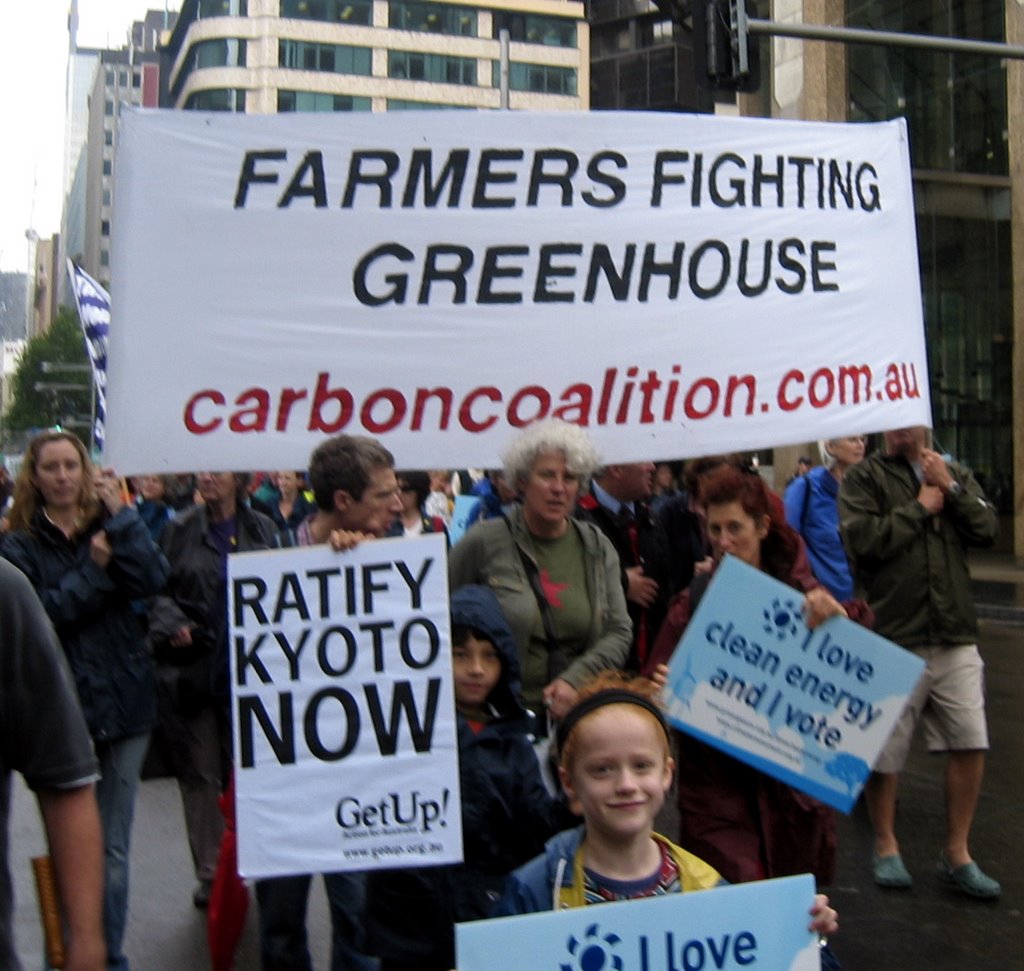
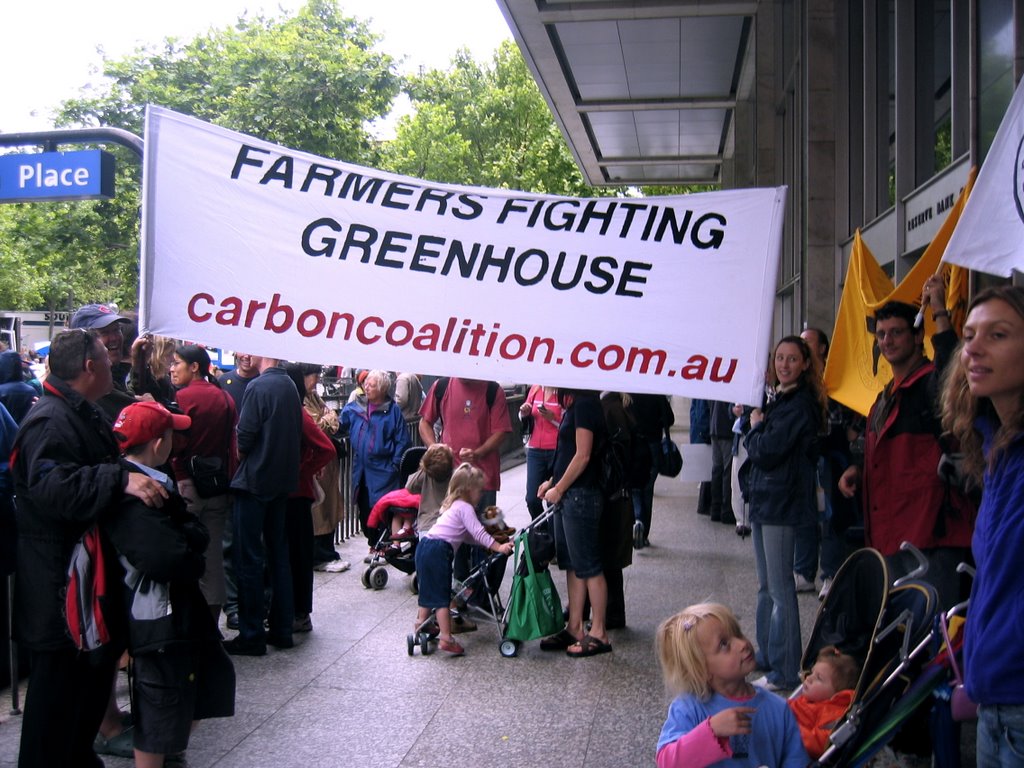
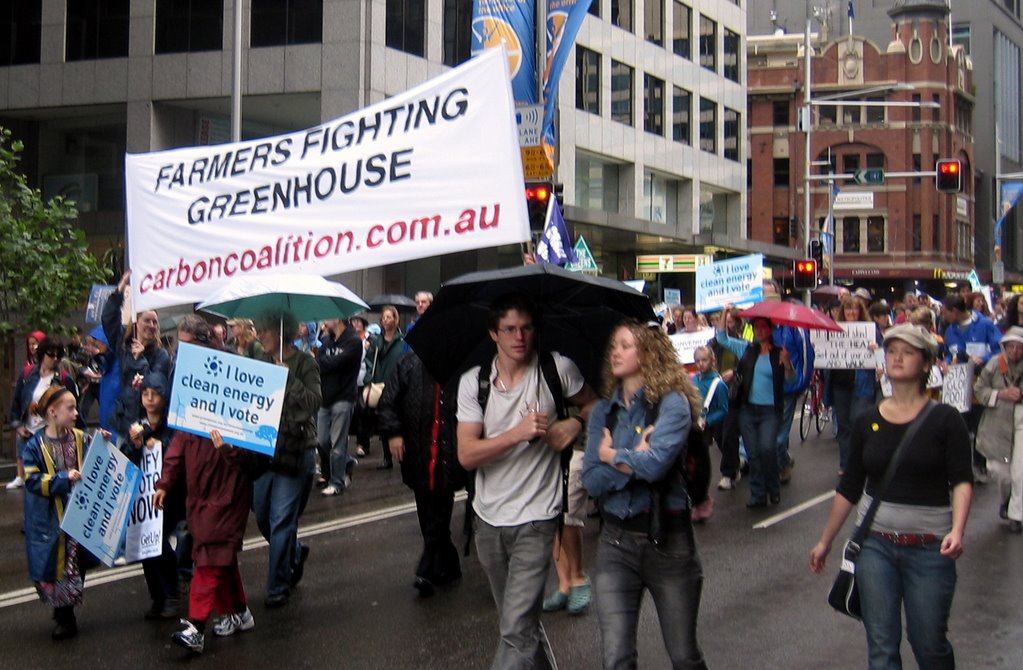
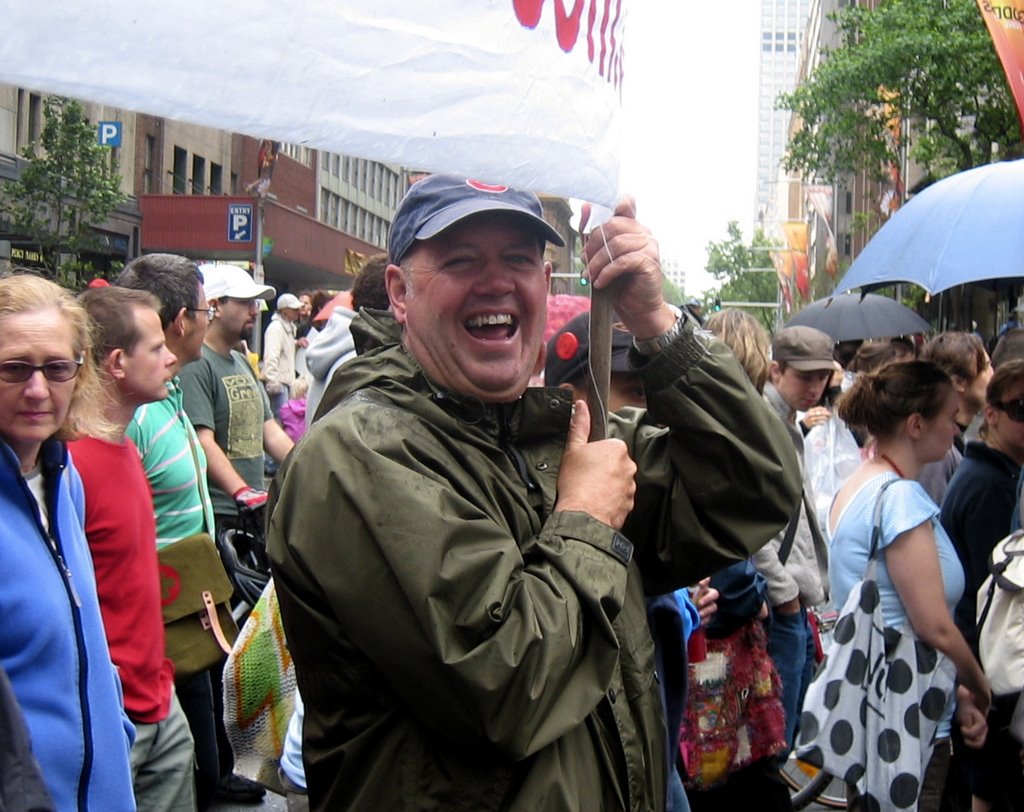
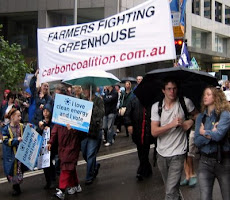
It was a small band of brave souls who held the Carbon Coalition banner high and carried it through the streets of Sydney on 4th November during the "Walk Against Warming". Sydney-based members Shane Press (and his son Brendon), Kevin and Leisel James, Jeff Sanders, and Jessica Kiely joined Goolma-based member Michael Kiely to walk with at least 100,000 people. Kevin made the banner, Jessica wrote the slogan, and Jeff manhandled it against the wind. We were interviewed by a TV crew from the Weather Channel. many people came up to us and congratulated us and mentioned that their sympathies are with people in the bush. The Commonwealth Shadow Minister For The Environment Anthony ALbanese spoke for 10 minutes with us, and now understands the importace of soils and asked to be sent more information for a white paper he is preparing on the environment and water policy. Many more people asked for our briefing sheet. It was a successful day. BIG THANKS go to Kevin and Marc Pop for making the banner and to those who walked. Unforturnately this is the only way the media will hear our message.

Saturday, October 28, 2006

2006 National Carbon Forum Canberra 22/23 November

CARBON FORUMS: Christine Jones's 'Managing the Carbon Cycle' Kingaroy Forum was a huge success with around 90 people attending and some very good papers presented. Surely the best lineup of theoretical and practical talent on this topic. Areas covered included Terra Preta soils, regenerative grazing, pasture cropping, biodynamics, carbon farming, and soil biological processes. The National Forum in Canberra is on 22nd and 23rd November, 2006 (see www.amazingcarbon.com)

Coalition expanding its operations

REGIONAL ORGANISERS: We are inviting members to get more involved after a couple of people at Kingaroy offered to do something locally for us. Appeal reads: "Would you like to be a "Regional Organiser" for the Carbon Coalition? The role would not be very onerous. 1. Helping us to recruit new members in your locale, district or region. 2. Occasionally sending your local members an email about an event, etc. 3. Reporting to us any 'carbon' activity in your area - eg. scientific trials, new technologies introduced, etc."

MEGA-WEBSITE "SOIL-C-CENTRAL": We are floating a Global Web site dedicated to Soil Carbon. It aims to promote the benefits of Soil Carbon; To attract new members to the soil carbon community; To speed the uptake of new information throughout the community; To increase the influence of the community; Build closer links between environmentalists, farmers and scientists; Build closer links between students of soil carbon on different continents. WE need you to send us soft copies of research and academic papers, links to websites, and any news you find. This project will be as good as we make it. Content will include News: Upcoming events, conferences and courses; New research findings and papers; New research studies and timetables; New websites; New newsletters and publications. There will be a Library featuring Bibliographies - lists of publications, Academic papers, Articles, Interviews, and a YouTube video library. Links to other Websites and Blogs. There wilL also be Profiles of Members (voluntary), Notice Boards, Chat room, Online events and “Webinars”.

PRACTITIONER PROFILES: Rod Rush announced a great idea at the Kingaroy Carbon Forum: profiles and case studies on people like you or whom you know, who are doing things differently and getting results. These stories will be posted on the website. You will be sent a template for reporting to the Practitioner Profiler.

PUBLICITY OPPORTUNITY: The “WALK AGAINST WARMING” – the International Day of Action on Climate Change on Saturday, Nov 4th 2006 – offers the Carbon Coalition a BIG OPPORTUNITY. IT is a community event promoted by Channel 7’s Sunrise Program. It will be on in Sydney - 11am Martin Place (walk to Tarpeian Way next to Botanic Gardens) - and other cities (see www.walkagainstwarming.org) Our opportunity is to take advantage of the media coverage of the Walk Against Warming to put Soil Carbon on the screen. We need to make the Media, Government, Govt. Agencies, Corporates and Potential Donors aware that we exist because they can help us achieve our goals. It is also an opportunity to register the Ecological Benefits of Soil Carbon Credits, change the image of the farming community, and to recruit new members. The plan we are suggesting is that we use this family-friendly event to capture the attention of people who can help us. By carrying placards on poles, above the heads of the crowd, our message will be televised to the world for FREE (we can afford that). The messages suggested by members for the banners include the following:


Farmers Fighting Greenhouse”Carbon Credits For Soils Now”

carboncoalition.com.au

“Carbon Coalition Against Global Warming”

“Soils Can Save The World

“Soil Carbon Credits Save Soils”

“Soil Carbon Credits Restore Ecology”

“Soil Carbon Credits Save The Family Farm”

“Soil Carbon Credits Save Water”

“Soil Carbon Credits Stop Erosion”

“Soil Carbon Credits Stop Salination”

“Soils: short term CO2 solution”

The more banners we can have made (professionally) the better. We need carriers, so we need to recruit as many supporters and city-based members of the Coalition as possible. We’d like to have everyone wearing Akubra hats to signal the connection with the Land.

Would you be interested in carrying a banner and walking with us?

Cheers!

BREAKTHROUGH WITH SCIENTISTS

Flux and soil variability are thrown in our faces whenever we ask for trading units of soil carbon. But one important US scientist has broken ranks with his colleagues to argue for sanity to prevail: "It is often pointed out that soils have a large amount of variability, but with knowledge of soil sciences and landscapes, variability can be described and sampling protocols can be developed to deal with this," writes Dr John Kimble in a paper published this year*. "One reason I feel people say that soils vary and SOC cannot be measured is that we soil scientists focus on showing variability, not on showing what we know about the variability. In soils we can go to a 100m2 field and sample every square meter and look at the differences we find. But if you sample every tree in a large area you would see a similar variability." Dr Kimble works for the US Department of Agriculture, National Resources Conservation Service, National Soil Survey Centre, Lincoln, Nebraska. "We too often focus on this [variability], worry about laboratory precision and field variation and do not look at the real world where most things are based on averages and estimated data. We tend to focus on finding variation and not on using our knowledge of soil science to describe what we know. All systems vary, but in soils we focus on a level of precision and accuracy that may not have any relevance to the real world because we can take so many samples and look at the variation." We need a half dozen more like this.

*Kimble, J., "Advances In Models To Measure Soil Carbon: Can Soil Carbon Really Be Measured?", in Lal, R., Cerri, C., Bernoux, M., Etchevers, J., and Cerri, E., eds., Carbon Sequestration in Soils in Latin America, Food Products Press, Birmingham, NY, 2006

SoilS are for early sequestration

"Terrestrial C sequestration could have an immediate application in climate change mitigation due to its availability, relatively low cost, and associated environmental benefits." Said R.W. Izaurrable anbd C.W.Rice, "Methods and Tools for Designing a Pilot Soil Carbon Sequestraton Project", in Carbon Sequestration in Soils of Latin America, Lal et al. eds, 2006

Thursday, October 12, 2006

Climate change brings invasive trees


The Green movement say Australia was largely covered by forest when white man arrived, and that we should let it return to forest. But palentologists say things are a little more complicated. Global warming could be the cause of the rapid expansion of woody weeds and trees, according to Brian Fagan's study The Long Summer: How Climate Changed Civilisation. After the last Ice Age, during the long warming, open grasslands were invaded by trees at a rapid rate. Pollen records reveal that the grasslands that covered much of Europe during the last Ice Age became denser and more productive - then the trees came! Within 500 years birch forests covered much of England and Europe. "Experts believe that trees such as birch, pine, alder and hazel could advance at a rate of 1 to 2 kilometers a year over periods of five hundred to two thousand years," says Fagan. "In New Zealand, the southern beech was confined to a few sheltered locations during the late ice Age, whewn grassland and scrub covered most of the land. But the rapid warming at the end of the Ice Age had beeches completely replacing the open vegetation of earlier time within a mere three hundred years." The Green Movement now has a dilemma. Which past state of natural balance should we return to? Pre firestick farming, back before Cromagnon Man started using fire to encourage grasslands to grow sweet new shoots to attract grazing animals? Pre white arrival, before iron axes made clearing the trees easier? Fagan floats the idea of man-managed landscape 13 millenia ago: "Combine the nut harvest with systematic burning of brush and grasses to stimulate new growth and attract game and you have the elements of a carefully managed landscape." Does man have a place in Nature?
...........

The Americans are asking themselves the same question.
The following is from Forest Landowner / Jan-Feb 1999 (found at http://home.flash.net/~falline/ocrPrimeval.htm)

...........

What did North America look like before Europeans arrived? One of our most popular, strongly held images is that of the “forest primeval.” We imagine a blanket of ancient forest, which nature maintained in equilibrium with the environment.

We also imagine native people who lived in the forests and on the plains without changing either ecosystem. Thus, another popular image is that of the ecologically invisible American Indian.

In fact, enormous areas of the continent’s forests and grasslands were very much cultural landscapes, shaped profoundly by human action.

At the time of European contact, many Indians were farmers. In the East and Southwest they raised maize, beans, pumpkins and squash to provide at least half their subsistence. Agriculture in the Americas originated more than 5,000 years ago. By 1500, indigenous people had cleared millions of acres for crops. Everywhere in the Americas they also regularly set fire to hundreds of millions of acres to improve game habitat, facilitate travel, reduce insect pests, remove cover for potential enemies, enhance conditions for berries and drive game.

Vast areas of the forest landscape in both the West and East were open, park-like stands shaped by frequent, low-intensity fires. In New England, Indians burned the woods twice a year. Roger Williams wrote that “this burning of the Wood to them they count a Benefit, both for destroying of vermin, and keeping downe the Weeds and thickets.” John Smith commented that in the forests around Jamestown, Virginia, “a man may gallop a horse amongst these woods any waie, but where the creeks and Rivers shall hinder.”

In many cases frequent forest burning created grasslands where forests otherwise would have existed. Prairies extended into Ohio, western Pennsylvania and western New York. In Virginia the vast prairie of the Shenandoah Valley covered more than 1,000 square miles. Ecologist R.C. Anderson writes that the eastern prairies and grasslands “would mostly have disappeared if it had not been for the nearly annual burning of these grasslands by the North American Indians.”

Wednesday, October 04, 2006

Carbon Coalition Against Global Warming launched in USA


The Carbon Coalition Against Global Warming was launched in the USA last week (on last Friday night) at "Maplewood Farm", Highgate, Vermont. Present for the inaugural meeting were (from left to right) Ted Yandall of "Cimarron Farm", Stanton, Vermont, Abe Collins, Eric Nowel of "Maplewood Farm", Louisa and Michael Kiely, Ridgeway Shinn or Bakewell Reproductive Centre of Massachusetts, and Gerald Fry, grassfed beef geneticist of Arkansas. This marks the internationalisation of the Coalition and the next stage of the grassroots campaign to have soil carbon credits become a reality.
The Coalition now has the outline of a trading strategy which will be discussed with the Council in Australia prior to a launch towards the end of the year. (More on that later.)

Search for the Holy Grail: Soil C MMV*

*soil carbon sequestration MMV (measurement, monitoring and verification)

Our journey continues... FromDC to Montana to Texas to New Mexico to Vermont, then onto Columbus, Ohio and Chicago, then to San Diego, LA, then home... We have had such luck, miraculously passing through walls and getting in to see the people who are at the very core of the issue of soil carbon sequestration MMV (measurement, monitoring and verification). The most significant figure in the soil C science field anywhere in the world (so significant his colleagues had to create an award to recognise his contribution) is Dr Rattan Lal, author of a small library of books and papers, co-author of many others, Professor of Soil Physics at the School of Natural Resources at Ohio State University, Columbus OH. He is a softly-spoken gentleman who exudes knowledge like a perennial plant's root system exudes the raw materials of soil carbon. He gave us many insights which we will share with you in a later post. Suffice it to say, the penny dropped! Dr Lal started his career working in Australia, at Sydney University, in the early 1970s. We also met Dr Lal's colleague from Germany, Dr Klause Lorenz whose research throws the glomalin issue into question. He knows of a myriad of constituents of soil carbon and his work is focussed on the most stable carbon stored in deep layers of soils.
"Abe of Vermont", our first American member, was as inspiring to meet as was Dr Lal. Abe Collins has largely taught himself an amazing amount about soil management. Much of his knowledge is unconventional, bordering on the 'plumb loco'. But he is living everyday with the soil, listening to the landscape, and observing the rhythms of the soil biota so he has an advantage over more casual observers. He share farms on a dairy at Stanton, Vermont. He uses (and teaches) holistic management, keyline farming and subsoil irrigation. You'll also hear more about this remarkable fellow and his inspiring family in an upcoming post.


Dr Brian McPherson, from the New Mexico Institute of Technology in Socorro, heads up the Southwest Regional Partnership, one of seven regional partnerships charged with evaluating available technologies to capture and to reduce CO2 emissions. The Partnership encompasses: Arizona, Colorado, Oklahoma, New Mexico, Utah, and portions of Kansas, Nevada, Texas, and Wyoming. The partners represent 21 State government agencies and universities, electric utilities, oil and gas companies, non-governmental organizations, the Navajo Nation, and federal agencies. We attended the Partnership's Phase 2 Workshop in Albuqurque, New Mexico, and heard presentations from their geologic and terrestrial (soil) sequestration experts. Dr McPherson invited us to address the gathering of 60 or so scientists and we shared with them some of the aggressive carbon farming techniques developed by Australian 'farmer scientists'. (More of that later.)


Dr Joel Brown and Dr Jay Angerer are the 'soil carbon sequestration' experts with the Southwest Partnership. Joel was on our list of 'must see' people. He has spent 7 years working in Australia. Joel and Jay were the best-dressed soil scientists we met in the USA. Their project involves riparian zone reclamation in arid and semiarid regions. A full report on the core content of our study tour will be published here as soon as we have a moment to write it up.


SNEAK PREVIEW OF FINDINGS: Don't wait for scientific exactitude. Just do it.

Wednesday, September 27, 2006

THE COALITION GOES TO AMERICA


On 17 September, Co-convenors of the Carbon Coalition Against Global Warming Michael & Louisa Kiely left for a 3 week fact finding mission to the USA where soil sequestration is at the forefront of the agenda of many soil scientists and there is a 'can do' attitude.

The itinierary is as follows:

18/19 September: Washington DC - 2006 Global CO2 Cap-And-Trade Forum
21/22 September: Bozeman, Montana - Big Sky Carbon Sequestration Partnership Phase 2 Project Management Plan Workshop
25 September: College Station, Texas - Professor Bruce McCarl, Department of Agricultural Economics, Texas A&M University
27 September: Albuquerque, New Mexico - Peter Holter, Holistic Management International
28 September: Albuquerque, New Mexico - Southwest Carbon Sequestration Partnership Phase 2 Project Management Plan Workshop
29 September: Swanton, Vermont - Address Farmers' gathering organised by Coalition member Abe Collins from Vermont.
1 October: Columbus, Ohio - Professor Rattan Lal (or colleague), Ohio State University
? October: Chicago Illinois - Chicago Climate Exchange

A full report will be posted here as soon as possible.

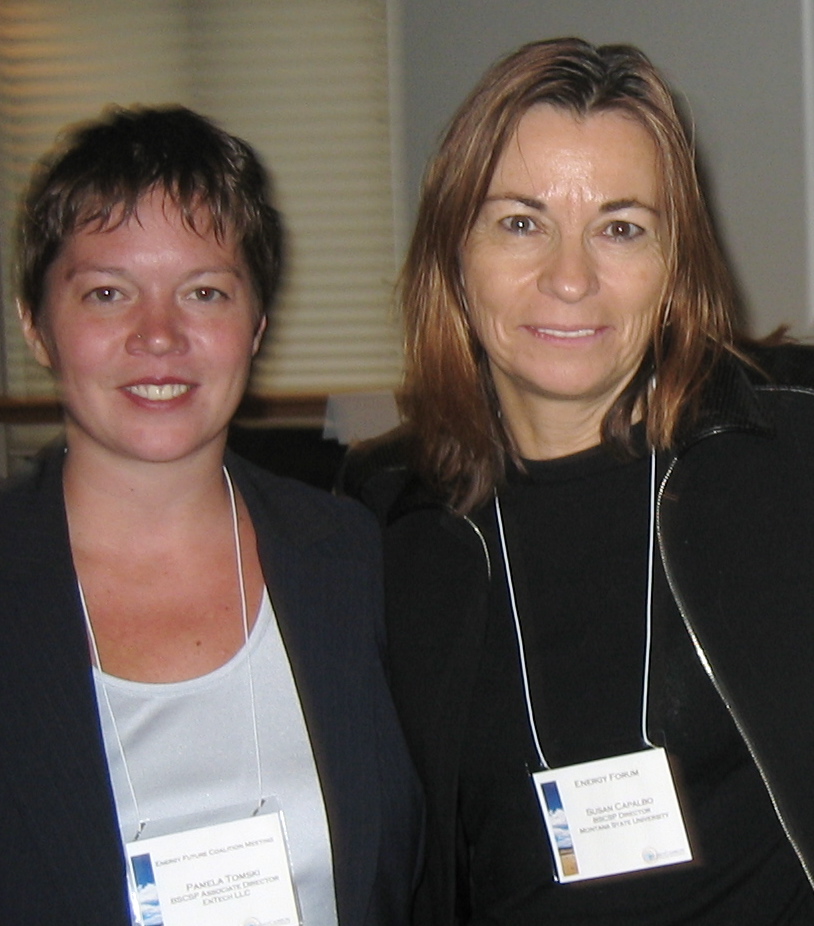
Susan Capalbo (right) is Director of Big Sky Carbon Sequestration Partnership. Pamela Tomski is Associate Director responsible for outreach and education. Big Sky is closest to finding the answer the Coalition seeks to the question: how and when will we be able to measure the carbon sequestered in soils as a result of changes in land management sufficient to trade carbon credits? The Big Sky Carbon Sequestration Partnership was set up to "build a new energy future" for Montana, Idaho, South Dakota, Wyoming, the Pacific Northwest and the nation. Led by Montana State University, the Big Sky Partnership is one of the U.S. Department of Energy's (DOE) seven regional partnerships.


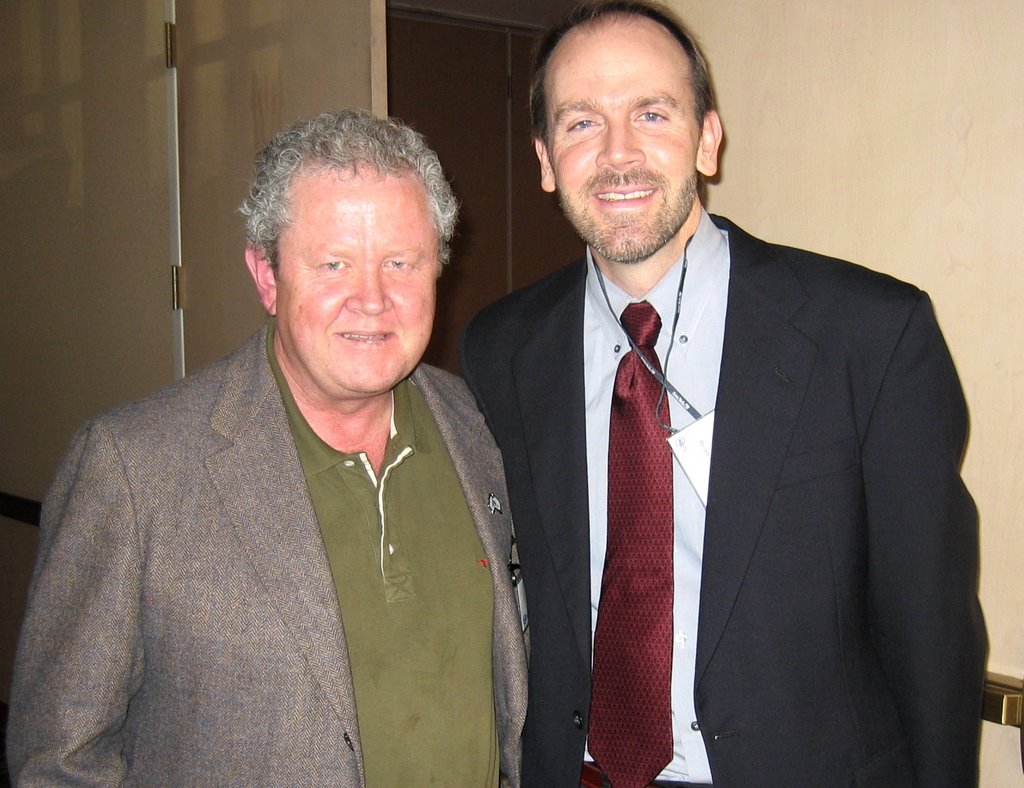
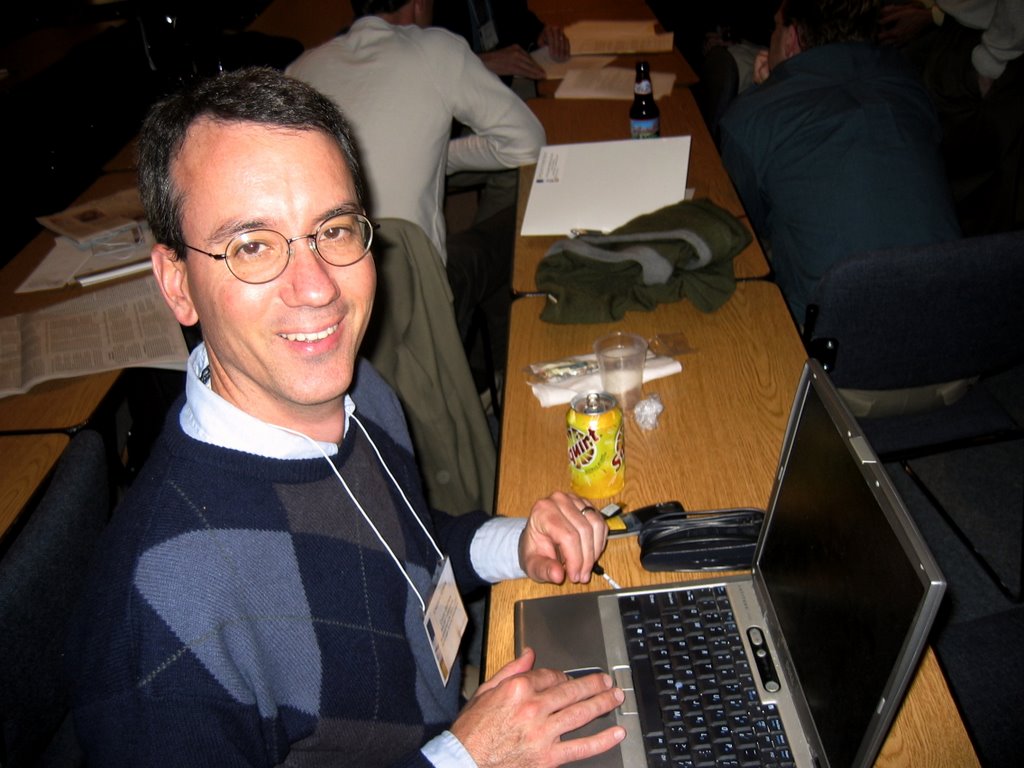
Dave Brown is Technical Lead, Terrestrial Sequestration with Big Sky. He revealed to us that the secret is not to try and measure the finite amount of carbon in the soil, but the difference over time.


Michael Bowman is a charismatic speaker who launched 25:25, a movement that aims to have 25% of America's fuel needs supplied by farmers in 25 years.


Ted Dodge heads up the National Carbon Offsets Coalition which brokered the first carbon credits paid to US farmers In Montana and Kansas. He wants to work closely with us.


Professor Bruce McCarl of Texas A&M University is on the Inter-Governmental Panel on Climate Change and he believes soils have a key role to play in the next 50 years. Biofuels are also his hot topic.

Tuesday, September 12, 2006

"When Gore convinces America, Howard will agree" says Herald

The Sydney Morning Herald has accepted the "Carbon Credits Domino Theory" first formulated by the Carbon Coalition months ago on this blog. "Nothing will change here until Gore manages to convert enough Americans to change US policy. Then our Prime Minister may be converted, as he was for nuclear power after his last trip to the ranch," says Professor Barry J. Allenin today's Herald. The Professor contradicts many of the assertions made by PM Howard to fillibuster his way past global warming issues, such as the fact that the dispute about whether global warming is man-made exists only in the media, not among scientists. Only the US and Australia, of all the Western countries, did not sign the Kyoto Protocol. Arguments for this were that China and India would not do so and carbon credits were a tax that would destroy the economy. "Last week the true impact of carbon credits became evident," he reports. "European companies are gaining carbon credits by funding the reduction of emissions in China. How about that: Kyoto leading to a reduction of emissions from the future major contributor to global warming?"

Like arguing over the cost of life boats on the Titanic, the Prime Minister's arguments about the impact on the economy of a carbon trading regime are hard to justify. Corporate Australia is coming to grips with the likely economic damage that will follow extreme weather events, such as cities running out of water, deeper, longer droughts in productive rural areas, electrical storms, cyclones, and rising sea levels invading coastal business and residential precincts, including CBDs of cities like Sydney. The PM will be safely out of Kirribilli House by then.

Monday, September 04, 2006

Double-edged benefit in carbon campaign

There is nothing but upside for farmers in the Carbon Coalition's campaign to have agricultural soils recognised as carbon sinks for the purposes of trading on the global greenhouse emissions offset market. While carbon credits must be bought by companies who cannot meet their greenhouse targets, famers could find themselves on the wrong side of the ledger. It is estimated that agriculture contributes between 19% and 25% of greenhouse emissions (more than the transport sector). Practices such as clearing native vegetation, overgrazing, ploughing and burning stubble release CO2 into the atmosphere. AS farmers manage more than two thirds of the earth's surface, the combined effect of their activities is massive. Soils were left out of the first round of Kyoto Protocols while carbon accounting issues were resolved. But they are expected to be included in the second round, starting in 2012. If the experts decide that there is no way to accurately estimate the amount of carbon present in a defined area of soils, and therefore soil carbon cannot be included in emissions trading, they cannot then turn around and charge farmers for CO2 they emit. How could they measure it? While computer models are used to estimate the amount of carbon sequestered in forests, higher levels of accuracy are demanded of soils. If a soil carbon credit system is introduced, farmers will be able to retain flexibility to use land management techniques that release CO2 by sequestering carbon in soils on other parts of their holding to offset their emissions. Either way, the Carbon Coalition's campaign to force the experts to take a position on soil carbon will protect the interests of landholders.

Grassland soils save the world from CO2

"A grassland ecosystem can, despite appearances, contain more carbon than a forest ecosystem," writes Fred Pearce in Managing Wholes (http://managingwholes.com/grass-carbon.htm) Research by Greg Retallack, a soil scientist at the University of Oregon in Eugene, suggests that soils under grassland played a key role in balancing CO2 in the biosphere. "The emergence of the first grasses was the breakthrough. Grass doesn't hold much CO2 itself, but it can create mollisols, soils that are very rich in organic matter and hence carbon," writes Pearce. He quotes the scientist Retallack: "Typically they are 10 per cent organic matter down to a depth of a metre, whereas forest soils are only that rich down to about 10 centimetres". In the past 40 million years, tall grasslands spread across the globe, invading forest zones. These ecosystems, according to Retallack, took control of the planetary thermostat, lowering CO2 levels. New grazing animals evolved to live on and coexist with the grasses. "The co-evolution of grasses and grazer created a carbon-hungry ecosystem of a kind never before seen," says Retallack. "I think mollisols are saving our skins right now. Without them the world would be a lot hotter."

Friday, September 01, 2006

Pressure on Bush hits boiling point


The opposition of President Bush to carbon trading is what bolsters John Howard's staunch opposition and denies Australian farmers access to revenue streams from trading carbon stored in agricultural soils. Cracks are appearing in the President's defences. Companies, consumers, even the Religious Right that has the President's ear, are calling for action. The head of the American Public Power Association says federal regulation of greenhouse gases is inevitable. Alan Richardson, president and CEO of the group, whose members supply 15% of America's power says there is "an emerging public consensus and a building political directive that inaction is not a viable strategy." US industry groups have fought any effort to limit gases linked to global warming, warning of dire consequences for the U.S. economy, but growing public anxiety and major corporations lobbying for Congress to regulate emissions are changing the story, reports the Los Angeles Chronicle.
The Bush administration is holding out against new limits on carbon dioxide. Legislation is gaining ground in Congress with members of both parties. States are moving forward with climate-change regulations. Two leading presidential candidates for 2008 -- Republican Sen. John McCain of Arizona and Democratic Sen. Hillary Clinton of New York -- support regulation.
Six leading energy companies went on record supporting mandatory limits on emissions in April, when the Senate called America's top energy companies to testify about new legislation to regulate emissions.The world's largest retailer, Wal-Mart, voiced its support for new limits on greenhouse gases.
Conservative Christian broadcaster Pat Robertson said recently temperatures across the United States had converted him into a believer in global warming which put him at odds with President Bush, who has benefited politically from Robertson's backing. "We really need to address the burning of fossil fuels," Robertson said. "It is getting hotter, and the icecaps are melting and there is a buildup of carbon dioxide in the air," Reuters reports. It is a dramatic shift for Robertson who last year accused the National Association of Evangelicals of getting into bed with "far left environmentalists" for saying global warming was caused by humans and needed to be mitigated. He also said natural disasters might be signs that the biblical apocalypse was nearing.
Bush, also an evangelical Christian, pulled out of the international Kyoto Protocol in 2001 saying it would hurt the economy.

Tuesday, August 29, 2006

CSIRO sounds the alarm

It's official. CSIRO says Australia is experiencing significant climate change as a result of global emissions of greenhouse gases from human activities. And it says we need to reduce emissions by 60% by 2050 to avoid catastrophic results. The Prime Minister denounced the report and said reductions of that order would destroy the Australian economy. The report was written for the Australian Business Roundtable on Climate Change is by CSIRO's Dr Benjamin Preston and Dr Roger Jones. They report that rainfall in regional Australia has already been affected and this will get worse. We stand to lose the Great Barrier Reef with only slight warming. Water availability will become a bigger problem than it is already. "The declines in precipitation projected over much of Australia will exacerbate existing challenges to water availability and quality for agriculture as well as for commercial and residential uses," they say. "Future changes in climate extremes, such as tropical cyclones, heat waves, and extreme precipitation events, would degrade Australian infrastructure and public health, for example, through increased energy demands, maintenance costs for transportation infrastructure, and coastal flooding."

Saturday, August 26, 2006

Cap and trade closer in US

US Senator Dianne Feinstein will introduce a bill proposing a national cap-and-trade scheme for greenhouse gases on the first day of the new Congress in January 2007. The scheme proposes to slash US emissions by 10 per cent by 2025. The last bill before the Congress for mandatory regulations failed by only a handful of votes. The Republicans are expected to lose control of Congress in the up-coming elections.

Thursday, August 24, 2006

More power companies call for credits trading

Power companies in Australia and the US have gone public in favour of carbon trading systems. The Australian Gas Light Co., the nation's largest energy retailer, which also owns power plants, said the States' proposed trading system is "positive'' because it gives an incentive to curb emissions, says Managing Director Paul Anthony. Origin Energy set the pace for support by its membership of the Business Roundtable on Climate Change which has also called for regulation. The two biggest power companies in the US, Duke Energy Corp. and Exelon Corp., have called for federal regulation of carbon emissions to help guide power-plant development, reports the international Bloomberg news service. Power plants emit 39% of all greenhouse gases in the US.

It's only a matter of time

"Emissions trading will exist in Australia. It's only a matter of time," says Martijn Wilder, a partner specializing in climate change at the law firm Baker & McKenzie in Sydney. The international Bloomberg media service reports that the move by States in Australia and the US to develop trading systems to curb greenhouse gases will see both countries enter the global trading system. In the US, seven northeastern states agreed on a plan that would begin in 2009, with the goal of cutting carbon dioxide emissions from power plants by 10 percent over 10 years. Other states are likely to join. In Australia, electricity companies in all eight states and territories will have to hold tradable permits to emit greenhouse gases starting in 2010. "The states can take action without the federal government,'' said Madeleine Tan, a counselor specializing in the Kyoto protocol at the law firm Brown Rudnick Berlack Israels LLP in New York. "You'll see a few more states interested." IN Australia, three states are hesitating. The US states in the Regional Greenhouse Gas Initiative are New York, New Jersey, Connecticut, Delaware, Maine, New Hampshire and Vermont. Maryland will join the group by next June. California, Oregon and Washington are also considering trading systems.

Saturday, August 19, 2006

NSW to introduce mandatory cap: Let the trading begin

The NSW Government will legislate mandatory emissions targets until 2020, updated every 15 years, reports The Australian Financial Review. The government has previously pledged to cut carbon dioxide emissions by 60 per cent by 2050. The NSW scheme sets annual targets for electricity retailers and generators to cut greenhouse gas emissions. They can offset emissions by investing in forestry and energy-efficiency measures, or by buying carbon credits (currently traded at between $12 and $15 a tonne).
Known as "GGAS", it was the first scheme of its kind in the world in January 2003, settinh targets in line with the Kyoto Protocol on climate change. It was due to expire in December 2012.
Several industry players, including Origin Energy, have previously criticised the lack of certainty on carbon offset agreements.
Other companies have been holding off on investing in carbon offsets until the extension of the scheme.

Thursday, August 17, 2006

States’ Greenhouse paper angers farmers

A new farmers’ lobby group has expressed disappointment at the Greenhouse Scheme discussion paper released on the 16 August, 2006 by the State and Territory Governments. “The paper ignores the enormous contribution agricultural soils can make to storing carbon,” says Michael Kiely, the convenor of the Carbon Coalition Against Global Warming, a lobby group that believes the best way to store carbon is to reward farmers for land management techniques that can sequester vast amounts of carbon in agricultural soils. “While millions of trees are being planted and various solutions are being investigated, none has the capacity to sequester sufficient CO2 in the next 50 years to meet the Greenhouse challenge. Only soils can do it. Yet the only mention of soils in the discussion paper is the emissions that can occur when it is disturbed (ploughed) or artificially fertilized. Once again the poor old farmer is painted as the bad guy when in fact he is a hero.”

Someone has to pay the Greenhouse bill


The attack on the Australian States's proposed Greenhouse Gas Abatement Scheme by the federal government and some industry groups ignores one critical fact: someone will have to pay for global warming. The Australian Financial Review - the voice of Australian business - disagrees with the attacks on greenhouse trading: "An international trade in emission rights (and other environmental services) is the way of the future... Australia, with its comparative advantage in the production of fossil fuels, has a very strong interest in the adoption by the global community of rational, market-based greenhouse strategies." And writing in BRW, Professor Paul Kerin, who teaches strategy at Melbourne Business School, said recently, "Howard says that, as Australia is (just) on track to meet its target, there is no need for market mechanisms. He is wrong: a market would ensure Australia meets its target at least cost, and would provide information to help decide whether we should overshoot our generous target. By comparison, the EU is already 5.5% below its 1990 emission level... Howard's claim that market trading would cost jobs by raising energy costs is also nonsense. The emission trading price is just a transfer between two emissions generators - overall, the industry's net cost is unchanged. High-cost polluters pay more (as they should) but low-cost players gain by reducing emissions and selling allowances.
"The Federal Government should join the states and territories to start a national carbon dioxide emissions market. The low trading prices that are likely to emerge, given our current overly generous emissions target, should persuade the Government to set a much lower emissions target, and then stand back and let market participants work out how to achieve it."

Tuesday, August 15, 2006

We meet with the NFF


If "bad science" is science you disagree with and "good science" is science you agree with, and charming, intelligent people are people you agree with, then the new President of the National Farmers' Federation, David Crombie, is a charming, intelligent man. The Coalition's Convenor Michael Kiely met with Mr Crombie and his natural resource management expert Dr Vanessa Findlay in Canberra on 15 August, 2006. Mr Crombie was eager to hear of the Coalition's mission and progress to date. The NFF is in full listening mode after releasing a paper called "Emissions Trading and the Land" in April 2006. (It is available on www.nff.org.au). Mr Crombie practices what communications expert Hugh Mackay calles "Active Listening". He engaged fully with our message. He explained that "Sustainability" is one of 4 key focus areas for the NFF and he could see how farming with an eye to increasing soil carbon could move farming in that direction. Even better, he liked our message about carbon farming as low input/high regeneration, revealing that he has sown perennial pastures with great results just recently. But the bell really rang when he said his personal philosophy of agriculture is based on the concept of "stewardship". This concept sits smack in the sweet spot of the Carbon Coalition's mission. We hope to use carbon credits to enable farmers to act upon their innate feelings of stewardship or sense of responsibility for leaving the natural resource base of their farms in better condition than when they first took over. David Crombie believes there should be and will be some economic incentive for this to happen. Dr Findlay is right across this issue and knows of the work we have been doing. Both were aware of the contribution Dr Christine Jones has made to this issue. The Coalition will continue to liaise with the NFF and the NSW Farmers' who also gave us a great deal of encouragement. Encouragement is all we can hope for and all we really need.

Sunday, August 13, 2006

Forests killing rural communities

The Financial Review
Tree schemes stir deep-rooted ire
Author: Narelle Hooper with Fiona Buffini
Date: 12/08/2006
Words: 1957
Source: AFR
Publication: The Financial Review
Section: Perspective
Page: 22
Tax incentives that favour plantations over other land uses are distorting the value of land and resources.

Robert Gerard just loves timber. The controversial Adelaide businessman, Liberal Party donor and former Reserve Bank of Australia board member describes his 2000 hectares of pine at Rosewood near Tumbarumba in southern NSW as a nest egg. He says the forestry has been good for the farmers and fantastic for the region and in coming years the carbon credits to be had from trees would be a goldmine for Australia.

"Not many people set out with a 30 year business planting 100 hectares a year," he told The Weekend Australian Financial Review in July. "I did that. I believe in timber, but I'm a bit of a queer bloke. I believe timber is a good investment."

But Gerard has a lot less timber to love than he used to have. And around Tumbarumba in the foothills of the Snowy Mountains, the locals don't like Gerard very much at all.

To farmers in the Lower Bago Valley, Gerard is the neighbour they never see but for occasional sightings of his helicopter, who sold them out to the enemy - pine plantation operator Willmott Forests Ltd.

The deal, finalised with Willmott just days after Gerard's resignation on December 2 from the Reserve Bank board over a multimillion-dollar tax scandal, halved Gerard's land holding. On December 16 last year, he booked a tidy $6.7 million selling two prime cattle properties of 1610 hectares to Willmott to convert into pine plantations for its Managed Investment Scheme.

The anger about the Gerard sale encapsulates the growing conflict between established rural landholders and the new breed of absentee tax-driven owners.

The friction is becoming an increasing issue for the federal government review of the tax treatment of MIS timber plantations and agribusiness schemes being conducted by assistant treasurer Peter Dutton.

Plantations have long been established in this part of NSW. It is their rapid spread that has been the main cause of the recent friction. MIS offers attractive tax deferrals for investors. The rapid expansion of the tree schemes has sparked growing opposition in rural communities and concern in investment markets about the long-term viability of the sector.

"It was a bolt out of the blue," says the deputy mayor of Tumbarumba Shire Council and a Rosewood neighbour, Graham Smith, of the Gerard sale.

Lower Bago angus cattle and merino sheep farmer Jeff Grady, who is affected by the change in land use, says he and his neighbours were devastated. MIS operators such as Willmott and Gunns Ltd in the nearby Maragle Valley had started to get a toehold in the area and the Gerard sale gave the plantation company a huge foothold in a prime agricultural valley.

"They've wrecked this valley," Grady says. "We were shocked for weeks because it changes your whole future. He has basically destroyed this valley and the community for his own personal gain.

"It's only tax breaks that are driving it and it's too high-value a country to be used for generating tax breaks for those blokes."

Gerard's employees were surprised too. Just weeks earlier they'd cut and stored masses of silage on the property for winter feed and hired a contractor to fix up the fences. Local stock and station agents also had to scramble to find buyers for 2000 cattle as the breeding herd Gerard had been building up was dispatched for about $1.5 million.

There has been plenty of speculation as to what prompted the sale. Gerard had spent five years buying up the best cattle properties in the area. He'd weathered a lengthy battle with neighbours and the council against his plans to expand his private pine plantations.The betting among locals is that Gerard needed cash following his $75 million settlement with the Australian Taxation Office in late 2003 and welcomed an attractive deal with Willmott after his exposure in the media over his tax affairs.

Despite Gerard's professed love for his trees, Willmott didn't think the 100 hectares of eight-year-old pine trees on the Gerard properties were such a great investment, and judged them fit for liquidation. In February, Willmott brought in the bulldozers, windrowed the trees and burnt the lot. They quickly made way for rows and rows of pines that were owned by a new crop of Willmott's tax-driven investors.

Willmott chief executive Marcus Derham, who claims he wasn't close to the arrangement, says: "He may have had some young trees that we may have come and knocked a few over. It depends how mature they are and if there's less than optimal spacing."

Derham confirms that Gerard has also been an investor in Willmott MIS plantations. But despite local talk that Gerard is a big Willmott shareholder, neither he nor his private companies appear on Willmott's register of shareholders.

When contacted, Gerard's office said he was away from his office and unable to respond to requests from The Weekend AFR for further information. In July he said he was a big supporter of Willmott. In his submission to the government, Gerard sided with the MIS operators and urged the federal government to maintain special tax treatment for timber plantations.

Derham describes Gerard as a big supporter of agroforestry who likes what Willmott does and a pretty-boots-and-all kind of guy.

"Rob's been a great absentee member of the Tumbarumba community," Derham says.

"He has been involved. It's a pretty tight-knit community. He's had cattle and sheep and trees and he understands how they can co-exist."

But to the locals, the Willmott deal embodies everything they see as wrong with the fast-expanding managed-investment scheme sector, which raised more than $1.14 billion from investors last year. For starters they can't see the economic logic in how there can be more money in planting new trees than in allowing existing ones to grow and mature.

Neighbouring farmers say they're doomed now to be surrounded by pine trees and fear the loss of productive farms and families from the community.

Jeff Grady says: "He's quoting employment opportunities but it's not happening.

"They neglect to deduct the jobs they've robbed from the community by pushing out the farmers and the business the farmers put through the towns during the year."

Grady says there are also serious concerns about the impact on environmental water flows. Tree plantations are thirsty. "It's good country for pine trees but it's also very good country for agriculture and by planting this high-rainfall land to pine, you are affecting your water yield further down the river."

A 1989 NSW Forestry Commission paper warned about the impact of extensive pine plantations in reducing environmental water flows. A number of other recent studies have raised similar issues.

Deputy mayor Smith expresses concerns at the loss of farmers, who are the major ratepayers in the area, while the council faces an escalating bill for road infrastructure for the timber industry.

"We walk a knife edge where your major ratepayers are your farmers and the timber on the other."

Of the impact on water flows, he says: "They deep rip on the contour and plant the trees, and that stops the run-off into streams. They'll tell you it doesn't, but it does. You can see the difference . . . there are creeks here are bone dry . . . we're worried because we are the catchment area for the Murray."

Merv Whittaker, whose 100 hectare block is caught in the middle of the land now owned by Willmott, chooses his words carefully. "There's a lot of worry and anxiety amongst the townspeople. It's not only this valley. The same thing is occurring in a dramatically short time in two other valleys nearby."

Gerard says he planted his first trees in 1983. By the late 1990s, he had expanded substantially in the valley by buying a number of prime cattle properties. His plans to expand the timber plantations brought increasing opposition from farmers and the council.

Graham Smith says Gerard has been low-key. "He's been a good employer of people in the Rosewood area. It was only this sale to Willmott that upset a few people in the valley."

Gerard argues in his submission that the expansion of timber scheme operators in the area has improved land values and provides employment. Jeff Grady retorts that it has been good only for a handful of farmers. Other farmers, he says, want to remain on the land but face a dramatically different environment.

Others say the local council has been bluffed by the timber lobby because the industry doesn't generate the huge employment they claim.

Tumbarumba Shire Council mayor George Martin says the expansion of the plantation sector in the area is proving difficult for council and the community. "There is a lot of emotion concerned. It's a difficult issue." He says when the plantation companies move into a valley they typically make an attractive "flagship" offer above the going rate. Early last year Gunns Ltd paid $2.5 million for 684 hectares in a neighbouring valley.

"The first one to sell gets the money and the last one gets very little," Martin says.

"We know we have major users who need the timber to be expanded. We also have grazing interests around who contribute to the local economy and we need them to be around. And we have a significant tourism industry and there are problems with wall-to-wall pine plantations blocking out the vistas."

The council has convened a working committee of grazing and pine representatives to try to resolve issues. But as plantation approvals have been in NSW government hands since 1999, Martin concedes this is basically a public relations exercise. "They don't have to bother with us at all, it's basically public relations."

In a phone call to The Weekend AFR in July in support of his submission to the federal government, Gerard said: "The big thing we haven't talked about is tax credits for carbon. When that becomes a [reality] they'll be worth a fortune. Once we can do carbon trading, my forests will give me enormous income. I might leave them there. You could make more out of credits than timber. Australia could make a goldmine out of credits."

Willmott's Derham says he's had discussions with Gerard about the possibilities for future credits. "It's something our business is looking at. We haven't done a carbon trade but we are certainly waiting for the right opportunity to do that."

Scheme operators have up to 12 months after raising the capital to find land and plant the trees for their investors, who gain attractive initial tax deductions.

The federal government has been consulting on proposed changes to the tax treatment of the schemes. The proposals include a cap of $6500 a hectare in first-year tax deductions, and extending the planting period to 18 months.

MIS opponents say this cap is still many times greater than the true cost of establishing plantations - and the real problem is that the tax incentives are all initial and there's no scrutiny of investment yields.

"Much of this vigour in the pine industry is caused by the 12-month rule, which seems to be working extremely well with lots of activity happening in my region," Gerard says in his submission.

"Personally, I cannot see why you need to change something that is working well."

Sunday, August 06, 2006

Two big questions need answers

Coalition Member Bob WILSON sent the following message to our Members' Forum (www.carboncoalition@yahoogroups.com)

G'day all,
Haven't seen much action lately, so I thought I might get the ball rolling again. I was talking about Carbon Credits with a friend from the East (NSW) recently, who posed a couple of couple of points about the issue.

1. If we have a system of Carbon Credits introduced, then we will also have Carbon "Debits" as well. His comment was that as a cattle producer I would be up for much more Debit Tax than I would be receiving in Credits!!! Any thoughts?

2. He told me that the Long term Fertilizer Trial at Hamilton (vic) has not shown any major increase in soil C over 30 years. Those involved think that after 40 years it may be measurable. (we ran out of time, so I didn't get to quiz him on the pasture type in that trial, so they may be annuals) Does anyone know?

They are always a bit of a worry , these wise men from the east.......?

Bob

....................

We responded to Bob's questions:

Hi Bob,

Thanks for posting. I should post more often.

Answering your questions:

1. Carbon Debit Taxes: This has become clear to us just recently. We believe that there is no "If" about manditory limits to greenhouse emissions. It is "When". Australia won't be able to withstand the pressure once the US introduces limits on emissions. Record temperatures in the US this week have put global warming on top of that nation's list of crises. Eventually every business will be given an allocation of tonnes of Carbon it can emit, and if it needs to emit more, it will have to provide "offsets" by sequestering cabon itself (in soil or forests, etc.) or purchase credits from other companies that have sequestered carbon. Agriculture contributes 19% of all greenhouse emissions (compared to transport's 14%). How is it emitted? Ploughing, burning stubble, baring soil by over grazing, applying nitrogenous fertilisers, clearing native vegetation. How is it sequestered? Maintaining groundcover by time controlled grazing, minimum/no tillage, pasture cropping, encouraging grassy woodland, applying natural fertilisers, Natural Sequence Farming (leaky weirs, etc.) So farmers who do not earn carbon credits will have no other means of offsetting their carbon debits than putting their hands in their pockets. As for the assertion that you'll pay more than you'll get, how can anyone know that? Cattle emit methane from manure... We reported on US dairy farmers who are actually earning credits for using manure digesters. Bob, there are so many opportunities opening up with this issue, anyone who sprouts long term predictions is in need of a digester.

2. I don't know the facts of the Hamilton fertliser trial, but I can say this with confidence: Traditional nitrogenous fertiliser does not contribute to carbon. In fact it can deplete it. A 40-year trial can only be using traditional soil management techniques. These are carbon depleting. Under the regime being studied, many Australian soils have lost more that half their organic matter in 15 to 20 years. Soil carbon levels cannot be 'grown' using conventional farming techniques.
Conservation farming techniques are required.

You're right - the carbon credit caper is not all one-way traffic as we may have thought when we first came across it. But the benefits of carbon farming are many. But don't forget, everyone has the right to farm their soil anywhichway they want to. It is important that everyone knows the implications of all the choices available. For mine, I'd rather stay ahead of the game than have some government busybody telling me what to do.

Thanks for the questions. I'd welcome your feedback and I'll post this exchange on the blogsite for all to see.


Cheers!
Michael

Wednesday, August 02, 2006

Carbon Farming catching on

Victoria's DPI is promoting Carbon Farming, according to a report by Nick O'Halloran, Primary Industries Research Victoria (Tatura): "Farmers, agronomists and researchers from southern New South Wales and northern Victoria have gathered at Echuca to discuss the importance of organic matter for maintaining soil health. In the midst of international concern about the degradation of carbon levels in agricultural soils, the workshop was held as part of a DPI and Grains Research Development Corporation soil health project investigating the effect of different farming systems on soil carbon, microbial activity, soil structure and yield. More organic matter in soils leads to high carbon levels, which in turn improves soil health and increases nutrient availability, among other benefits. The project was initiated in response to growers' concerns about the sustainability of continuous cropping systems as a result of a decline in soil structure. It has revealed clear evidence that farmers can increase soil carbon by using a wide range of farm management systems. Participating farmers were generally confident about the benefits of increasing soil organic matter, but still seek information on specific management options and a stronger link between improved soil health and easier management or profit. The project will continue over the next 12 months. For more information contact Peter Fisher on 5833 5341 or email peter.fisher@dpi.vic.gov.au."

California and Britain bust the Kyoto trade barrier

"THE Governor of California, Arnold Schwarzenegger, and the British Prime Minister, Tony Blair, have struck an agreement to bypass the Bush Administration and work together to fight global warming," reports the Sydney Morning Herald.
California and Britain will create a market for the trading of carbon emissions, effectively punching a hole in the trade barriers between kyoto and non-Kyoto signatory countries. This move could opens the doors for Australians with carbon sinks to trade them in the high price Kyoto marketplace. The deal also includes sharing economic and scientific research on climate change and non-polluting technology.
"The evidence of climate change and its danger is overwhelming," Mr Blair said. "It is very hard for anyone to dispute it."
Gov. Schwarzenegger is running for his second term as governor. Despite being a staunch Republican, he attacked President Bush's refusal to recognise the problem: "We saw that there isn't leadership from the Federal Government when it comes to protection of the environment."

Present to support the deal were high profile corporate leaders, including James Murdoch, son of Rupert Murdoch; Anthony Pratt, chairman of the Melbourne company Pratt Industries USA; the co-founder of Google, Sergey Brin; and Virgin's Richard Branson. Sir Richard said: "I think businesses can influence leaders who are not worrying enough about our grandchildren.... I'm afraid that Bush and [John] Howard, when it comes to global warming, stand out somewhat. Even China is actually doing better than those two leaders."
Britain is fourth and California is fifth among the world's economies.
Google's Mr Brin said the presence of political and business leaders answered the claim by countries such as Australia and the US that the treaty would put them at an economic disadvantage. "Any signals, milestones, acknowledgement about this issue, particularly the acknowledgement that we can improve the environment and the economy at the same time, is a very strong message," he said.

Monday, July 31, 2006

Climate Change is Bull----, says Murdoch Press

Debate on climate change far from over
The UN panel from which governments get their information is deeply flawed, writes Economics editor Alan Wood
19jul06

AT lunchtime on Monday, John Howard and Victoria's Steve Bracks were on their feet talking about energy, climate change and the environment. While their approaches were notably different, there is one thing on which they both agree: the UN's Intergovernmental Panel on Climate Change is the font of all scientific wisdom on global warming.

In fact it has become quite fashionable of late to assert the global warming debate is over and an overwhelming scientific consensus prevails. This is simply untrue.

As acknowledged in an Australian Bureau of Agriculture and Resource Economics report on climate change scenarios, also released on Monday, there are still considerable scientific uncertainties surrounding the nature and extent of future climate change.

A report released in the US on Friday has torn apart one of the main props used by the IPCC to illustrate the need for urgent action on climate change. The report raises serious questions about the IPCC process and the findings on which world governments rely in forming their climate change policies. First, some background.

In telling the global warming story the IPCC, since 2001, has relied very, very heavily on what has become known as the "hockey stick". It is based on a 1999 paper, the principal author of which was paleoclimatologist Michael Mann.

Before the publication of his paper the generally accepted view of the past 1000 years was that there was a period of elevated temperatures known as the Medieval Warm Period, which was followed by the Little Ice Age, and then a new period of global warming.

Mann's hockey stick eliminated the Medieval Warm Period, flattening the fluctuations in global temperatures over most of the past millennium (the handle of the hockey stick) until we get to the 20th century, where the rate of global warming takes off in a sharp upward surge (the blade of the hockey stick).

This is the basis for the IPCC claim, now widely accepted, that the 20th century was the warmest in the past 1000 years, the 1990s were the warmest decade in the past millennium, and 1998 was the warmest year in the past 1000 years. Scary stuff!

Two Canadians, Steve McIntyre, an engineer, and Ross McKitrick, an economist, challenged Mann's work in 2003. They argued his technique produced hockey sticks from just about any set of data. Mann responded in a notably less than scientific manner by withholding adverse statistical results and important data, and discouraging the publication of criticism of his work.

A Wall Street Journal report of the controversy last year attracted the attention of the US House Committee on Energy and Commerce. It wrote to Mann and his co-authors, as well as to the IPCC, demanding relevant information and then approached independent US statisticians for advice on assessing the data provided.

Leading US statistician Edward Wegman, of George Mason University, who is chairman of the US National Academy of Sciences' committee on applied and theoretical statistics, agreed to assemble a group of statisticians to assess the Mann data. Their report was released last Friday and supported McKitrick and McIntyre's criticisms of the hockey stick, finding Mann's statistical work flawed and unable to support the claims of the hottest century, decade and year of the past millennium.

Yet the IPCC used the hockey stick in its publications, media releases, press conferences - where senior IPCC figures sat with the chart as a backdrop - and, for a time, incorporated it into the IPCC's logo.

It is important to understand that this is a debate about the use of statistics. Mann did no original scientific work, using available data and manipulating it in a new way.

However, it destroys the idea of an alarming escalation in global temperatures and, as the Wall Street Journal remarked on Friday, brings the present temperature rise within the range of natural historical variation.

There remains plenty of room for argument about the projections of future temperature rises and their implications, based on what are still primitive climate change models. But there is no escaping the damage done to the IPCC's reputation. It has relied heavily on a badly flawed piece of work, produced by what Wegman discovered was a small, insular group of paleoclimatologists who incestuously peer review, reinforce and defend each others' work.

Significantly, former commonwealth statistician Ian Castles and his colleague David Henderson, former head of the Organisation for Economic Co-operation and Development's economics department, have also exposed statistical and analytical flaws in the economic scenarios underlying the IPCC's climate change projections. As with McIntyre and McKitrick's criticism of the hockey stick, the IPCC establishment initially tried to ignore, then discredit, their work.

However, last year a House of Lords committee looking at the economics of climate change praised their work and said that without them the debate on emissions scenarios would not have taken place.

The Lords committee also expressed concerns that the IPCC was an increasingly politicised body that tried to suppress dissent. It warned of a risk it was becoming a knowledge monopoly, "in some respects unwilling to listen to those who do not pursue the consensus line".

In an article last week in Canadian newspaper the National Post, McIntyre and McKitrick say the IPCC's lead author, who selected Mann's hockey stick for prominent display, was none other than Mann himself. They quote eminent US climate science academic Kurt Cuffey as saying the IPCC's use of the hockey stick sent "a very misleading message".

They ask a pertinent question.

If the IPCC process isn't fixed, and there is no evidence the IPCC intends to do anything about it, how do we know it won't send out another very misleading message in its upcoming Fourth Assessment report?

privacy terms © The Australian

Government just doesn't get it, says Fairfax press

Australia's Fairfax press empire is throwing its weight behind a sane approach to global warming. Two recent articles sound the call to arms. In The Age, Tim Colebatch wrote on July 18, 2006: "If the science is right (and each year seems to confirm it), then we and the world are facing changes that will reduce our ability to grow food, and could threaten the livelihoods of hundreds of millions of people worldwide.

"The Prime Minister's disappointing speech yesterday was more evidence that at the top of this Government they just don't get it. New technology is not an alternative to carbon taxes and emission trading schemes, it is their outcome. And the massive scale of the problem is not a reason to do less, but to do more.

"You can pour money into research and development of clean technologies and hope for breakthroughs. But let's be pragmatic. Unless the new clean technologies cost less than the old polluting ones, business will not take them up. That's why you need a tax or regulatory system that creates a financial incentive to do so. Then markets will work, and clean technologies will take over."

The next day, the Sydney Morning Herald's planning writer Elizabeth Farrelly wrote, "This is the mystery. Polls show we worry about climate change, but we vote from the hip pocket. John Howard, the polls tell us, makes us feel safe. But we blind ourselves to the yawning chasm between feeling safe and being safe."

Climate change has become a moral issue, she says. Maybe the moral issue. "In Australia, where governments quail before moral issues, the vacuum is filling with an unlikely alliance of business and philanthropic lobby groups. The Australian Business Roundtable on Climate Change argued in April that a 60 per cent cut in Australia's emissions is compatible with strong economic growth. Westpac's chief executive officer, David Morgan, known for lampooning emissions proposals as Mein Kampf and seeing carbon trading as a European conspiracy, notes that 'the next president of the United States … [is expected] to initiate urgent action on climate change'.
"In the US, where the writer Elizabeth Kolbert argues the need for an "environmental Churchill", an obstructionist Bush White House is nevertheless ringed by cities, states, Congress and the courts, plus a few inner-Republican colleagues, determined to make change. Last year, California's Governor, Arnold Schwarzenegger, launched a plan to cut state emissions by 80 per cent by 2050. "The debate is over," he said. "The science is in. The time to act is now." Right-wing evangelical leaders of 30 million people marched on Capitol Hill, urging leadership on climate change. Since then, 238 US mayors have pledged to "meet or beat" Kyoto; the House of Representatives Appropriations Committee has supported emissions caps and the Supreme Court has agreed to decide whether CO 2 regulation should be mandatory."

"THE SCIENCE IS REAL": US GOVERNMENT SCIENTISTS

U.S. government scientists testified before a congressional committee July 20, trying to dispel any doubts that climate change and the human role in it is real, documented by abundant scientific research.

House Government Reform Committee Chairman Tom Davis, a Republican from Virginia, urged the issue be discussed in a nonpartisan way. “For too long, the political dialogue on climate change has been dominated by black-and-white grandstanding, either finger-wagging or head-in-the-sand denial and denunciation,” he said. “There has been no reasonable discourse.”

Committee members wanted to know if climate change was real and what is the impact of human activity.

The director of the National Climatic Data Center of the National Oceanic and Atmospheric Administration, Thomas Karl, said: “Some greenhouse gases are increasing in the atmosphere because of human activities and increasingly trapping more heat.”

Scientists use climate models to project what the different outcomes might result from fluctuations of the many variables in the climate system. Climate models are computer programs that use mathematical equations to simulate the interactions of the atmosphere, oceans, land surface and ice. “Climate models have become the primary means to predict climate,” said Karl.

Scientists have to use some approximations in their data about climate conditions in constructing the models. Critics of climate-change science argue those models are inaccurate and provide insufficient basis upon which to make major changes in the use of fossil fuels, which create the greenhouse gases believed to contribute to global warming.
Mr Karl stood by the models. “They’re reliable enough to be a very useful guide into the future,” he said.

Sunday, July 30, 2006

Big corporates call for carbon credits for Aussies

A group of leading companies, including Visy Industries, BP Australia, Insurance Australia Group, Origin Energy, Swiss Re and Westpac called on the Commonwealth Government to set up a national carbon trading scheme.
The six-company Australian Business Roundtable on Climate Change is a part of the Committee for Economic Development of Australia (CEDA). Business could not act effectively on climate change without a government-sponsored carbon trading policy, said Visy Industries chief executive Harry Debney, addressing a CEDA luncheon on 20 July, 2006. "We need more policy certainty to achieve the long-term investments needed to really change the game," he said. "We will never really achieve the optimum policy in water as we won't with energy unless we have the right economic signals. A carbon trading signal of some form has to be developed."
BP Australia environmental affairs adviser Fiona Wild said that by not taking action on climate change today "we are not only making the task a lot harder, we are also making it more expensive".
The federal government has ruled out a national carbon trading scheme.