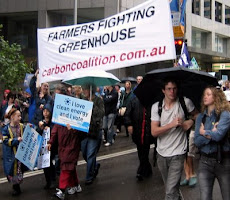
The following happened while the Carbon Farming Expo & Conference was underway - sparked by the event:
Media Release | Spokesperson Christine Milne
Monday 17th November 2008, 2:21pm
Australian Greens Deputy Leader and climate change spokesperson, Senator Christine Milne, said: "The best climate change strategy for rural and regional Australia is in learning how to keep more carbon in the soils - reducing our climate impact and building resilience to the warming that we've already caused."Enhancing soil carbon is being recognised globally as not only a great thing for improving productivity and building resilience in the face of climate change, but it is also potentially a huge opportunity to reduce the carbon emissions which cause climate change.
"It is stupid and short-sighted in the extreme for any government to be closing down a facility which has 75 years of data to back the new, exciting science around soil carbon... We have lost too many scientists from our research institutions who understand how carbon is stored in soils and how natural systems work. We cannot rely on the agribusiness sector which is putting huge pressures on farmers' margins as well as on soils. Instead of getting rid of scientists who understand soil carbon, we should be recruiting them again and increasing their research funding.
19 November 2008
Greens MP calls on Government to reprioritise Soil Carbon Sequestration
Greens MP Ian Cohen, in coincidence with this week’s Soil Carbon Expo, is calling upon the Minister for Primary Industries to cull government funding for the Clean Coal fund and reinject the funds into soil carbon sequestration and agricultural based GHG emission reduction projects. “Last week I put a motion before the Legislative Council that the NSW Government acknowledge the emission reduction capacity of New South Wales’ agricultural sector and start prioritising this sector instead of subsidising clean coal projects” says Mr Cohen.
“NSW Department of Primary Industries has provided $500,000 to the National Centre for Rural Greenhouse Gas Research compared with $50 million dollars already committed for clean coal projects in NSW.”
“Why is the NSW Government disproportionately subsidising Clean Coal research for companies awash with record profits off the back of a sustained resource boom while leaving the agricultural sector, battling through an extended drought, with bread crumbs.”
“Some of the world's leading soil scientists suggest that more regenerative farming and grazing practices in Australia would sequester upwards of 927 million tonnes of CO2 a year and that such practices on 5 per cent of Australia's grazing land could offset this country's total greenhouse gas emissions.”
“Instead of acknowledging my repeated calls for increased funding in Parliament, the Minister has closed the Glenn Innes research facility which has undertaken extensive research into soil carbon and crop rotation.”
“If Alberta, Canada, home of the environmentally damaging Oil Sands can introduce a voluntary carbon offset market which includes 9 different agricultural emission reduction methods, then NSW can surely do the same. Albertan farmers who have adopted reduced tillage practices to reduce Co2 release from soils into the atmosphere have received $6,000 dollars on average from a carbon purchase agreement with a provincial electricity generator EPCOR.”
Thursday, December 04, 2008


Saturday, November 29, 2008
URGENT COMMENTS ON NATIONAL SOILS POLICY NEEDED BY DEC.8TH!
THERE IS TO BE A NATIONAL SOILS POLICY.
You will find the discussion paper written by Andrew Campbell at the following address:
www.clw.csiro.au/aclep/SoilDiscussionPaper.htm
Campbell A (2008) Managing Australia's Soils: A Policy Discussion Paper. Prepared for the National
Committee on Soil and Terrain (NCST) through the Natural Resource Management Ministerial Council
(NRMMC).
IT IS URGENT THAT SANE SOIL SYMPATHISERS LIKE YOU HAVE INPUT BECAUSE THOSE OF DIFFERENT PERSUASIONS WILL BE THERE IN SPADES.
PLEASE forward a copy of your submission and we'll publish it (if you like).
Carbon Farming Conference slides will be available soon
Most of the speakers' slides will be posted at a location and linked from here asap. Be patient. I need to get permission.
Michael
Michael
Wednesday, November 26, 2008
DID YOU FEEL THE WIND SHIFT? (CONFERENCE DVD NOW AVAILABLE)

Hello,
If you were at the 2008 Carbon Farming Conference in Orange (18-19 November, 2008) you may have felt it. A subtle shift in the wind. The year before, when we stood up before the scientists and carbon farmers from every State of Australia and NZ, we had only promises. Not much data. And we had no explanation for why the scientists could not report any significant carbon increases in Australian farm soil. There were even people in high places who preached that our soils couldn’t sequester much carbon. And many people believed them.
That was then. This is now. The wind has shifted. The Carbon Farmers have got data. And we have found a reason why science has not been able to detect the carbon increases that we knew all along were possible.
Even the writers of the Green Paper have to revisit their calculations. Because Farmer after Farmer got up and revealed results that defy logic and science. Last year’s Carbon Cocky of the Year Anne Williams reported a 1% difference in Carbon between land cropped with compost tea and land left uncropped. That’s 1% increase in a year. Cam McKellar reported a 0.5% lift in 9 months. Col Seis reported his 1.8 – 4% in 10 years.
He then recited a strange set of scores: his soil bacteria had increased 3.5 times, fungus was up by 9 times, protozoa up by 10 times, and nematodes increased 60 times. And insect life had increased 600%.
And there, for all to see, was the reason for the gap between soil carbon’s behaviour when scientists observe it and its behaviour when its microbial manufacturers of carbon are given their head. Unfortunately, there has been not much research done on soil biology. Most of the scientists of note are chemists or physicists. Hence the reason the CSIRO Plant people cold make those astounding claims about the cost of humus, as if there was only one source of nitrogen – a bag.

Biology is not fashionable in the science world. Many referred to it disparagingly as ‘witches brew’, probably in response to the eccentric Rudolf Steiner and his cows horns and the phases of the moon. Certainly Ken Bellamy from Townsville was in danger of being burned at the stake for the carbon scores he reported from the “Probiotic” treatments he has devised. The soil’s rapid response to the biological inoculants forms the basis for the carbon trading system Mr Bellamy has established in the region around Townsville.
His carbon scores ranged from the sober 1.5% over three years in a banana plantation to a scary 1.5% in only 7 months under sugar cane and to an outrageous 2% in just over 2 months under pasture. He was also able to report that Townsville Council has been able to halve the water it puts on its parklands after inoculating with probiotics.
It is a sign of the times that, rather than putting him to the sword, our seasoned senior soil scientists agreed to put Mr Bellamy’s claims to the test.
As a result of these two factors - data (yet to be verified by peer-reviewed process) and biology (bcoming more popular, with Sydney University advertising for a senior lecturer recently) – there was a different tone to the conference. An atmosphere of hope. How different the final session was, when the same old messages and predictions of minimal soil carbon emerged. (Annette Cowie’s presentation was brilliant.) One soil carbon minimalist was so brave as to predict the future – that no innovation would ever solve the problem of carbon in rangelands.

"The science is lagging the politics," said Head of Land & Water, Michael Robinson.
PS. The value of soil carbon is measured in many different ways. Dr Lal, in his speech at the Carbon Farming Conference, revealed that soil carbon could be worth US$250 a tonne in production and environmental and social value. But if soil carbon was worth $20/tonne (as proposed by the Australian Carbon Pollution Reduction Scheme), Anne Williams and Cam McKellar could have earned an extra $500/ha for the carbon they ‘grew’, Col Seis could have earned an extra $200/ha/year for 10 years (or a total of $2,000/ha), and Ken Bellamy’s grazier in Canberra would be $2000/ha better off (after only 2 months). [NB. Calculations based on increase in top 10cm, Bulk Density 1.4.]
Cheers!
Michael

The Carbon Farming Handbook

There are so many people with questons about soil carbon and carbon farming. Are you one of them? I thought so. That's why we have produced The Carbon Farming Handbook. It is a useful introduction to the concept, practice and philosophy of farming for carbon.
Written in an easy-to-understand style, it makes the complexities simple. Read it once and you'll be in command of the facts. Read it twice and you'll be an expert.
The Carbon Farming Handbook is perfect for briefing family members, colleagues, neighbours, agronomists, politicians and decision-makers, and anyone else who wants to know what this 'carbon farming' is all about.
Glance through the Contents and you'll get a feeling for what the Handbook offers:
2. Introduction
3. Contents
4. What is Soil Carbon?
5. Benefits of Soil Carbon
6. Carbon Farming & Natural Resources
8. Carbon Farming & Climate Change
11. Soil Carbon & Urgency
13. Changing the Way We Farm
15. Measuring Soil Carbon
21. Permanence
22. Additionality
26. Carbon Sinks & Sources
28. Soil Carbon Dynamics
29. On-Farm GHG Emissions
31. Cap & Trade Systems
33. Soil Carbon Trading Schemes
42. Carbon Farming Techniques
1. Grazing Management
2. Conservation Tillage
3. Pasture Cropping
4. Biological Farming (including Organic Farming)
5. Biodynamic Farming
6. Natural Sequence Farming
7. Keyline and Subsoil Ploughing
8. Ameliorant Soil Treatments
64. Panchagavya: Ancient Vedic Recipe for Soil Health
66. Useful Charts and Facts
70. Soil Carbon Frequently Asked Questions
80. Glossary
90. Useful References
You can order over the telephone or by fax or by email.
And remember, you are supporting the work of the Carbon Coalition.
Thank you.
Michael Kiely
Convenor
Carbon Coalition
Tuesday, November 25, 2008
Australian Carbon Farmers Join UN FAO Campaign to change Kyoto

PRESS RELEASE 24 NOVEMBER, 2008
The United Nations Food & Agricultural Organisation has launched a global campaign to have the Kyoto rules re-interpreted so that soil carbon be recognised as a class of offset credit for greenhouse gas emissions trading.
Under the title of “Sustainable Intensive Production”, the FAO wants to see food production stepped up to meet world demand and that this be done sustainably. The FAO sees rewarding farmers for growing carbon in soils as the link to sustainable increases in production.
Carbon Farmers of Australia principal Michael Kiely addressed a recent FAO meeting at Purdue University in Indiana on Australia ‘carbon farming’ trends. Australia’s own Carbon Farming Conference (held last week) saw a working party produce a communiqué which:
• Endorsed the FAO’s campaign to change Kyoto rules
• Endorsed the NFF and other groups calling for Agriculture’s involvement in carbon markets
• Called for a CRC for Carbon Responsive Farming to be established
WORKING GROUP FROM THE CARBON FARMING EXPO & CONFERENCE 2008

Ken Bellamy, Prime Carbon
Jane Bradley, Northern Agricultural Catchments Council, WA
*Jeremy Bradley, Foodprints Farming
*Peter Calkin, Microsoils
Angus Campbell, Recycled Organics Unit, UNSW
Andrew Carroll, Health Support
Bryan Clark, Grain Growers Association
John Dalton, Landcare NSW
Nigel Diprose, Caidoz Consuting
John Fry, Conservation Volunteers
Gerry Gillespie, NSW Department of Environment and Climate Change
Chris Higgins, Western CMA
*Andrew Hines, Moss-Ridge Pastoral Company
*Barney Hughes, Microsoil
*Michael Kiely, Carbon Farmers of Australia
*Louisa Kiely, Carbon Farmers of Australia
Helen King, ANU
John Lawrie, Central West CMA
Honor Lee, organic farmer
Kate Lorimes-Ward, DPI NSW
Tony Lovell, Soil Carbon Australia
*Cath Marriott, Yarallah
Nicole Masters, Integrity Soils NZ
John Mills, NSW TAFE
*Hamish Munro, The Cattle Council of Australia
Tom Nicholas, Carbon Communicator
Susan Orgill, NSW DPI
*Col Seis, “Wiona”, Gulgong
*Paul Smith, Pipinui NZ
Peter Wadewitz, Wåste Management Association
Alan Welch, Central West CMA
Tim Wiley, Department Agriculture & Food, WA
*Bob Wilson, Evergreen Farming WA
*Farmers
COMMUNIQUE OF CONFERENCE

24 November, 2008
A working group of the 2008 Carbon Farming Conference and Expo, organised by Carbon Farmers of Australia, has endorsed the statement of the UNITED NATION’S FOOD & AGRICULTURE ORGANISATION communiqué “Mitigating Climate Change” with the following:
“We confirm:
1. that agriculture can respond immediately to sequester carbon through capture and storage.
2. that agriculture should be provided with an opportunity to support the national and global climate management effort and
3. that soil carbon should be included in voluntary offset markets.
“We support the position taken by the National Farmers Federation and those national farm lobby groups arguing for Agriculture to play a positive role in Climate Change Mitigation.
“We request that the Commonwealth Government establish a CRC for Carbon Responsive Farming.
“And we urge the United Nations’ Food & Agriculture Organisation’s Crop & Grassland Service convene a meeting of conservation and carbon farming representatives in Australasia as part of its campaign for soil carbon offset trading.”
MESSAGE OF SUPPORT FROM UN FAO

MESSAGE OF SUPPORT FROM
THE UNITED NATIONS FOOD & AGRICULTURAL ORGANISATION
Theodor Friedrich, Senior Officer (Crop Production Systems Intensification) FAO Crop and Grassland Service (AGPC) Room C-782 Viale delle Terme di Caracalla 00153 Rome Italy
FAO’s first and still valid mandate is to fight the hunger in the world and to achieve food security for all. In order to achieve this, agriculture has to be not only productive, but also sustainable, respecting the natural resource base and the environment. In recognition of the fact that agricultural production must be in harmony and not in opposition with environmental integrity, FAO is defining a new programme called sustainable production intensification.
A major component of this programme is the recognition of the mutual relationship between agricultural production and climate and the effects of climate change. Agriculture is directly affected by climate change but it has also a huge potential to mitigate climate change. Besides reducing GHG emissions, agriculture can restore in the soils significant amounts of carbon from the atmosphere. Farming practices and systems, such as conservation agriculture, have been developed, which allow such carbon sequestration in soils without sacrificing agricultural production or having negative repercussions on other ecosystem services. In a recent Conservation Agriculture Carbon Offset consultation a clear agreement could be reached that agriculture can in this way significantly contribute to climate change mitigation, while at the same time fulfill its role to produce food, fibre and other required products and to provide important ecosystem services.
With this in mind, the farmer can “produce” besides the traditional agricultural products also carbon, stored in the soils as a service to mankind, which hopefully will also get an adequate recognition and payment as other products and services. FAO is promoting concepts like conservation agriculture in all world regions through awareness raising activities, conferences and through demonstration projects in the field. FAO is convinced that with such practices agriculture will be able to feed the world in a sustainable way and welcome initiatives, such as the Carbon Farming Conference in Australia, which support this cause.
BACKGROUND TO UNITED NATION’S FAO SOIL CARBON COMMUNIQUE

The Principals of Carbon Farmers of Australia were invited to represent Australia and address a 3-day conference organized by the United Nations Food & Agriculture Organisation (UN FAO) as part of a campaign to have soil carbon accepted as a class of offset credits tradable on the world’s emissions markets.
At the Conservation Agriculture Carbon Offset Consultation –held in West Lafayette, Indiana, USA, 28-30 October 2008 – 84 delegates from 14 nations agreed to a communiqué calling for the governments of the world to take steps on soil carbon trading.
This was the second of a series of ‘consultations’ run by the UN FAO prior to the InterGovernmental Panel on Climate Change (IPCC) meeting in Copenhagen in 2009.The first was held in Rome in July, 2008. The UN FAO is determined to put a strong case for changing many of the Kyoto rules that preclude soil carbon’s engagement in trade.
The month before, 181 countries attending the High-Level Conference on World Food Security: the Challenges of Climate Change and Bioenergy, convened by UN FAO, 3-5 June, 2008, called for farmers to be given access to the billions of dollars coursing through the world’s carbon markets. "It is essential to … increase the resilience of present food production systems ... We urge governments to create opportunities to enable the world's smallholder farmers …. to participate in, and benefit from financial mechanisms and investment flows to support climate change adaptation, mitigation and technology development…”
The CFA is seeking to have Australia more deeply involved in the United Nation’s FAO soil carbon campaign.
WHO is Carbon Farmers of Australia (CFA)?

Carbon Farmers of Australia (CFA) is the commercial arm of the Carbon Coalition Against Global Warming (the Carbon Coalition) , a farmers' lobby that promotes increasing soil carbon levels as a solution to declining soil health and farm profits, and the effects of Climate Change. Active members include farmers, agronomists, scientists, educators, entrepreneurs and extension officers. The Coalition has conducted an awareness-raising campaign in the media and members have addressed more than 200 gatherings in Australia, New Zealand and the United States. The Coalition’s members have appeared before and made submissions to many government enquiries and lobbied individual politicians. When Prime Minister Kevin Rudd announced an enquiry into soil carbon in early 2008, The Land newspaper declared that the Coalition had “single-handedly barnstormed the issue onto the national agenda.” A Coalition delegation visited the USA in 2006 and consulted with leaders of the 3 Presidential partnerships of States addressing terrestrial carbon sequestration. It also secured the first order for Australian agricultural soil carbon from the Chicago Climate Exchange. To encourage more collaboration between scientists and farmers in research projects, the Coalition, in collaboration with Catchment Management Authorities, has staged a series of 4 “Soil Science Summits” to promote knowledge exchange between farmers and graziers and leading soil scientists. The CFA has now staged 2 annual Carbon Farming Conferences. Most recently they represented Australia at the United Nation’s Food & Agriculture Organisation’s “Conservation Farming Carbon Offset Consultation” in Indiana in October, 2008. Co-Convenors of the Coalition, Michael and Louisa Kiely, are woolgrowers from the Central West of NSW in Australia.
FOR MORE INFORMATION:
CALL (612) 6374 0329, michael@carboncoalition.com.au
Sunday, November 23, 2008
COMMUNIQUE 2008 CARBON FARMING CONFERENCE
 A working group of the 2008 Carbon Farming Conference and Expo, organised by Carbon Farmers of Australia, has endorsed the statement of the UNITED NATION’S FOOD & AGRICULTURE ORGANISATION communiqué “Mitigating Climate Change” with the following statement:
“We confirm:
1. that agriculture can respond immediately to sequester carbon through capture and storage.
2. that agriculture should be provided with an opportunity to support the national and global climate management effort and
3. that soil carbon should be included in voluntary offset markets.
“We support the position taken by the National Farmers Federation and those national farm lobby groups arguing for Agriculture to play a positive role in Climate Change Mitigation.
“We request that the Commonwealth Government establish a CRC for Carbon Responsive Farming.
“And we urge the United Nations’ Food & Agriculture Organisaton’s Crop & Grassland Service convene a meeting of conservation and carbon farming representatives in Australasia as part of its campaign for soil carbon offset trading.”

WORKING GROUP FROM THE CARBON FARMING EXPO & CONFERENCE 2008
Ken Bellamy, Prime Carbon
Jane Bradley, Northern Agricultural Catchments Council, WA
*Jeremy Bradley, Footprints Organic Farming
*Peter Calkin, Microsoils
Angus Campbell, Recycled Organics Unit, UNSW
Andrew Carroll, Health Support
Bryan Clark, Grain Growers Association
John Dalton, Landcare NSW
Nigel Diprose, Caidoz Consuting
John Fry, Conservation Volunteers
Gerry Gillespie, NSW Department of Environment and Climate Change
Chris Higgins, Western CMA
*Andrew Hines, Moss-Ridge Pastoral Company
*Barney Hughes, Microsoil
*Michael Kiely, Carbon Farmers of Australia
*Louisa Kiely, Carbon Farmers of Australia
Helen King, ANU
John Lawrie,Central West CMA
Honor Lee, organic farmer
Kate Lorimes-Ward, DPI NSW
Tony Lovell, Soil Carbon Australia
*Cath Marriott, Yarallah
Nicole Masters, Integrity Soils NZ
John Mills, NSW TAFE
*Hamish Munro, Cattle Council
Susan Orgill, NSW DPI
*Col Seis, “Wiona”, Gulgong
*Paul Smith, Pipinui NZ
Peter Wadewitz, Wåste Management Association
Alan Welch, Central West CMA
Tim Wiley, Department Agriculture & Food, WA
*Bob Wilson, Evergreen Farming WA
*Farmers
BACKGROUND TO UNITED NATION’S FAO SOIL CARBON COMMUNIQUE
21 November, 2008

The Principals of Carbon Farmers of Australia were invited to represent Australia and address a 3-day conference organized by the United Nations Food & Agriculture Organisation (UN FAO) as part of a campaign to have soil carbon accepted as a class of offset credits tradable on the world’s emissions markets.
At the Conservation Agriculture Carbon Offset Consultation –held in West Lafayette, Indiana, USA, 28-30 October 2008 – 84 delegates from 14 nations agreed to a communiqué calling for the governments of the world to take steps on soil carbon trading.
This was the second of a series of ‘consultations’ run by the UN FAO prior to the InerGovernmental Panel on Climate Change (IPCC) meeting in Copenhagen in 2009.The first was held in Rome in July, 2008. The UN FAO is determined to put a strong case for changing many of the Kyoto rules that preclude soil carbon’s engagement in trade.
The month before, 181 countries attending the High-Level Conference on World Food Security: the Challenges of Climate Change and Bioenergy, convened by UN FAO, 3-5 June, 2008, called for farmers to be given access to the billions of dollars coursing through the world’s carbon markets. "It is essential to … increase the resilience of present food production systems ... We urge governments to create opportunities to enable the world's smallholder farmers …. to participate in, and benefit from financial mechanisms and investment flows to support climate change adaptation, mitigation and technology development…”
The CFA is seeking to have Australia more deeply involved in the United Nation’s FAO soil carbon campaign.
Friday, November 21, 2008
Carbon Coalition addresses UN Pre-Copenhagen Soil C Forum
Soil scientists and experts from 15 nations across 5 continents were assembled in Indiana, USA to plan soil carbon's assault on the IPCC meeting in Copenhagen in 2009 where Kyoto is to be renegotiated. The Australian delegation included the convenors of the Carbon Coalition (Akubra, red jumper) who prersented a paper and moderated a session. The meeting produced a communique which pleased meeting sponsor Theodor Friedrich, senior officer for Crop Production Systems Intensification in the FAO’s Crop and Pasture Service at the organization’s world headquarters in Rome, Italy. “We had a very good, sound gathering of experts and we had an unexpectedly high degree of coinciding views and agreement, and that allowed us to come up with a fairly punchy, clear and concise document with relevant recommendations,” he said. “I could imagine that this meeting, the outcome and the proceedings being produced might be future references to further our objective to get soil carbon into the international carbon trading markets.” (Mr Friedrich is pictured in hat and glasses.)

The UN FAO International Conservation Agriculture Carbon Offset Consultation called for soil carbon to be included as a class of offset credits for greenhouse gas emissions trading on the global market. It called for governments of the world to recognise farming that accumulates soil carbon as providing an ecosystem service and creating economic opportunities.
The meeting’s Communique states: “Conservation Agricultural systems for crops and pastures sequester carbon from the atmosphere into long-lived soil organic matter pools; they maintain and increase productivity, promote a healthy environment and strengthen rural communities. Potentially one third of annual global fossil fuel emissions could be offset by applying Conservation Agriculture.”

UN meeting recognises soil as massive carbon sink
Carbon Coalition convenors Michael & Louisa Kiely presented a report on the state of play in Australia on the morning of the first day. "I am very delighted that such a significant group of experts has assembled here from all over the world," said the FAO's Crop and Grassland leader Theodore Frederich. "This meeting produced an output which should stimulate the inclusion of appropriate agricultural land management culture linked to global mechanisms for the mitigation of climate change."
Nations represented that the FAO’s “Consultation” included Australia, Brazil, Italy, Canada, Columbia, Mexico, Germany, Denmark, South Africa, Tunisia, and the three biggest emitters who are yet to enter the Kyoto trading system, the USA, China & India.
The North Americans - now headed in the same direction as Australia - are also headed into the same quagmire called "the science": “To create working markets for farmers’ efforts to capture atmospheric carbon, we need to understand the science of how carbon acts in the soil, and the science behind no-till systems,” said Karen Scanlon, executive director of co-host Conservation Technology Information Center. “With that insight, we can quantify the effect that farmers have with specific practices and on specific soils, and create a fair compensation structure for those effects.”
The USA and Canada may have a natiional offsets market on the voluntary side, but they are yet to start unravelling the hard parts of the puzzle, as this statement reveals: "Changes in soil carbon are small... Complex chemistry dictates that the soil can only sequester a limited amount of carbon per year, and that after a certain number of years – scientists believe it is 15 to 20 years – a field reaches a plateau.
To make it even more complex, the soil’s capacity to store carbon depends on soil type, tillage system, the use of cover crops, cropping history and how much carbon it lost in the first place. Research from highly degraded soils in South America put into improved pasture showed dramatic jumps in carbon levels after five years – much higher storage than Midwestern soils in the U.S. Deep-rooted pasture plants also have the capacity to place carbon deeper into poor South American soils than annual crops do in cooler climates with richer ground. “The higher the clay content, the more capacity there is to store carbon,” said Charles Rice of Kansas State University.

In Brazil, Telmo Amado of the Federal University of Santa Maria plants corn and a deep-rooted, perennial pasture grass called deep into the soil. The result is a tremendous amount of biomass above and below the ground – a cash crop, a grazing opportunity and plenty of residue for carbon-fixing microbes.
But just growing biomass isn’t enough, says Amado. “One side of the equation is introducing this carbon,” he noted. “The other side is how we stabilize it in the soil. Both physical and chemical protections are important.”
That means protecting the soil surface with plenty of residue, maintaining soil structure by no-tilling or minimizing tillage, keeping soil microbes healthy (again through minimal soil disturbance), fertilizing crops adequately, avoiding soil compaction and rotating crops. “It’s really site-specific, and we really need to understand the crop system we’re talking about,” said Amado.
Got to Pay
Building carbon levels in the soil delivers a variety of important benefits, from improved soil quality to better water-holding capacity, higher fertility and resistance to erosion. Still, the biggest enticement to sequestering carbon will be creating markets through which farmers can sell the service they provide.
“I think what we’re really looking for as a farm organization, or society in general, is some way to reward farmers and ranchers for doing things like storing carbon and some other environmental practices,” said North Dakota farmer Dale Enerson, who serves as director of the Carbon Credit Program for the National Farmers Union in Jamestown, N.D.
The National Farmers Union has served as an aggregator of carbon credits, collecting pledges from 3,700 growers in the U.S. to sequester carbon on 4.7 million acres of cropland and rangeland and selling the bundle of carbon credits on the Chicago Climate Exchange (CCX). Participating growers received an average of $1.20 per ton of sequestered carbon. Official CCX estimates for carbon sequestration range from 0.2 to 0.6 metric tons per acre on no-tilled cropland, 1 metric ton per acre on long-term grassland (such as CRP ground) and 0.12 to 0.52 metric tons on rangeland with enhanced management practices.
In a pioneering carbon offset trading program in Alberta, Canada, 47 percent of the offsets are from agricultural land. On the Chicago Climate Exchange, 25.52 percent of the offsets have been purchased from farmers. In Canada, provincial carbon offset trading in Alberta and Saskatchewan are paving the way for nationwide caps on industrial greenhouse gas emissions that will kick in on Jan. 1, 2010. Capping emissions will boost the market for tradable carbon offset credits, and agriculture wants to be part of the package.

Preparing soil carbon offset credits for a full-scale, regulation-driven market will require policymakers to sort out an array of issues, ranging from how long the contracts should be, who owns the carbon (the operator or the landowner), how practices are verified, and how to handle situations in which an operator releases carbon by disturbing the ground in violation of his contract.“These cross-cutting issues can be worked out by working together,” says Don McCabe, an Ontario farmer who serves as vice president of the Soil Conservation Council of Canada, “because at the end of the day, it’s the same science. We’re starting to see the ball running down the hill. We’ve got to keep it rolling.”
Though voluntary markets have kept the value of a ton of sequestered carbon low – prices on the Chicago Climate Exchange have ranged from 90 cents to $7.50 per metric ton, and Alberta prices have ranged from $6.00 to $12.00 – McCabe believes a free market in which buyers are motivated by regulatory emissions caps could reach $65.00 per metric ton by 2020.
That would be music to the ears of farmers – and the participants in the October meeting. “There has to be a fair-price incentive,” said Rattan Lal, director of the Carbon Management and Sequestration Institute at The Ohio State University, “and $2 or $3 or $4 per acre in the market isn’t going to do it.”
 The meeting produced a communique which pleased meeting sponsor Theodor Friedrich, senior officer for Crop Production Systems Intensification in the FAO’s Crop and Pasture Service at the organization’s world headquarters in Rome, Italy. “We had a very good, sound gathering of experts and we had an unexpectedly high degree of coinciding views and agreement, and that allowed us to come up with a fairly punchy, clear and concise document with relevant recommendations,” he said. “I could imagine that this meeting, the outcome and the proceedings being produced might be future references to further our objective to get soil carbon into the international carbon trading markets.” (Mr Friedrich is pictured in hat and glasses.)

The UN FAO International Conservation Agriculture Carbon Offset Consultation called for soil carbon to be included as a class of offset credits for greenhouse gas emissions trading on the global market. It called for governments of the world to recognise farming that accumulates soil carbon as providing an ecosystem service and creating economic opportunities.
The meeting’s Communique states: “Conservation Agricultural systems for crops and pastures sequester carbon from the atmosphere into long-lived soil organic matter pools; they maintain and increase productivity, promote a healthy environment and strengthen rural communities. Potentially one third of annual global fossil fuel emissions could be offset by applying Conservation Agriculture.”

UN meeting recognises soil as massive carbon sink
Carbon Coalition convenors Michael & Louisa Kiely presented a report on the state of play in Australia on the morning of the first day. "I am very delighted that such a significant group of experts has assembled here from all over the world," said the FAO's Crop and Grassland leader Theodore Frederich. "This meeting produced an output which should stimulate the inclusion of appropriate agricultural land management culture linked to global mechanisms for the mitigation of climate change."
Nations represented that the FAO’s “Consultation” included Australia, Brazil, Italy, Canada, Columbia, Mexico, Germany, Denmark, South Africa, Tunisia, and the three biggest emitters who are yet to enter the Kyoto trading system, the USA, China & India.
The North Americans - now headed in the same direction as Australia - are also headed into the same quagmire called "the science": “To create working markets for farmers’ efforts to capture atmospheric carbon, we need to understand the science of how carbon acts in the soil, and the science behind no-till systems,” said Karen Scanlon, executive director of co-host Conservation Technology Information Center. “With that insight, we can quantify the effect that farmers have with specific practices and on specific soils, and create a fair compensation structure for those effects.”
The USA and Canada may have a natiional offsets market on the voluntary side, but they are yet to start unravelling the hard parts of the puzzle, as this statement reveals: "Changes in soil carbon are small... Complex chemistry dictates that the soil can only sequester a limited amount of carbon per year, and that after a certain number of years – scientists believe it is 15 to 20 years – a field reaches a plateau.
To make it even more complex, the soil’s capacity to store carbon depends on soil type, tillage system, the use of cover crops, cropping history and how much carbon it lost in the first place. Research from highly degraded soils in South America put into improved pasture showed dramatic jumps in carbon levels after five years – much higher storage than Midwestern soils in the U.S. Deep-rooted pasture plants also have the capacity to place carbon deeper into poor South American soils than annual crops do in cooler climates with richer ground. “The higher the clay content, the more capacity there is to store carbon,” said Charles Rice of Kansas State University.

In Brazil, Telmo Amado of the Federal University of Santa Maria plants corn and a deep-rooted, perennial pasture grass called deep into the soil. The result is a tremendous amount of biomass above and below the ground – a cash crop, a grazing opportunity and plenty of residue for carbon-fixing microbes.
But just growing biomass isn’t enough, says Amado. “One side of the equation is introducing this carbon,” he noted. “The other side is how we stabilize it in the soil. Both physical and chemical protections are important.”
That means protecting the soil surface with plenty of residue, maintaining soil structure by no-tilling or minimizing tillage, keeping soil microbes healthy (again through minimal soil disturbance), fertilizing crops adequately, avoiding soil compaction and rotating crops. “It’s really site-specific, and we really need to understand the crop system we’re talking about,” said Amado.
Got to Pay
Building carbon levels in the soil delivers a variety of important benefits, from improved soil quality to better water-holding capacity, higher fertility and resistance to erosion. Still, the biggest enticement to sequestering carbon will be creating markets through which farmers can sell the service they provide.
“I think what we’re really looking for as a farm organization, or society in general, is some way to reward farmers and ranchers for doing things like storing carbon and some other environmental practices,” said North Dakota farmer Dale Enerson, who serves as director of the Carbon Credit Program for the National Farmers Union in Jamestown, N.D.
The National Farmers Union has served as an aggregator of carbon credits, collecting pledges from 3,700 growers in the U.S. to sequester carbon on 4.7 million acres of cropland and rangeland and selling the bundle of carbon credits on the Chicago Climate Exchange (CCX). Participating growers received an average of $1.20 per ton of sequestered carbon. Official CCX estimates for carbon sequestration range from 0.2 to 0.6 metric tons per acre on no-tilled cropland, 1 metric ton per acre on long-term grassland (such as CRP ground) and 0.12 to 0.52 metric tons on rangeland with enhanced management practices.
In a pioneering carbon offset trading program in Alberta, Canada, 47 percent of the offsets are from agricultural land. On the Chicago Climate Exchange, 25.52 percent of the offsets have been purchased from farmers. In Canada, provincial carbon offset trading in Alberta and Saskatchewan are paving the way for nationwide caps on industrial greenhouse gas emissions that will kick in on Jan. 1, 2010. Capping emissions will boost the market for tradable carbon offset credits, and agriculture wants to be part of the package.
“I think what we’re really looking for as a farm organization, or society in general, is some way to reward farmers and ranchers for doing things like storing carbon and some other environmental practices,” said North Dakota farmer Dale Enerson, who serves as director of the Carbon Credit Program for the National Farmers Union in Jamestown, N.D.
The National Farmers Union has served as an aggregator of carbon credits, collecting pledges from 3,700 growers in the U.S. to sequester carbon on 4.7 million acres of cropland and rangeland and selling the bundle of carbon credits on the Chicago Climate Exchange (CCX). Participating growers received an average of $1.20 per ton of sequestered carbon. Official CCX estimates for carbon sequestration range from 0.2 to 0.6 metric tons per acre on no-tilled cropland, 1 metric ton per acre on long-term grassland (such as CRP ground) and 0.12 to 0.52 metric tons on rangeland with enhanced management practices.
In a pioneering carbon offset trading program in Alberta, Canada, 47 percent of the offsets are from agricultural land. On the Chicago Climate Exchange, 25.52 percent of the offsets have been purchased from farmers. In Canada, provincial carbon offset trading in Alberta and Saskatchewan are paving the way for nationwide caps on industrial greenhouse gas emissions that will kick in on Jan. 1, 2010. Capping emissions will boost the market for tradable carbon offset credits, and agriculture wants to be part of the package.

Preparing soil carbon offset credits for a full-scale, regulation-driven market will require policymakers to sort out an array of issues, ranging from how long the contracts should be, who owns the carbon (the operator or the landowner), how practices are verified, and how to handle situations in which an operator releases carbon by disturbing the ground in violation of his contract.“These cross-cutting issues can be worked out by working together,” says Don McCabe, an Ontario farmer who serves as vice president of the Soil Conservation Council of Canada, “because at the end of the day, it’s the same science. We’re starting to see the ball running down the hill. We’ve got to keep it rolling.”
Though voluntary markets have kept the value of a ton of sequestered carbon low – prices on the Chicago Climate Exchange have ranged from 90 cents to $7.50 per metric ton, and Alberta prices have ranged from $6.00 to $12.00 – McCabe believes a free market in which buyers are motivated by regulatory emissions caps could reach $65.00 per metric ton by 2020.
That would be music to the ears of farmers – and the participants in the October meeting. “There has to be a fair-price incentive,” said Rattan Lal, director of the Carbon Management and Sequestration Institute at The Ohio State University, “and $2 or $3 or $4 per acre in the market isn’t going to do it.”
Wednesday, November 05, 2008
The Audacity To Hope

Today a black man became President of the United States.
Unthinkable.
Until it happened.
Obama wrote a book called The Audacity To Hope.
We too have the audacity to hope. We hope for the day that soil carbon will be traded and farmers paid fairly for what they grow,
We hope for the day when rising soil carbon levels start returning the soils to health, returning native species to the landscape, and returning hope to rural communities.
We hope for that day because it will also be the day when farmers wlll start soaking up the excess CO2 that is troubling our climate and threatening our childrens' and grandchildrens' futures.
We hope for better times for everyone. Because we know what we can do if allowed to do it.
Some Sanity in Canberra - only in the Times
Brian Toohey, in The Canberra Times 3/11/2008:.
"Just as surprisingly, the government is ignoring attractive options to encourage rural Australians to play a major role in reducing emissions. Due to worries about asking farmers to buy pollution permits to cover emissions from livestock and land cultivation, the rural sector will not be included in the initial stage of the pollution reduction scheme. But this overlooks the positive side which would let farmers make money from selling offset credits for storing carbon in soil and vegetation. Ultimately, these opportunities could result in large cuts to Australian emissions in a relatively painless manner.
"In the final report of his Climate Change Review, released in the September, Professor Ross Garnaut saw tremendous potential for absorbing carbon in soils and plants. The report said, "The comprehensive restoration of degraded low value grazing country in arid Australia ... would remove up to the equivalent of 250 million tonnes of carbon dioxide per year." That’s about half the nation’s present emissions. Garnaut is not suggesting that land restoration on this scale will fully eventuate, but achieving half the potential gain would make a significant contribution to the reducing emissions.
"In discussing a related approach, Garnaut says carbon farming — involving the planting of suitable trees or other vegetation — could absorb over 140 million tonnes of carbon dioxide a year. He says that a recent study shows farmers could earn up to $100 per hectare more a year than from current land use by to selling carbon offsets, even if a pollution permit price were only $20 a tonne. One advantage of carbon farming is that there are no costs for harvesting and transporting timber. Nor does it matter if the land is in a remote area, or producing only marginal returns from its current usage.
"Moving down this path would also help tackle problems of soil salinity and erosion, as well giving farmers a chance to improve their income while abandoning agricultural practices that damage the land. It would also make it easier to meet stricter emission targets. To achieve these benefits, however, the government needs to start now — not in a decade’s time —on rolling out demonstration programs to introduce farmers and land care groups to the opportunities. "
Tax farmers, don't pay them for soil carbon: Australia Institute
Energy and environmental lobbyists want farmers shut out of the biggest commodity market in history - and instead to pay a new tax to punish them for growing cattle and sheep.
Soil Carbon Trading was attacked recently in an Australia Institute Paper by energy expert Dr Hugh Saddler and former AGO executive and ANU Masters of Environment & Society student Helen King.
The report has at least three fundamental flaws:
Fundamental Flaw #1: Dr Saddler says farmers cannot measure the emissions from their animals or crops accurately: "To get an accurate estimate of them, you've actually got to go and make the measurements of what's actually being emitted from a cow or from a paddock of wheat and that's very, very costly and complex to do and will always be, so its not a matter of getting the science better," he said.
Dr Saddler, who is an energy industry expert, would know that measurement is not the problem, says according to Tony Lovell of SOil Carbon Australia. “In the energy industry they don’t ‘measure’ the amounts of carbon released by a coal-burning power station. They would have to capture all its emissions, separate off the GHG's, and weigh them - 24 hours a day, 7 days a week. Forever. They do not do this - they use regular sampling and apply generally accepted formulas to come up with reasonable estimates of the emissions.”
There is next to no "measurement" involved in this whole process - but there is a lot of "estimation". Understanding the difference between these two terms is absolutely critical.
Fundamental Flaw #2: The so-called fact that “farming contributes about 16% of Australia’s emissions” Is still widely believed, but is now out of date. Ruminant numbers are not the cause of methane increases, according to research by the Food and Agriculture Organisation, a United Nations agency. “Since 1999 atmospheric methane concentrations have leveled off while the world population of ruminants has increased at an accelerated rate,” it reports at http://www-naweb.iaea.org/nafa/aph/stories/2008-atmospheric-methane.html
“The role of ruminants in greenhouse gases may be less significant than originally thought, with other sources and sinks playing a larger role in global methane accounting,” says the FAO.
In 2003 the National Oceanic and Atmospheric Administration reported that the concentration of the methane in the atmosphere was leveling off at the 1999 level. The Intergovernmental Panel on Climate Change acknowledged this in 2007, with “emissions being equivalent to removals.” Yet the number of new ruminant animals rose from 9m to 16m per year in the same period.
Fundamental Flaw #3: Taking the Australian Greenhouse Office’s National Greenhouse Gas Inventory as a reliable guide to agriculture’s emissions. The gaps in the data sets used to make decisions on the potential for Australian soils to emit and sequester carbon have been widely acknowledged. I have an email from a former senior AGO executive admitting that the AGO was aware of the gaps all along.
Australia is heading in the opposite direction to the rest of the world on soil carbon: After attending a global gathering of soil carbon experts organised by the FAO last week, I can tell you that Australian farmers are world leaders in soil carbon sequestration. But our Government and our ‘experts’ are headed backwards while the FAO and the rest of the world are seeking to include soil carbon in the global markets.
Dr Saddler and Ms King (a former AGO senior executive and Masters student in “Environment and Society” at ANU) have been invited to the 2008 Carbon Farming Expo & Conference, on 18-19 November, at Orange NSW.
Wednesday, October 29, 2008
Lal: We can put back more than we took out

Professor Lal says carbon farmers can put back far more soil carbon that has been taken out. Speaking at the Conservation Agriculture Carbon Offset Consultation in Indiana this week, he indicated that innovative technology can do it. One such technology is "Probiotics" that is delivering staggering soil C results in Australia as trials progress.
SEE PROBIOTICS LAUNCHED AT THE 'CARBON FARMING EXPO & CONFERENCE AT ORANGE NSW 18-19th NOVEMBER 2008.
(See www.carbonfarming.net.au for registration forms and program.)
Soil carbon worth US$250/tonne says world authority
Soil Carbon is easily worth more than US$200 a tonnes, according to the world's most senior soil carbon specialist, Professor Rattan Lal of Ohio State University. He calculated the value to the farmer of the enhancement of soil quality by carbon and the value to society for its role in ecosystem services. Soil Carbon performs many useful tasks for society, he said at the opening of the Conservation Agriculture Carbon Offset Consultation run by the UN FAO in Indiana, USA yesterday (28th Oct.)
These tasks include:
* reducing erosion
* reducing sedimentation of waterways
* improving water quality
* biodegrading pollutants
* mitigation of climate change
He includes in his calculation the quantity of N, P, K, Zn, Cu, etc. fixed and the water retained in Humus.
"We need to determine a just value for soil carbon because undervaluing a resource can lead to its abuse," he says. He asks the eternal question: "How can soil C be made a commodity that can be traded like any other product?"
He said the challenges ahead included:
1. Aggregating small landholders (around 1.5 acres) into meaningfyl transaction sizes
(eg. US$100,000).
2. Assessing the net increase in soils year-on-year over a country or district.
3. Calculating the social value of soil C.
4. Paying farmers a just and fair price.*
5. Minimising transaction costs.
"We should be making Agriculture a solution rather than a cause of environmental problems."
*The rates paid on the Chicago Climate Exchange are generally felt to be too small to attract rapid uptake by farmers.
PROFESSOR LAL WILL BE SPEAKING AT THE 'CARBON FARMING EXPO & CONFERENCE AT ORANGE NSW 18-19th NOVEMBER 2008.
(See www.carbonfarming.net.au for registration forms and program.)
Carbon Coalition presents to historic UN Soil Carbon Confer
In a breakthrough in world Climate Change affairs, America, China and India are sitting down together to find joint solutions to the Soil Carbon issue. The UN Food & Agriculture Organisation have gathered delegates from these and 10 other nations to discuss how conservation agriculture can be included in the global market for offsets. "I am very delighted that such a significant group of experts has assembled here from all over the world,"said the FAO's Crop and Grassland leader Theodore Frederich. "This meeting will hopefully produce an output which should stimulate the inclusion of appropriate agricultural land management culture linked to global mechanisms for the mitigation of climate change."
The event - called a "Conservation Agriculture Carbon Offset Consultation" - is being held at Purdue University in Indiana over 3 days, and nations represented include Australia, Brazil, Italy, Canada, Columbia, Mexico, Germany, Denmark, South Africa, Tunisia, and the three biggest emitters who are yet to enter a cap and trade scheme, USA, China & India.
Carbon Coalition convenors Michael & Louisa Kiely presented a report on the state of play in Australia on the morning of the first day (yesterday, 28th Oct.) The delegates were disappointed to learn that the Green Paper rendered the creation of offsets impossible for Agriculture and also threatened the existence of the Voluntary Market.
The ambition of the organisers is to brainstorm a method for certifying soil carbon credits as tradable.
A FULL REPORT WIL BE DELIVERED AT THE 'CARBON FARMING EXPO & CONFERENCE AT ORANGE NSW 18-19th NOVEMBER 2008.
(See www.carbonfarming.net.au for registration forms and program.)
Government nationalises soil carbon credits!
Peter Spencer was right. The Commonwealth Government wants to confiscate Australian farmers' soil carbon credits to meet its obligations - and that was the plan all along.
The following section from the Green Paper does one or all of these things:
1. It nationalises soil carbon credits by claiming them for the 'national abatement'.*
2. It claims the notion of offset credits is flawed, contrary to the views of the rest of the world.
3. It claims the baseline process, a Kyoto mechanism, is subjective and unworkable.
4. It forces Agriculture to wait until 2013 to start sequestering significant a mounts of CO2e while the DCC dawdles through its consideration of whether we should be covered or not.
5.It creates the absurd situation where Australian companies cannot buy farm soil credits from Australian farmers, but they can buy the from American farmers.
*The Justice in Monaro farmer Peter Spencer's last appearance in the Supreme Court declared that a carbon credit could be a property right. This means legal action could be possible.
The Green Paper says the following:
"The broad coverage proposed for the Carbon Pollution Trading Scheme creates limited scope for activities to create offset credits. Offset credits are rewards for reductions in emissions measured against an assumed baseline. Offset schemes are administratively complex and require considerable judgment to determine baselines—‘what would have happened in the absence of a particular decision’. Determining these baselines is inherently subjective, increasing the risk that schemes do not promote genuine abatement.
"Offsets also do not increase national abatement, as the provision of credits into an emissions trading system allows additional emissions in the covered sector.
Since the scheme already creates an incentive to reduce emissions in covered sectors, it makes sense for offsets to be considered only in uncovered sectors. However, if a sector may be covered in future—for example, if agriculture is to be included in the scheme in 2015—it makes little sense to develop offset methodologies and install the required administrative arrangements for such a short period, particularly given the questions raised above regarding baselines and the lack of additional abatement. "Accordingly, the Government is not proposing to establish an offset scheme for the agriculture sector prior to a final decision being made in consultation with the industry on final inclusion of agriculture in the proposed Carbon Pollution Trading Scheme (in 2013)."
The Australian Greenhouse Office might have been dissolved, but its spirit lives on in the continuing campaign it waged against the recognition of soil carbon offsets.
The Total Environment Centre recently released a position paper complaining that the Voluntary Market for Offsets is under threat. An industry group has been formed to take the issue up to the Government.
"For all the promise and positivity of Mr Rudd and Professor Garnaut, the DCC have simply written us out of the game with a collection of bogus claims and convoluted mumbojumbo," says Michael Kiely. It's arguments about bush fire and drought are thin and misleading, plaaying on the Prime Minister's fears.
"In this case we believe that government officials are acting against the national interest. There is enough dissatisfaction in the bush about the ETS to cause real problems for the Government, and the Senate is a problem for them."
Thursday, October 16, 2008
Soil scientists can save the world!
Soil scientists are my heroes...
It is the largest deployment of scientists in the history of humanity: Climate Change has unlocked billions for science. But not for soil carbon science, until recently.
Soil science has been on a downhill trajectory for many years, they tell us. There used to be soil science departments in most universities. Alas most have closed. Student numbers plummeted.
But that could be behind us because it is an exciting time to be alive in soil science.
Soil science is an inspiring field to work in. It is the final frontier. Any senior scientist will tell you there is so much yet to be discovered. We need the schools of soil science reopened at all universities. We need more places funded, more teachers, more equipment, more resources thrown at soil science. Because scientists can save the world from starvation and despair.
We believe a percentage from each soil carbon trade be dedicated to research. We believe in soil science.
Trouble ahead for 'marriages"?
Since Penny Wong is sloshing millions around, the words "soil carbon" appearing on countless research proposals. We should rejoice: Soil C finally gets some research attention. Unfortunately the two recent rounds of funding may have built into them a wild card that could cause many projects to produce suboptimal outcomes. The requirement that large numbers of partnerships be formed has set the scene for conflict between parties in these marriages of convenience. Nice idea. A bold experiment. Does it reflect the sense of urgency required to meet the Climate Change challenge? Maybe.
Wednesday, October 15, 2008
Is there a soil biology “cell” in the GRDC?
A recent tender document reveals that the ‘biology’ bug has bitten someone inside the GRDC.
Without once using the word “biology”, the GRDC tender specifies a biological approach, which it terms ‘novel’ to refer to Mother Nature’s oldest soil technology: “Novel approaches to making fixed soil P available to plants are required, as are practical means of increasing crop uptake of the P present in some sub-soils... Typically 60-80% of the fertiliser P applied to crops becomes ‘fixed’ and unavailable for plant uptake. Plant P uptake can be affected by mechanisms in the plant itself and by processes in the rhizosphere.”
“Proposals should also consider the role of soil pools in N availability (including non-symbiotic N fixation)… Work is also sought… to examine the practicality and economic feasibility of novel sources of nutrients for broadacre cropping. The outputs from this component of the program must include practical measures that growers can use to optimise nutrient cycling and availability within the soil profile and its nutrient pools and stores.”
The GRDC is best known to us as the lead institution in the National Campaign to Deny Soil Carbon Sequestration in Australian Soils At Any Cost and With Any Argument. Readers might recall the “Australian soils too ancient and degraded to sequester significant amounts of carbon” argument. In fact, it is still being recited at seminars and conferences, despite being dismissed by leading soil scientists as “nonsense”. The new line of attack features the assertion that it is too costly to grow humus because you have to add nitrogen, phosphorus and sulphur, and these elements are more expensive than the return in soil carbon credits. This argument proved to be a defining moment in the debate because it revealed the gap between soilies that ignore biology, and those who focus on microbiology (with the danger that they can drift off into a soil mysticism a la Steiner).
Try Biology?
The current rush to “Try Biology” is sweeping up scientists, soils extension people and research institutions. Sydney University’s Soil Science Department is advertising for a senior lecturer in soil microbiology. Soil-Bio has been declared ‘the new frontier of soil science’ by one senior scientist.
Dr Elaine Ingham and Dr Christine Jones (both working outside the mainstream) deserve credit for raising the profile of the applied science of soil biology in Australia. Dr Ingham is responsible for the formation of Microscope Clubs among farmers in the Central West of NSW and beyond. For many years, soils officers dismissed microbial inoculation as ‘witches brew’. But farmers perservered. Now we know that a new paradigm of soil dynamics is made possible by harnessing the microbial workforce around the roots and giving these workers the tools they needs to perform miracles in plant nutrient availability and carbon storage.
Soil biology provides the answer the conundrum: where does the C come from if outputs equal inputs? And, where does the N, P and S come from? Probiotic inoculants and soil treatments are recording extraordinary levels of carbon, nitrogen, and phosphorus performance in field trials. Naturally they won’t be believed until the findings have been reproduced and subjected to peer review. (Both are major hurdles: 1. Science has yet to reproduce on-farm results with grazing management, largely due to methodological problems associated with studying an holistic ‘ecological’ phenomenon. There is controversy inside the scientific community about reductionism - studying a single organism in isolation - and holism - studying the organism as part of a system. 2. Even if the phenomenon can be reproduced, the results may not be believed. There is no observation without interpretation. The “Theory-Laden Observation” is a condition that scientists who study the process of scientific practice have identified. It means that what scientists observe is a function of the theories they believe in, that even the language used determines outcomes. For instance, words like ‘atom’ and ‘current’ presuppose a particular theory of matter. "Wave" and "Packet" imply another. In soil C science, the use of the words “inputs” and “outputs” implies a balance within a closed system. It says, “What else is there?” So soil biology’s prodigious potential may never get the official tick. But that hasn’t stopped grazing management or pasture cropping. (BTW, a university scientist conducting a sampling exercise for one soil inoculant user threw the first round samples and results away recently because they were “too high”. Coalition members report similar experiences. "There must be something wrong with the sample" is a normal first response.)
"Don't wait to get it right!" says Garnaut
Ross Garnaut has become more alive to the Coalition's basic argument for deploying soils immediately to sequester the vast amounts of carbon we know they can capture and hold. Hundreds of millions of hectares will sequester hundreds of millions of tonnes of CO2e.
Unlike those who caution against rushing ahead to start a soil carbon program before the global community is 100% certain we can measure it and hold it and count it... (unlike every other area of Climate Change Mitigation). Garnaut says "Just do it!" He says: "The mitigation gains are potentially so large that it is important for Australia to commence work on program design and implementation even before the issues of coverage, national and international, are fully resolved.”
Unlike those who caution against rushing ahead to start a soil carbon program before the global community is 100% certain we can measure it and hold it and count it... (unlike every other area of Climate Change Mitigation). Garnaut says "Just do it!" He says: "The mitigation gains are potentially so large that it is important for Australia to commence work on program design and implementation even before the issues of coverage, national and international, are fully resolved.”
Soil Carbon: $12billion/year cash crop?
The Garnaut Report estimates that Australian agricultural soils can sequester 600 million tonnes of carbon dioxide each year, which could be worth up to $12 billion to Australian farmers. The total value of Australia's agricultural output is less than $40 billion.
This would make soil carbon the most valuable commodity Australian agriculture produces. And Garnaut’s estimates are very conservative, following the low-dollar/low carbon removal potential Chicago Climate Exchange soil carbon trading values.
The Carbon Coalition’s 2nd annual Carbon Farming Conference – 18th-19th November in Orange NSW - is themed “Soil Carbon: The New Cash Crop”
Professor Garnaut used scientific and expert sources to set rates of soil carbon capture: Cropping lands have an annual removal potential of 68 million tonnes of CO2e on 38 million hectares – that is 1.7 tonnes CO2e/ha (or 0.5 tonnes of carbon per hectare). At $20/tonne CO2e, a farmer ‘carbon farming’ on 500ha could earn and additional $18,000 per year, on top of the income from crops normally harvested.
This is the type of level that would convince a farmer to change land management styles. We have no concern about that price, given the shortages of tradable carbon that will become clear when the various Emissions Trading Systems start up.
Garnaut says the potential for Australia’s arid and semi-arid grazing land is very significant: “A carbon price of $20 per tonne would provide up to a tenfold increase in income for property holders in this region if current practices were replaced by land restoration through a strategic property management program." Professor Garnaut identifies the vast areas of pastoral country as “a potential international comparative advantage. He estimates that Australia’s grazing lands (358 million hectares) can sequester more than 500 million tonnes of CO2e each year.
Monday, September 22, 2008
Free N, P and S when you grow C
Rather than having to pay for nitrogen, farmers growing their soil organic matter and their carbon could get it for free! Professor Charlie Rice of Kentucky State University explains it this way: Soil Organic Matter is 59% Carbon. It also contains N, P and S. Up to 95% of soil N, 40% of soil P, and 90% of soil S is directly affected by SOM. "Plant productivity is directly associated with SOM content and nutrient turnover by microbial activity. For example, in agricultural soils approximately 2%-4% of the organic N is made available for plant uptake on an annual basis.... In cropping systems, as much as 50%-80% of the N can be supplied from SOM and nearly 100% of the N in native ecosystems." This percentage represents up to 300kg/ha, between $200 and per hectare at recent superphosphate prices ($600 - $2000/tonne). Kimble, J. et. al., Soil Carbon Management, CRC Press
IT COMES OUT OF THE AIR
The following appears in P.E.V. Charman's chapter "Soil Nutrient Decline" which appears in SOILS: THEIR PROPERTIES & MANAGEMENT edited by Brian Murphey and Charman: 2nd ed, 2000: "Most nitrogen in soils, and that used by plants, is derived ultimately from nitrogen in the air which has been assimilated by certain soil micro-organisms, many associated with leguminous plants...." "Following fixation, the nitrogen is stored temporarily in the soil in organic forms. These may then be broken down by other soil micro-organisms into ammonium and nitrate forms... for direct uptake by plants in solution."
Questions for Soil Carbon Sceptics
Some soil carbon sceptics demand that the we provide the data to support our claims. (Hard to do that when there has been no investment in studying genuine Carbon Farming until recently, so we are in the 3-to-5 year trials-to-peer-reviewed-article cycle.)
Meanwhile those making these requests make statements without providing evidence.
Please provide data that supports your contention that:
1. soil carbon is difficult to measure for the purposes of trading?
2. the only way to increase soil carbon in soil under crops is to increase inputs of organic matter?
3. the Nitrogen 'tied up' in humus can only be supplied by fertilisers?
4. it is difficult to increase carbon levels in cropped soils, no matter what soil management regime is employed?
5. the carbon market is atypical and the price of carbon will remain at around $20?
These questions deserve answers.
Dr Christine Jones on where the additional nutrients come from
DR CHRISTINE JONES' TESTIMONY BEFORE AUSTRALIAN SENATE STANDING COMMITTEE ON CLIMATE CHANGE, TRANSPORT AND AGRICULTURE 30 JULY, 2008
Dr Jones—When we measured the nutrient levels in his paddock this year prior to him sowing his crop [again], the phosphorous levels had gone up by a factor of five. The agronomist actually thought there was a laboratory error in the data. We relooked at that and at bare areas compared with areas under the grass, and it was correct that available phosphorous had gone up by a factor of five.
Senator HEFFERNAN—And that is the microbes releasing it.
Dr Jones—Yes. Phosphorous fertilisers had been used over time, under 15 years of zero till in that area, and they just formed a phosphorous bank that had been inaccessible. A fortune has been spent on phosphorous fertilisers. That farmer will not need to apply phosphorous fertiliser, we do not know for how long but for several decades, because the microbes are releasing what has been built up. You mentioned before the issue with your conventional zero till and why it is that carbon does not work, nitrogen does not work and phosphorous does not work. Nothing works because you have to have a microbial bridge between plants and minerals in the soil. Plants cannot actually access those unless that is in place. Normally the carbon from plants feed the microbes that in turn bring nutrients back to the plants. We have destroyed all those associations in soil by loading it with toxic chemicals, basically. What has been in favour of its adoption is not only climate change but the rapidly increasing price of phosphorous, nitrogen and herbicides. That has encouraged farmers to look for alternatives to that system.
CSIRO/GRDC: Costs too much to grow Soil Carbon
It will cost 4 time as much to grow soil carbon as you could hope to make from it, according to the GRDC and CSIRO. This truly incredible claim has moved many in the soil carbon community to question the science behind it.
The GRDC's Ground Cover article: "The hidden costs of sequestering carbon in the soil" (Passouria et.al., CSIRO) seeks to prove that it would cost too much to grow soil carbon because of the price of nitrogenous fertilisers. "The C content of humus is about 60 per cent, so that every tonne of it contains 600 kg C (equivalent to 2.2 t CO2), and about 60 kg N, 12 kg P, and 9 kg S. Given that these amounts have to be locked up for as long as the carbon is stored, the question arises of what is the value of these required nutrients? The simplest assumption is that their value equals the cost of replacing them with fertiliser..."
The question has been framed to make the answer inevitable. The question should be, "Where can these required nutrients come from?" The source determines the prices. Once the frame is set, the next step is inevitable: "The simplest assumption" involves the application of expensive artifical fertilisers. After that shift, soil carbon is doomed.

"Carbon trading is normally based on a tonne of CO2 equivalent, of which there are about 2.2 tonnes per tonne of humus. Thus, if the trading price for CO2 is, say, $20 per tonne, then humus would be worth $44 per tonne. This is but a quarter of the estimated value of nutrients locked up, as shown in the Table."
The lead author kindly sent us an advance copy of the article, with these comments: "I am aware of Colin Seis's remarkable achievements, and I have wondered how he has succeeded in increasing soil organic matter in the topsoil by 2%. If that increase is largely humus, then it is likely to contain, in organically bound form, about 2 tonne/ha of N, 400 kg/ha of P and 300 kg/ha of S. I puzzle about where such large amounts could have come from."
Now he has asked the right question. Col Seis says the answer is: soil microbiology. "They should ask their own people," he says. "It's no mystery. The mystery is that they can completely ignore what goes on in the soil and write these articles."
Free-living nitrogen-fixing bacteria and symbiotic fungi can release and make available to plants vast amounts of the N, P, and S locked up in the soil after years of over-application of fertilisers. A CSIRO Fact Sheet says: "We know the current amount of nitrogen fertilizer applied per year is about 100 Megatons of nitrogen. However, we do not have an accurate knowledge of the amount of nitrogen addition through nitrogen fixation, although estimates are between 50 and 200 Megatons of nitrogen per year."(1) A NSW Department of Primary Industries fact sheet says, "Rhizobium bacteria ... can fix 100kg of nitrogen per hectare per year." (2)
In 1998, a CSIRO team claimed that Australian agricultural soils may be holding up to $10 billion worth of phosphorus, as a result of fertiliser applications. "The rural industry spends $600 million each year on phosphate-based fertilisers, yet often only about 10 to 20 per cent of the phosphorus is directly used by plants in the year it is applied," said CSIRO Plant Industry researchers Dr Alan Richardson and Dr Peter Hocking (3). "The remaining phosphorus becomes locked-up in the soil," he said.
If the right bacteria and fungi are present, more nutrient means more growth, which means more microbial activity and more biomass to enrich the soil. "When phosphorus is scarce in soil, plants that have developed mycorrhizas on their root systems have greater access to and take up more phosphorus others," according to the University of Western Australia's Soil Science Department.(4)
The belief that only by introducing organic matter from outside the system can organic carbon grow seems to dominate thinking in high places. But wasn't it superseded long ago? “Numerous studies have shown that the introduction of strains of [bacteria] into the rhizospheres of cultivated plants led to significant increases in grain yield as well as total dry matter... The stimulations observed are most likely due to the production of growth hormones by these bacteria." (5)
We have to answer every challenge. We believe that, if given a level playing field and bullet-proof scientific methodology, we can prove that carbon farming land management techniques, if properly applied, can result in accelerated rates of C sequestration.
(1) http://www.csiro.au/resources/GlobalNitrogenFixation.html
(2) http://www.dpi.nsw.gov.au/__data/assets/pdf_file/0005/41639/Microbes_and_minerals.pdf
(3) http://www.csiro.au/files/mediaRelease/mr1998/Raiding10BillionPhosphorusBank.htm
(4) http://www.soilhealth.segs.uwa.edu.au/components/fungi
(5) Davet, Pierrre, Microbial Ecology of the Soil and Plant Growth, 2004
Monday, September 15, 2008
An Open Letter to the Minister for Climate Change and Water, Senator Penny Wong
Dear Minister,
The way the issue of soil carbon sequestration and Climate Change has been handled by yours and the previous Government's Administration raises important questions of public duty that will not disappear as time passes. They will demand to be answered as the full impact of Climate Change throws the spotlight on the lost opportunities that soil carbon has offered for more than 12 years.
You may wish to seek answers to these questions, if only to satisfy yourself that the claims we make are false. Because if they are not, the legacy of your time in office will be forever diminished.
The Questions:
Q. Why has the science of carbon measurement been fast-tracked in the case of forests and stalled, underfunded and delayed in the case of soil carbon?
Q. Why has a concerted campaign to depict soil carbon sequestration as either not possible in Australia or hardly worth the effort been conducted by bodies such as the former Australian Greenhouse Office and the Grains Research & Development Corporation? Why are senior officials in your own Department still quoting this discredited information?
Q. Why, if Climate Change is as urgent as each new scientific report about it indicates, has your Administration not given a high priority to interviewing land managers and scientists who claim soil carbon can be grown quickly to give them every possibility of providing you with a large scale sequestration opportunity?
Q. Why was it left to a Senate Standing Committee to recognise the true potential of soil carbon and raise the alarm that an opportunity for mitigation is in danger of being lost?
Q. Why do high profile academics and senior officials in your Department spend their time building arguments against the deployment of soil carbon instead of searching for ways to remove the barriers?
Q. Why are the opponents of the soil carbon solution allowed to claim that they have tested the ‘potential’ for Australian soils to sequester carbon when in fact they have no scientific evidence of anything other than that the researchers were unable to grow soil carbon using one or other technique?
Q. Why have scientists been unable to repeat the findings of farmers about soil carbon? Could it be that the “pot or plot” format makes it impossible to reproduce the broad ecological context that contributes to soil carbon sequestration?
Q. Why, if the gaps in the data sets in the first tranch of soil carbon studies in the National Carbon Accounting Scheme were known and advance planning done to fill them (as senior people in your Deparment imply), did AGO documents make major pronouncements on Australian soils’ potential for soil carbon before all the data was gathered? Could it be more likely that those constructing the samples were not aware that they were selecting only carbon-emitting land management approaches?
Q. Is the approach to data and sample integrity mentioned in the item above an example of the ‘sound science’ on which you base your decisions?
Q. Why do local authorities such as CMA’s insist that their staff use the term “Soil Health” and not “Soil Carbon”?
Q. Why have CMAs failed to engage the majority of land managers in NRM activities? Is it because they rely upon the ‘Extension, Education, and Encouragement” model that suits around 15% of farmers? Would the words “Enterprise and Earnings generate more Enthusiasm”?
Q. Why have the following facts not been prominently communicated to farmers and the wider community: Research published by the UN’s FAO reveals that methane emissions have plateaued since 1999 onwards while the number of additional ruminant animals jumped from 9million to 16million per year. This report severs the connection between cattle and sheep and methane levels.
Q. Why has the following fact not been communicated to the farming community, or is it Government strategy to have all its agencies dwell on ‘worst case scenarios’ to scare farmers into compliance? Professor Richard Eckard, who heads the Government’s research effort into farm emissions, estimates that methane will cost farmers less than $1 per cow in the first period of an ETS.
Q. Why has soil carbon farming, which has a capital start-up cost within a farmer’s reach (around $200/Ha compared to $3m for a wind turbine) been obstructed?
Q. Why have plantation forests that depopulate rural areas and destroy social infrastructure been favoured with tax arrangements while soil carbon, which will strengthen local communities, has been denied?
Q. Why have farmers been scared into abandoning their farms, selling out to the plantation forest operators or the big corporates? Have they been unsettled by a constant barrage of ‘worst case scenario’ presentations and PR emanating from Government agencies?
Q. Why is carbon measurement not an issue with forests because the variations between trees have statistical properties and are therefore considered manageable, whereas measurement is claimed to be a major barrier to soil carbon trading, even though the variances (flux) exhibited by soil C samples also have statistical properties and are therefore manageable?
Q. Why is the word ‘estimate’ used in every other sphere in the Climate Change world, but never applies to soil carbon?
Q. Why did the Green Paper introduce a new set of arguments against soil’s inclusion? Wheresas all the discussion during the consultation period focussed on the standard objections, ie. ‘difficult to measure’, hard to hold, additionality, etc., the Green Paper introduced the arguments of the danger of large emissions from drought (bare earth) and bush fire. And there was a passing reference to “changing land management” (ie. farmers reneging on their agreements). A fully-‘carbonised’ landscape has groundcover and so is cooler. A “Carbon farmer” is less likely to bare the soil because they know how important topsoil is. Such a landscape is also more perennialised, and so retains more water in the upper profiles. Emissions from fire are less likely to be as damaging as in conventional systems. And finally, growers who reneg on carbon contracts pay a penalty, as with any such contract.
Q. Why, instead of waiting for the perfect solution to soil C’s ‘problems’, and filling the last 8 years of Stern’s “Decade For Serious Action” with more trials, don’t you choose a baselining methodology and start farmers growing carbon simultaneously while the trials are conducted. If at the end of the allotted time, the farmers have grown no soil carbon, they don’t get paid. If they have, they do.
Q. Why is the discredited notion of Additionality still used to block soil carbon? (The International Emissions Trading Association (IETA), has stated that proving the intent of developers applying for the CDM "is an almost impossible task". Three quarters of the projects being approved by the CDM's executive board were already complete at the time of approval. It would seem clear that a project that is already built cannot need extra income in order to be built.)
Q. Why is it that those who visit or live on a carbon farm find no difficulty in believing in it, whereas those whose contact with rural reality is via reports find themselves compelled to recite a litany of soil carbon’s fatal weaknesses?
………….
If those of us who live in daily contact with agricultural soils are right, here is the dimension of the opportunity lost:
There is a ‘legacy load’ of GHG in the atmosphere that is sufficient, we believe, to carry us through the 2°C barrier into Climate Chaos. All the popular renewable energy candidates can’t do anything about it, even if they had reached critical mass, which none of them will for at least 20 years. Clean Coal can’t. This can only be removed by photosynthesis. We couldn’t plant enough trees in the time Stern gave us to do something serious about GHG. (Trees are net emitters for the first 5-10 years. Not all soils suit them. They are expensive to grow and plant. And they threaten to depopulate the bush. They suck the children out of bush schools, the patients out of the medical services, the family grocery spend out of local businesses, and the heart out of local communities.)
But soils are already deployed and are at critical mass. There are 450 million hectares in Australia and 5.5 billion on the Planet.
Here lies the opportunity, which, if you pass over it, you should be aware of the potential downside. If the farmers of the world can sequester 0.5tonne C/Ha/year, they will have captured more than 10 gigatonnes of CO2e. (More than the excess emitted by human activity.)
Half a tonne of C is at the lower levels of our expectations. Farmers on the sandy loamy soils in WA are managing to sequester 1-2tonnesC/Ha.
So the soil carbon solution, if we are right, can dramatically alter the balance of nature back towards safety. If this is to work, it must be started soon. We need 80%-85% engagement of land managers.
If we are right and you act on a soil carbon market without waiting for ‘sound science’, you appear far-sighted.
If we are wrong and we grow no soil carbon, you have lost nothing. We will withdraw and bother you no more.
The upside: 10 gigatonnes of CO2e removed, with Australia breaking the logjam for the rest of the world.
The downside: You gave us a shot at it and we were proved wrong.
It is a question of political will.
When there is a hole in the bottom of the boat and the water is rushing in, we don’t need a scholarly paper on the physics of water entering a boat through a hole in the bottom. We need to plug the hole.
Yours sincerely,
Michael Kiely
Convenor
Carbon Coalition
The New Cash Crop
2008 Carbon Farming Expo & Conference
18-19 November, 2008
Orange NSW
Hello,
What a difference a year makes! Soil Carbon is now squarely on the national agenda and, with Methane at least, the science is going the farmer’s way for once. (Dr Richard Eckard, Australia’s top farm emissions scientist, will be speaking at the Conference.)
The early soil C data is coming in from trials which started 18 months ago. Tim Wiley has some exciting data from WA – with significant amounts sequestered. Tim will report at the Conference.
We are meeting with senior scientists to see if we can have a special announcement at the Conference about a trading system like that of the CCX in Chicago. At the same time CSIRO’s Dr Jeff Baldock is working on a “Catchment Calculator” for making the trade possible. He will be speaking at the Conference.
We believe that a voluntary trading scheme will be launched at the Conference. There are rumors going around and we have negotiated with the scheme’s developers to stage the launch with us.
Another launch planned for the event is called Soil-C-Central, our mega-website which will eventually have every piece of information and advice about Soil Carbon that we can locate in the world. The draft site has been delivered and we are proceeding quickly to be ready for late November.
We hope we see you in Orange on 18th-19th November. WE also have opportunities to promote services and products via exhibiting and/or sponsoring this unique event.
Your support is critical to success.
Details 02 6374 0329
Cheers!
Michael Kiely
Convenor
Monday, September 08, 2008
Soil carbon credits 'as soon as possible': Garnaut
"It's very important that, if we're not going to have the whole of agriculture in an Emissions Trading Scheme, long before that we've got proper credits for the increase in carbon in soils," says Professor Ross Garnaut. Asked by ABC Rural Radio on Friday 5 September to nominate when trading should begin, he said: "As soon as possible." As for the usual objections thrown up against soil carbon, he says: "I don't think it's impossible to measure either the carbon in soils - the increase in carbon - or the vegetation on properties. It is going to be much easier if groups of farmers within a region band together so that you reduce overall costs in that way. But in the end we're going to need to develop satellite imaging, remote sensing and other new tech ways of measuring these things so we can get the costs down." He says scientific work on measurement 'should be given very high priority'. "The opportunity in the Australian countryside is very large."
The founder of the Australian Soil Carbon Accreditation Scheme, Dr Christine Jones, praised Professor Ross Garnaut's call for carbon in soil to be included under an emissions trading scheme. She says Australia could be made carbon neutral if carbon stored in the soil in 2% of the nation's farmland was increased by 0.1%.
Interest in soil carbon has exploded recently, she told ABC Rural Radio: "I think there's been a huge change, even in just the last couple of weeks. It seems to be almost every day there's more and more interest. We have a group of Senators coming out to have a look next week from Canberra. The fact that at the highest political level we now have interest being shown by the Federal Government, that's a very, very positive step."
Sunday, September 07, 2008
Cows NOT GUILTY - UN

Cattle are not the cause of methane increases, according to research by the Food and Agriculture Organisation, a United Nations agency. “Since 1999 atmospheric methane concentrations have levelled off while the world population of ruminants has increased at an accelerated rate,” it reports at http://www-naweb.iaea.org/nafa/aph/stories/2008-atmospheric-methane.html
“The role of ruminants in greenhouse gases may be less significant than originally thought, with other sources and sinks playing a larger role in global methane accounting,” says the FAO.
In 2003 the National Oceanic and Atmospheric Administration reported that the concentration of the methane in the atmosphere was leveling off at the 1999 level. The Intergovernmental Panel on Climate Change acknowledged this in 2007, with “emissions being equivalent to removals.”
This report is a dramatic reversal of the FAO’s position in its 2006 paper called “Livestock’s Long Shadow” in which it blamed cattle for most of the greenhouse and environmental ills. This was leapt upon by vegan, vegetarian and religious groups which urged consumers to avoid meat or reduce their intake to save the planet.
Professor Aslam Khalil, at the Portland State University, in an analysis of more than 20 years of atmospheric sampling, concluded that “global emissions and the lifetime of methane in the atmosphere have been constant, so the buildup of methane in the atmosphere has been slowing for as long”. Since 1999, there has been a non significant atmospheric increase of 0.3 ppb methane/year. This contrasts with the 10.8 ppb/year for the previous time period of 1979 to 1999. “Seeing that the total source has remained constant for at least the last two decades, it is questionable whether human activities can cause methane concentrations to increase greatly in the future.”
Thursday, September 04, 2008
World's Top Soil Carbon Scientist to address Carbon Farming Conference

Rattan Lal, director of Ohio State's Carbon Management and Sequestration Center and a professor with the School of Environment and Natural Resources, is the keynote speaker at the 2008 Carbon Farming Conference on 18th November. "Lal" as he is known, has authored more books and papers than any other living scientist on the subject. He helped establish the Chicago Climate Exchange soil trading system by giving expert advice on rates of sequestration in various climatic zones in US farm states. He is a strong supporter of the Carbon Coalition and is committed to the cause of soil carbon credits. He will address the conference on the subject of soil carbon's role in global food security.
Ross Garnaut says "Change Kyoto to fit soils"
Biosequestration - capturing carbon in vegetation and soils - is Australia's big advantage, but we must break through the bureaucratic barriers to achieve it, says the Government's Climate Change and Emissions Trading Scheme advisor Professor Ross Garnaut.
“We need some big changes in established international approaches to accounting for Carbon in international trading regimes because neither the CDM set up by the Kyoto Protocol or the European Trading System credits many of these forms of Carbon sequestration,” Professor Garnaut said on the ABC Rural Radio's Country Hour on 4 September, 2008.
He made a call for Australian farmers to avoid plantation forests and switch to native grasses to capture vast tonnes of carbon when speaking to a conference organised by the Australian Academy of Technological Sciences and Engineering's Crawford Fund in Canberra yesterday.
Subscribe to:
Posts (Atom)