Monday, March 22, 2010

Helping Growers Make A Decision On Trading Soil Carbon

Recently, when Minister Tony Burke said famously: “ If you’re able to improve the amount of carbon in the soil through sequestration, you get cash." He also said: "Now people can do their own sums as to what sort of deal that would end up being for farmers.” Can they? We believe they can't. That's why we have developed the Soil Carbon Offset Grower’s Risk/Return Calculator.

Soon Australian growers will be faced with a decision: "To Trade Or Not To Trade - and With Whom?". As part of our 'Getting Ready To Trade' workshops* which we have conducted throughout NSW and OLD, we have developed decision-making tools to make it easier to navigate through the confusion. The Soil Carbon Offset Grower’s Risk/Return Calculator enables you to weigh the returns against the risks. You can use this Calculator to analyse any one of the many opportunities offered to you and do your own sums as to what sort of deal that would end up being for you.
PRICE: Price Per Tonne is what we have found most growers focus on. A range of prices have been floated, from $5 to $40. Farmers always favour a higher price per tonne. But is Price Per Tonne the Bottomline? Price Per Tonne can be high, but the Grower can be disadvantaged by: • Low volume per hectare • High middleman costs • High insurance cost • Low protection against C losses • Long contract period. Price Per Tonne can be low and the Grower can be advantaged by: • Higher volume per hectare • Fixed low middleman costs • Low insurance cost • High protection against C losses • Short contract period. So Price Per Tonne should not be the sole decider.
TONES PER HECTARE: All trading systems will need to have an element of estimation* involved, as all carbon trading and all trading systems do. Tonnes Per Hectar allowable will depend on the system adopted by each operation. The Tonneage allowed in an estimation system is likely to be between 2 and 10tCO2(-e) per hectare per year. Tonneage under an accurate measurement system varies with the amount measured. The Grower will have less to trade if only Humus is measured, more if Total Carbon is measured. But the security of humus will attract a higher prince per tonne.
HECTARES ENROLLED: Carbon Farmers of Australia recommend that Growers have their property 'Baselined" and put a toe in water with 150Ha to start.
COST OF LAND MANAGEMENT CHANGE: To be eligible to sell soil carbon offsets, a farmer must be able to demonstrate that these amounts of additional carbon are the result of a change in land management. The Cost of Land Management Change can vary dramatically depending on which technique is chosen. Random costs we have heard include 'wire and water' for grazing management ($40k), installing leaky weirs (Natural Sequence Farming - $5k to $40k), spreading Microbes $7k, Pasture Cropping $3k.
COST OF BASELINING AND MONITORING:
The Cost of Baselining and Monitoring must be low enough to allow trade to proceed but high enough to give buyers confidence. The cost in the only system currently making public its information, Prime Carbon, has been floated at $5.50/ha/yr
MIDDLEMAN COSTS:
Middlemen are a necessary evil. But as the smallest trading unit allowable is far higher than one Grower could supply, farmers will have to be aggregated into pools. So a necessary middleman is an Aggregator. There also needs to be management of the "Buffer Pool", part of a self insurance system which requires Growers to submit additional tonnes to cover losses from fire and drought. A Database of Units must be managed transparently. The Auditor role is important. Both the latter two make buyers confident enough to buy. We need a Broker to make the sale and there is a fee for using the system. The Prime Carbon system caps the middleman costs at 10%. The CCX equivalent is 15% and for many years was 30%.)
DURATION OF CONTRACT:
The Duration of the Contract should be a major consideration. The Kyoto Protocols require contracts for trees to be 100 years or at least 75 years. Such a period would be an unacceptable risk to Growers. But under the New Deal for Agriculture being shepherded through the UNFCCC Copenhagen '09/Mexico City '10 process by the FAO, soil sequestration is expected to draw down the equivalent of 50ppm for 50 years, so 50 years could be considered. Another option is 25 years. The contracts offered by the Chicago Climate Exchange are 5 years renewable and Prime Carbon's period is 5 years non-renewable. These periods do not mean the captured carbon is immediately released. Soil carbon reaches equilibrium and seeks to maintain that new level via its own resources. A Stewardship Payment system would maintain enthusiasm among land managers.)
PERMANENCE LIABILITY: Permanence Liability is a downside risk that can be managed by the Buffer Pool, which is a collective self insurance. The Grower contributes units to be held in trust. The Chicago Climate Exchange (CCX) requires that the Grower submit 1 in 5 tonnes, and Prime Carbon 1 in 2 tonnes.

The Grower needs to give their own weight to each element to make their ultimate decision.


FOOTNOTES:
* Practical Soil Carbon Farming Workshops by Carbon Farmers of Australia. Call (02) 6374 0329 to find out when we will be in your area. (If you have a group of farmers interested in a one- or two-day workshop, we can organise to come to your location.
**An "estimation system" uses indicators such as land management change to estimate volumes of carbon captured and stored, according to modelled data. On the opposite pole is a "direct measurement system" which seeks to detect exactly the amount of carbon captured with a view to trading the maximum amount grown. Versions of a hybrid system are most likely to be adopted for risk management and measurement cost reasons.

Beware the Myths of Trade

"Farmers will be reluctant to lock themselves into any changes in land use or land management, particularly where this involves them taking on liabilities if soil carbon later declines (such as due to prolonged drought)." These words appear in "The Low Carbon Growth Plan for Australia", a report released last week by ClimateWorks Australia. This is a myth repeated by the. Every soil carbon trading system that has existed or is being planned right now involves three fundamentals: 1. Aggregation - the collecting together of growers who individually do not have enough tonneages to sell to deal with the market alone. 2. Buffer Pooling - Growers are required to contribute additional tonnes to act as self-insurance should the worst happen. If an individual's losses are greater than their buffer stock, the collective pool carries them. 3. Limited contract duration - no possibility of 100 years is entertained for soil sequestration. Kyoto doesn't rule.
[The Buffer Pool acts as a 'collective self insurance program' so no Carbon Farmer should stand to lose if drought or fire causes carbon losses.] NB. These concepts are taught as part of the Carbon Farmers of Australia "Practical Carbon Farming Workshop. Call 02 6374 0329 to find out when the workshop will be in your area.

Sunday, March 21, 2010

"Potential" to be false and misleading

Industry & Investment NSW (I&I NSW) scientists claim that they have revealed the potential for storing carbon in soil to reduce the impact of climate change. “We have spent three years studying carbon in soils and now have sufficient data available to assess the potential of soil as a carbon sink for mitigating the effects of climate change," says leader of the project, Dr Yin Chan.
Let's get this straight: No attempt has been made to test the 'potential' sequestration capability of Australian soils. And there is no work underway that will reveal it. There is no attempt to study the impact of biological farming on its own and, more to the point, there is no plan to study 'portfolio planning' or combinations of land management practices that complement and reinforce each other to maximise soil C sequestration. This is the reality on the farm. This is what Carbon Farmers do. (Eg. At "Uamby' we use grazing management pasture cropping and probiotic innoculants, on the same piece of ground.) We have developed the Soil Carbon Optimising Tool to help farmers build a carbon farm plan to 'mix and match' their sequestration techniques. So while Science is measuring the potential of the past, we are seeking to live the potential of the present while helping to create the future.
MOTIVATION: Ponder for a moment the meaning behind the act of declaring the limits of the potential of our soils and our management to sequester carbon. It is like telling an Olympic athlete before they compete that they can only run so fast, no faster. Why demotivate the athlete when the goal is higher, further, faster... and our goal is a safer world? Science seems to be constantly in the sideline, urging us to fail. Rarely bringing us ideas to help us achieve more.

The PUSHBACK is ON!

There are many actively lobbying for Tony Burke to reverse his "You Get Cash" announcement, especially the "We'll Ignore Your Emissions" part of the statement. Green groups are outraged: The Climate Institute's Corey Watts (ex-Australian Conservation Foundation) responded to the new deal for Agriculture in disbelief: "Including agricultural offsets by exempting agriculture from any liability for their own emissions and asking other sectors to pay is a situation that can’t last." The Institute has never been a friend to farmers.

A methodology for building a market mechanism for soil C

The following is from a paper we produced in 2008 called Soil Carbon and Measurement: Practical Solutions to Practical Difficulties.

The path to a soil carbon trading system does not appear to lie in the direction of more scientific knowledge alone. Other disciplines must be engaged, as Dr Rattan Lal declared**. Integrated teams of economists, scientists, traders and agronomists must contribute to a solution that meets the needs of the market.

The solution could lie in reframing the question. Instead of asking: “How can we measure soil carbon more accurately?”, we could ask: “How can we measure soil carbon to assure a buyer of offsets that they have achieved their objective?” The answer lies with the buyer’s objective. What are they buying? A tonne of CO2e removed from the atmosphere and stored. Does it matter to them that they are buying an ‘aggregated tonne’ from a large ‘aggregated pool’ of tonnes that have been ‘equalised’ ie., flux is statistically ‘compressed’ (peaks and troughs equalised)? The buyer buys from an aggregated pool of tonnes as part of an aggregated pool of buyers. The significant variations at individual tonne level are eliminated by statistical smoothing.

• This approach was first noted by Sandor and Skees who say that we need not worry about how much carbon is sequestered on an individual paddock, because, while estimates at an individual level may be flawed, the error has ‘typical statistical properties’ and that estimating many individual parcels and aggregating them into a single parcel will improve the estimate significantly. (Sandor, R. L. & Skees, J. 1999. Creating a market for carbon emissions. Choices 3rd Quarter, pp 13-17.)

• A similar note was sounded by the Australian Farm Institute: “if measurement or estimation systems are robust and unbiased… the aggregate result for the combined scheme will be relatively accurate due to the effect of combining many estimates together.” (The New Challenge for Australian Agriculture: How do you muster a paddock of carbon?)

• Wholesale aggregators are already commonly used in carbon markets and the system for aggregation exists. The Australian Greenhouse office already recognizes the benefits of aggregation in forest sinks, called ‘carbon pooling’. Dr Lal also sees the way forward in pooling: “[A protocol to trade C credits] will require development of routinely usable techniques to measure change in soil C pool at landscape level over a time span of 1 to 2 yr.”

• The concept is in tune with the call by Dr John Kimble for a ‘real world’ approach to soil carbon measurement, based on what is known about the behaviour of soil carbon.***

A market-driven solution: Therefore the preferred methodology is to engage buyers, traders and regulators in discussion of MMV issues and enlist their help to develop a workable system. References will be made to analogous uncertainties in other categories of abatement and GHG offset. The engagement strategy includes interviews and workshops with carbon traders, commodity market experts, statisticians, buyers, regulators, and growers. Scientists will be involved where they understand that the objective of the exercise is not precision but practical solutions. By revealing to the stakeholders the elements of systems for assessing soil C levels and their uncertainty levels, as well as the potential for using combinations of techniques, the stakeholders can gain an understanding and give considered opinions about degrees of confidence.

** “In cooperation with economists, soil scientists must develop a protocol to trade C credits.” Dr Rattan Lal, “Soil Science and the Carbon Civilisation”, Soil Science Society of America Journal, 71 (3), Sept-Oct 2007. Dr Lal is Director, Carbon Management and Sequestration Center, Ohio State University, Columbus, Ohio; Professor of Soil Science, College of Food, Agricultural, and Environmental Sciences, School of Natural Resources, Ohio State University; Liebig Applied Soil Science Award,
World Congress of Soil Science 2006; President, Soil Science Society of America.
*** Dr John Kimble: "It is often pointed out that soils have a large amount of variability, but with knowledge of soil sciences and landscapes, variability can be described and sampling protocols can be developed to deal with this," writes Dr John Kimble.47 "One reason I feel people say that soils vary and SOC cannot be measured is that we soil scientists focus on showing variability, not on showing what we know about the variability.” Dr Kimble recently retired from the US Department of Agriculture, National Resources Conservation Service, National Soil Survey Centre, Lincoln, Nebraska. "We too often focus on this [variability], worry about laboratory precision and field variation and do not look at the real world where most things are based on averages and estimated data. We tend to focus on finding variation and not on using our knowledge of soil science to describe what we know. All systems vary, but in soils we focus on a level of precision and accuracy that may not have any relevance to the real world because we can take so many samples and look at the variation." Kimble, J., "Advances In Models To Measure Soil Carbon: Can Soil Carbon Really Be Measured?", in Lal, R., Cerri, C., Bernoux, M., Etchevers, J., and Cerri, E., eds., Carbon Sequestration in Soils in Latin America, Food Products Press, Birmingham, NY, 2006

Does Science hold all the answers?

One of the essential features of scientific method is "repeatability" - which means that a scientist can repeat an experiment and get the same result. This result is called 'scientific knowledge', said to be the most reliable form of knowledge. But soil carbon seems to exclude itself from "scientific' status because it can't be repeated. It won't stay still. Dr Chan et al., in "A Farmer's Guide..." reported that soil organic carbon levels in a 40m x 40m area varied between 2.72% and 1.44%. A total of 20 soil samples were taken to 5cm deep*. This phenomenon is called "Spatial Variation" and it means trouble for pure science. The researchers say this 'large field variability tends to mask any small real difference in SOC due to management practice...' They go on to say this mask could be the reason why they couldn't detect differences between management techniques.

Could it be that it is time to call in the actuaries? We have a dataset. Actuaries can see patterns in data others can't.
Could it be time to call in the market economists, the innovators and inventors?

It is natural for scientists to believe that highest possible degrees of accuracy in measurement are needed for trading. Indeed, to believe trade could not take place without it. In fact, the opposite is the case. We are faced with finding an acceptable way to "generalise" the data.

* Chan, YN, Oates, A., Lui, DL., Li, GD., Prangnell, R., Poile, G., and Conyers, MK. (2010). "A farmer's guide to increasing soil organic carbon under pastures", NSW Industry & Investment, Wagga Wagga, NSW

Saturday, March 20, 2010

The gap widens between science and farm ?

WE HAVE A PROBLEM CALLED SCIENCE: When a highly respected scientist such as Dr YN Chan produces a report* which says we can't sequester carbon except by using traditional fertiliser, science has a problem. Farmers who are growing carbon in their soils know these results are wrong. Scientists we speak to are surprised at the results. But Science has never been able to justify any land management approach that it did not originate: eg. planned grazing or pasture cropping or zero tillage. To find for the petrochemical companies and against grass-roots-developed natural systems has caused some cynical remarks.

GAP GROWING WIDER: More than a decade ago a soil scientist declared that the gap between science and farmers was widening. Professor Ben Norton identified this 'impasse' between graziers and researchers in the McClymont Lecture** in 1998: "The results of grazing trials have been counter-intuitive... Based on scientific research, [we] can only recommend continuous grazing and reduced stocking rates..." [to increase pasture biomass]. Science, based on 'hundreds of studies' concluded that planned grazing is not cost effective. This would be embarrassing if one study reported it, but the entire research community? Professor Norton*** observed that "graziers are looking elsewhere for advice". How many graziers today use some form of stock movement to manage their pasture? The emergence of farmer groups to drive their own research agendas and control their own destinies has paralleled the rise in biological agriculture.

HANDY LITTLE BOOK: The report on soil carbon and fertiliser is published in the form of a handy little book which has quite useful information: ie. the basics about measuring and calculating amounts, how they take samples, etc. There is a stunning ilustration of the way soil carbon levels vary across a field. All useful stuff. (Given the propaganda surrounding the release of the topline results several months ago, this book should be seen in the context of that desperate campaign by DII to discredit and disprove the potential for soil carbon. They admit it: "There is a need for farmers to be better informed of the facts about soil carbon in agriculture so they can make sense of the many but often confusing claims appearing in the media." The claims appearing in this booklet are confusing as well. (Out of confusion comes knowledge.)

FOOTNOTES:
* Chan, YN, Oates, A., Lui, DL., Li, GD., Prangnell, R., Poile, G., and Conyers, MK. (2010). "A farmer's guide to increasing soil organic carbon under pastures", NSW Industry & Investment, Wagga Wagga, NSW
**Norton, BE., "The application of grazing management to increase sustainable livestock production," Animal Production In Australia, Vol. 22 1998.
*** Ben Norton was a Professor in the Department of Rangeland Resources at Utah State University.

Tuesday, March 16, 2010

Are you part of the Problem? Or part of the Solution?

Are you part of the Problem? Or part of the Solution? How can you tell? If you find yourself always ‘playing Devil’s Advocate’ when some new plan is presented, you’re part of the problem. If you believe that observing the rules is more important than achieving a breakthough, you are part of the problem. If you have achieved high office under the current system, you are likely to be part of the problem. If you find yourself saying “that can’t be done”, you are part of the problem. If you find yourself saying “but it must be this way’”, you’re part of the problem. If you feel you don’t get enough respect, you are probably part of the problem. And if you feel something bad will happen if we deviate from protocols and procedures, you are part of the problem. But if you can free yourself from the past long enough to imagine the future, a future in which there is solution to the insoluable, you are part of the Solution.

ACCC proves ‘false and misleading’ easy

The Carbon Coalition says the recent action against Ken Bellamy and Prime Carbon by the Australian Competition and Consumer Commission (ACCC) was as much about sending the Soil Carbon Offsets Industry a message as it was about Mr Bellamy’s actions. Consumer affairs watchdog Chairman Graeme Samuels is eager to get involved in this field: “The ACCC is closely monitoring this industry… We’ve put on notice anyone else who is in this business.”
The industry welcomes the ACCC’s attention at this early stage of its formation, says Michael Kiely, Convenor of the Carbon Coalition. “In every new industry there is no path to follow,” he says. “It’s easy to make mistakes when everything is so new. Few understand soil carbon issues and even bodies such as the ACCC and the ABC can make mistakes with the wording of public statements about it.”
ABC Rural Radio reported on NSW Country Hour on Friday 12th, 2010 that the Federal Court found Mr Bellamy had made false statements about ‘the environmental benefits of its products’ when in fact the Court made no mention of them. “The ABC Country Hour had no intention to make a misleading statement, but the complexity of the soil carbon issue tripped them up,” says Michael Kiely.
The ACCC itself made a wrong statement in the headline of its press release announcing its victory over Prime Carbon. It wrote: “Company admits misleading consumers about marketing carbon credits”. There were no consumers involved in the Prime Carbon transactions. The buyers are major corporate emitters. The farmers growing the soil carbon to create the offsets are suppliers, or sellers.
The ACCC also demonstrated how easily a misleading impression can be made by what it fails to say: The main crime alleged against Prime Carbon was that it claimed ‘that it was registered as a broker and an aggregator with the National Stock Exchange’. This statement on its own is very serious. But when you include the rest of the story - that Prime Carbon ‘was and is registered as a broker and aggregator with the National Environment Register (a subsidiary of the National Stock Exchange (NSX Limited)’ - the seriousness of the offense is plain to see.
Some have accused the ACCC of trivialising the soil carbon industry by pursuing one of its members for confusing the names of third parties in brochures several years ago. They question the timing of the action, with the Government's voluntary carbon market standard about to be announced. The Coalition, however, welcomes the Commission’s timely reminder to all members of the industry. A charge of ‘greenwashing’ can be easy to make and hard to defend, especially when outsiders cannot understand the industry. “We have to educate the public and their officials about what we stand for. We are not primarily a consumer market operation,” says Michael Kiely. Soil carbon is an agricultural commodity.
Mr Samuel said he would be on the look out for “unsubstantiated claims.” The Soil Carbon Offsets Industry is a hornet’s nest of ‘unsubstantiated claims’. "The lack of Australian research and the conflicting versions being presented to farmers make for a healthy debate,” says Mr Kiely. “We believe – where Climate Change is at issue – the world should use the Precautionary Principle: “where there are threats of serious or irreversible damage, lack of full scientific certainty should not be used as a reason for postponing such measures”.’ (A GUIDE TO THE CLIMATE CHANGE CONVENTION AND ITS KYOTO PROTOCOL, UNFCCC, Bonn, 2002)
The Carbon Coalition supports Ken Bellamy as a member and as a technical leader. “He is motivated by a sense of urgency about Climate Change. His brinksmanship and risk-taking led him to rush ahead of the rest – and as a result he is closest to providing the market with a workable trading model,” says Michael Kiely. “For this reason the Carbon Coalition endorses Ken Bellamy’s unorthodox methods. The ends can justify the means, when the end represents the only hope we have to slow Climate Change long enough to make the transition to alternative energy.”

The Urgency of Prime Carbon’s Work

Scientists have now agreed that it is too late to avert the damaging impact of Climate Change. The globe is on track to an average increase in temperature of more than 2°C.(1) The Carbon in the Atmosphere is the load arising from 100 years of emissions. There is only one way to reduce this load: by drawing down the CO2 via the process of photosynthesis, the only process known to sequester atmospheric CO2. Agricultural soils and vegetation can draw down the equivalent of 50ppm of atmospheric CO2 for 50 years.(2)
Farmers manage 5 billion hectares of agricultural land around the world. The success of this project depends upon their willingness to change from Greenhouse Gas emitting land management practices to techniques that expand the capacity of photosynthesis to draw down the excess emissions. The market for soil carbon offsets – the field in which Prime Carbon operates – is the source of the funds to reward farmers for making this change. The Australian Government has started the search for a workable trading model. The process of the draw down cannot start without it.
Many companies and innovators have attempted to formulate a model. Ken Bellamy’s Prime Carbon is the closest to achieving that goal that we know of. There is no other apparent at this stage. “But if there were, the Coalition would be supporting them as well,” says Mr Kiely. The Mission of the Carbon Coalition is: “To see soil carbon offsets traded and farmers paid fairly for what they grow.”
The rapid increase of extreme climate events increases the urgency of the mission. The Australian Government has set a date of 1 July 2010 for the market in soil carbon offsets to commence.(3) It cannot start until we have a workable model.
“Ken Bellamy has been a leader in that search, at great personal expense. He is not a scientist. He is an inventor. A practical innovator,” says Michael Kiely. “That doesn't put anyone above the law.”

FOOTNOTES

1. “The science now tells us that it will be next to impossible for nations to achieve the scale of reductions required in sufficient time to avoid dangerous climate change unless we also remove carbon from the atmosphere and store it in vegetation and soils…The power of terrestrial carbon to contribute to the climate change solution is profound.”- “Optimising Carbon in the Australian Landscape” - Wentworth Group of Concerned Scientists, October 2009

2. ‘The technical potential of carbon sequestration in world soils may be 2 billion to 3 billion mt per year for the next 50 years. Thus, the potential of carbon sequestration in soils and vegetation together is equivalent to a draw-down of about 50 parts per million of atmospheric CO2 by 2100.’ - Rattan Lal (lal.1@osu.edu) is Director of the Ohio State University’s Carbon Management and Sequestration Center and Professor of Soil Science in the School of Environment and Natural Resources.

3.http://www.climatechange.gov.au/government/initiatives/carbon-offset.aspx “The National Carbon Offset Standard provides Australian businesses, particularly farmers, with the opportunity to develop offset credits for voluntary carbon markets. These opportunities include offsets from increased soil carbon and from other land-based emissions sources.”

Wednesday, March 03, 2010

"You get CASH!" Minister Burke"You get cash!" Burke pledges soil carbon credits

The Minister Tony Burke spoke plain English at the ABARE Conference this week - admitting his Government had failed in telling farmers about the change in policy in November 2009. "If you’re able to improve the amount of carbon in the soil through sequestration, you get cash." Don't punish yourself, Tony. More than half the population out here has stopped listening to politicians and scientists with degrees in anything approximating climate studies.


"How does all of this come back to the farmer? ...what it actually means for someone on their own property. Inputs – fertiliser price, chemical price, unchanged. Fuel price goes up, fully offset by a relay. Electricity prices do go up. And there’s a direct line of money to help people with the cash to be able to move to lower energy use for their electricity with a particular focus on meat process, dairy and malt.... For emissions Agriculture [is one of] the only sections of the Australian economy where we ignore the emissions, ignore them completely. Even if they go up, we ignore them. The only section of the Australian economy where it did that.

"But if you’re able to reduce your emissions through abatement, you get cash.

"If you’re able to improve the amount of carbon in the soil through sequestration, you get cash.

"Now people can do their own sums as to what sort of deal that would end up being for farmers. But simply inputs roughly the same, cost of emissions completely ignored, opportunities for new lines of income created. That is the legislation in its final form."

Wednesday, February 17, 2010

PERSISTENCE

“Nothing in this world can take the place of persistence. Talent will not; nothing is more common than unsuccessful people with talent. Genius will not; unrewarded genius is almost a proverb. Education will not; the world is full of educated derelicts. Persistence and determination alone are omnipotent. The slogan "press on" has solved and always will solve the problems of the human race”

Calvin Coolidge

ABBOTT SERIOUS ABOUT SOIL?

Dale Enerson, Director of the US National Farmers Union's Carbon Credit Program asked us about the Abbott soil carbon proposal: "Supposedly there would not be trading, but a set price by the government?" He is right. It is not trading, sos the price mechanism will not operate.

The Abbott Model for soil carbon is too sketchy to judge properly, but there are some fundamentals you cannot overlook:
1. The “Practical Action” strategy is Howard-like. When the electorate want something that you don’t believe in, do something trivial but visible to make them think something serious is being done.
2. As part of such a strategy, soil carbon might not last beyond the first term of an Abbott Government in its Government-funded form. There is no doubting the sincerity of Greg Hunt, shadow minister for Climate Change. He believes Climate Change is real.
3. A Market is the best form of incentive reward because it lasts beyond the next election, it is something farmers know and appreciate, and it offers a farmer more dignity to be paid for what they grow instead of getting Government handout money.

IS A MARKET NECESSARY AT ALL?
To achieve our goals for the planet, we need 85% of the agricultural lands involved in sustainable land management practices. The trade is not the main game. It is the attention-getter. It is the behaviour change device. But the main game is not just behaviour change for a period on a plot. It is culture change. This comes when a farmer learns how it feels to work in a carbon rich environment. And comes to understand the co-benefits – healthy soils, fertility, lower inputs, water efficiency, productivity, etc.

RISK MANAGEMENT - COLLECTIVE SELF-INSURANCE


Contrary to the mythunderstandings spread like superphosphate on a windy day by people who do not understand the structure and dynamics of markets, no soil carbon trading program forces the individual farmer to carry the risk of carbon lost to fire, drought, etc. The CCX and its affiliates use a "Buffer Pool" of credits. For every 5 tonnes of CO2-e a farmer submits in the CCX world, only 4 can be sold. 20% are retained in a vault, never to be sold, as a surety against catastrophic or man-made losses. To reflect the increased danger of bushfire and drought in Australia, the Prime Carbon system puts one tonne in the vault for every tonne sold. The farmer is therefore part of a large collective self-insurance system. The International Federation of Agricultural Producers calls it a "collective persistence" -our version of The Permanence Principle is as dynamic as Carbon itself.

WHAT MARKET IS THAT?

There are 4 markets available or coming available: 1. The “Cap and Trade” Compliance Market. That will commence when and if the Government is successful getting the CPRS passed by Parliament. “Compliance” because companies covered by the legislation must reduce their emissions to the level of the “Cap” or buy offsets. 2. The Regulated Voluntary Market. This market is to be used by companies and consumers wanting to voluntarily abate their emissions. It is regulated by a series of standards. Australia should have its first official voluntary market standard by July 2010. 3. The Unregulated Voluntary market. Buyer and seller come to a mutually agreeable arrangement. In the case of farm soil credits, the volumes tend to be small and the purchase deemed a form of ‘sponsorship’ by buyers, atype . 4. The Chicago Climate Exchange, Chicago, Ill. We took an order for 25,000 acres in 2006 and we are still waiting on the science.

WHAT DO GROWERS THINK?

When the Government and the Opposition made their recent announcements about soil carbon, nobody thought to ask farmers about the price they are expected to accept. Prices from $5 and $8 a tonne for CO2 stored in soil have been floated – but farmers we have consulted so far say these prices as not sufficient to cover the risk. Carbon Farmers of Australia are conducting a series of 2-day workshops which prepare the farmers to trade and at the same time canvass their views on such issues as price. They are in Tamworth on 16th-17th February, and Bungendore at Mulloon Creek on 23rd-24th the week afterwards, having already met with farmers in Dubbo, Wagga Wagga, Young and Moree. We are in Queensland after that – Biloela 9th-10th March and Ayr 15th-16th March.
The Minister for Agriculture Tony Burke told us that he was very pleased to hear that these meetings are being held and farmers are learning about the benefits of soil carbon.
Under the National Carbon Offset Standard, released last December by the Commonwealth Government, the market can open from July this year.
Carbon Farmers of Australia intends to have a program up and running in the Voluntary Market by then. Carbon Farmers is a not-for-profit ‘growers’ service association’. Services will include education, information, advice. It is a continuation of the work we have been doing as Convenors of the Carbon Coalition to win for farmers the right to trade soil carbon. We are woolgrowers from near Wellington, NSW. The 2-day “Boot Camp” is Farm Ready Approved which means that farmers may be eligible to be fully reimbursed for the cost which is $550 (incl. GST.) The workshop takes participants through the A-to-Z of Carbon, Soil Carbon, How to Grow it and sell it and hold onto it. A copy of the book Practical Carbon Farming, is given to each attendee.
Call (02) 6374 0329

The Money In Soil Carbon


Q.: Is there any money in soil carbon? YES. A Carbon Farmer can earn as little as $10 per hectare or as much as $900 per hectare, according to experts.

Here we use 3 price predictions: $5/tonne CO2-e (used by two parties preparing trading systems), $10/tonne CO2-e (the Abbott proposal) and $30/tonne CO2-e (the Government’s proposal, as reported by the Wentworth Group of Concerned Scientists).
And we use 3 ‘average tonnages possible’: 2tonnes, 5-to-10tonnes, and 30tonnes. The following scenarios take their tonnages from several respected sources:

2 TONNES CO2-e/ha/yr – Chan, YN (changed cropping methods - unpublished) to Garnaut Review; Grace, Peter, et al., 2004 – changed cropping in south east Australia (Grace, P.R., Antle, J., Aggarwal, P.K., Andren, O., Ogle, S., Conant, R., Longmire, J., Ashkalov, K., Baethgen, W.E., Valdivia, R. & Paustian, K. 2004, Assessment of the Costs and Enhance Global Potential of Carbon Sequestration in Soil, IEA/CON/03/95.)
5-10 TONNES CO2-e/ha/yr - Christine Jones, personal communication, to Garnaut Review; Wiley, Tim, WA Food & Agriculture personal communication, to Garnaut Review; Prime Carbon Assisted Land Management Change Program
30 TONNES CO2-e/ha/yr Christine Jones, personal communication, to Garnaut Review (ideal conditions)

NB: The following figures are gross revenue, with no allowance for costs and fees. These should not amount to more than 10% of gross.

At $5 a tonne:
• At 2 tonnes CO2-e/hectare/year, the grower could earn
the princely sum of $10/ha – or $1500 for 150 ha.
• At 10 tonnes CO2-e/hectare/year, the grower could earn
$50/ha – or $6500 for 150 ha.
• At 30 tonnes CO2-e/hectare/year, the grower could earn
$150/ha – or $22500 for 150 ha.

Per annum.

At $10 a tonne:
• At 2 tonnes CO2-e/hectare/year, the grower could earn $20/ha – or $3000 for 150 ha.
• At 10 tonnes CO2-e/hectare/year, the grower could earn $100/ha – or $15000 for 150 ha.
• At 30 tonnes CO2-e/hectare/year, the grower could earn $300/ha – or $45000 for 150 ha.

Per annum.

At $30 a tonne:
• At 2 tonnes CO2-e/hectare/year, the grower could earn $60/ha – or $9500 for 150 ha.
• At 10 tonnes CO2-e/hectare/year, the grower could earn $300ha – $45000 for 150 ha
• At 30 tonnes CO2-e/hectare/year, the grower could earn $900/ha – or $135,000 for 150 ha.

Per annum.

NB. These figures are before costs and risk management contributions to buffer pools, etc.

Thursday, February 11, 2010

Farmers to “own” soil carbon trading

Farmers can only avoid the sharks in the coming soil carbon market if they take control of it for themselves, says farmers’ group Carbon Farmers of Australia. They can take advantage of the early notice of the coming market in soil carbon to join with other farmers to form trading ‘groups’ and stand their ground on price.
“When the Government and the Opposition made their announcements about soil carbon, nobody thought to ask farmers about the price they are expected to accept,” says Carbon Farmers’ Director Michael Kiely. “Prices from $5 and $8 a tonne for CO2 stored in soil have been floated – but farmers we have consulted so far say these prices as not covering the risk they are expected to take.”
“To get the uptake by farmers the country needs to tackle the CO2 problem, prices will have to start at $25-$30,” says Kiely. Carbon Farmers are conducting a series of 2-day workshops which prepare the farmers to trade in the Prime Carbon system and at the same time canvass their views on such issues as price. They are in Tamworth on 16th-17th February, and Bungendore the week afterwards, having already met with farmers in Dubbo, Wagga Wagga, Young and Moree.
“The Minister for Agriculture Tony Burke told us that he was very pleased to hear that these meetings are being held and farmers are learning about the benefits of soil carbon,” says Michael Kiely.
Under the National Carbon Offset Standard, released last December by the Commonwealth Government, the market can open from July this year. The only program ready to go is run by Prime Carbon which has submitted its system to the Government for approval. “Carbon Farmers of Australia is a not-for-profit ‘growers’ representative. We advise the grower and represent them in disputes and negotiations, if necessary,” says Kiely, who with his wife and fellow Director Louisa have campaigned for four years as Convenors of the Carbon Coalition to win for farmers the right to trade soil carbon. They are woolgrowers from near Wellington, NSW.

The 2-day “Boot Camp” is Free To Farmers (Farm Ready Approved) which means that farmers are fully reimbursed for the cost which is $555 (incl. GST.) The workshop takes participants through the A-to-Z of Carbon, Soil Carbon, How to Grow it and sell it and hold onto it. A copy of the book Practical Carbon Farming is given to each attendee.
Call (02) 6374 0329

Can the globe afford modern science?

"We often say in science that eminence is measured by the length of time progress is held up by a scientist's ideas." (James Loveock, The Revenge of Gaia)

The National Carbon Offset Standard released in December was not a standard that described how we could trade soil C. It was a plea for help. How long will we have to wait for the Government to realise that science will never provide a workable trading mechanism because science cannot, has not and will not create such a thing. it is against its nature to do so. The process of science is not to simplify but to complicate. The needs of a market is simplicity and averaging. The market needs low cost solutions to weights and measures issues. Science cannot supply them and therefore says they can't and won't ever exist. Science would rather see the trade not occur than suggest less than pristine mechanism.
Will the Minister have the courage to tell Dr Brian Keating - director of CSIRO's new Sustainable Agriculture Flagship - that we are dealing with an emergency that could destroy civilisation. We don't need to be told that "the science is not advanced enough to confirm that whether this abatement could be achieved in practice." Can we do nothing until the CSIRO says we can?
There is little possibility that the CSIRO will be able to do anything more than confirm the beliefs of the scientists, such as that expressed by Dr Jeff Baldock in The Land: "A CSIRO soil carbon expert, Dr Jeffrey Baldock, said that while the technology had enormous potential in Australia, it was hard to measure and retain carbon stored in soil over a large area." The phenomenon of scientists being unable to verify what farmers on the ground are finding was demonstrated in a paper called Production-Oriented Conservative-Impact Grazing Management. It was prepared for a WA Department of Agriculture workshop in 2002, by Professor Ben Norton. He points out that the majority of published research studies of rotational grazing find that continuous grazing is better than or comparable to rotational grazing in terms of either animal or plant production. Yet “Hundreds of graziers on three continents claim that their livestock production has increased by half or doubled or even tripled following the implementation of rotational grazing…”

The Parable of the Space Pen illustrates the point: During the Space Race the AMericans spent US$25m developing a titanium biro that could write in weightless conditions (There was a Seinfeld episode featuring a Space Pen.) The Russians achieved the same result for a few cents. They equiped their cosmonauts with a pencil each.

Don't let's wait another 10 years

Imagine what Australia would be like if all the farms and land holdings had been managed as carbon farms for the past 10 years. Carbon rich soil, good ground cover, well-established vegetation, moisture retained in the landscape for far longer, less erosion, heathier soil microbes hard at work manufacturing more carbon and making more nutrients available for plants to grow. The cooling influence of vegetation sees microclimates joining microclimates and expanding to include districts and regions, forging feedback loops that cascade through mineral and energy cycles, unleashing processes long hidden that have unanticipated impact on production and productivity. And all the while this same vegetation and soil are extracting vast amounts of 'the airborne fraction' - the Legacy Load, the CO2 and other greenhouse gases that are the real cause of the climate chaos battering our planet. Imagine your own version of that. Then think what the place will be like if we have to wait another 10 years for carbon farming to become widespread. If the doubters and delayers get their way. If its 'too hard' to try. If the cynics and the deniers win. Then we lose hope. And all we have left is despair.

Thursday, January 28, 2010

Soil Carbon spells H-O-P-E

Two conversations yesterday - an officer from a rural municipality who reported that optimism is in short supply in the bush. "We are overstocked with Doom and Gloom." Everything points to Bad. Even Soil Carbon. The Negativists have got to them. Would we come and talk to them. They need some hope. Second conversation was with a most senior soil scientist who is working on a measurement methodology and is including economists and statisticians in his development team. He is a Simplifier, not a Complicator. He gave me hope. We have a lot to be hopeful about. Tony Abbott is announcing his Great Soil Carbon Plan in a few days, after a media build-up akin to the Second Coming. The Government's National Carbon Offset Standard announced itself last December, with several pointed references to soil carbon and farmers' creating offsets. The Standard starts operation in July, which isn't much time. Slowly but surely soil carbon is breaking through to the media and their understanding will grow - and with it the community's understanding. Then we could see a shift in mood. The "stifling fear" of climate change that people carry in their hearts - and which sparks denial and other disorders of the spirit - can terrify them only while they feel that there is no hope. Ironically it is those in denial who rob them of hope by denying the source of the problem, giving humanity no action it can take to counter the threat. Once soil carbon is understood, truly understood in its every dimension, optimism will return. And once there is a price on soil carbon, then the innovators will deliver the solutions that currently remain hidden under a pile of old ideas and ideologies. "Let the dead bury their dead." (Luke 9:59-62) The future speaks a language that the past cannot understand. It is the language of hope.

"Men argue; Nature acts." Voltaire

Imagine what our landscape would be like if we had started carbon farming in earnest a decade ago... Imagine if, 10 years ago, instead of arguing about climate change, we had acted. Imagine if Australia's agricultural lands had been managed to increase carbon in the soil for decade. In 10 years even the driest, hottest landscape could have experienced what ecologists called the 'emergent properties' of a natural system. Would one of these emergent properties be the 'micro-climate' effect, a feedback loop that starts with increased vegetation causing cooler air which attracts more moisture which in turn leads to increased vegetation. It is related to the albedo effect, which occurs when harsh sunlight is reflected from a light-coloured, smooth surface (like bare earth) more effectively that from a darker surface (like vegetation). If cooler air could be released, it may mean more rain. What if the 'microclimate was an entire district? Or a series of districts? Would we see a series of cascading feedback loops, working in our favour this time? I believe we could draw down the Legacy Load and at the same time set the microclimate/albedo dynamic free upon the land. Imagine if we had had even 5 years already of steady carbon farming... What could we have done?

February workshops in NSW

READY TO FARM SOIL CARBON?

AUSTRALIA’S VOLUNTARY CARBON MARKET STANDARD BEGINS JULY 2010

Practical Carbon Farming – 2-Day Workshop
(FarmReady Approved)
Wagga Wagga 3rd-4th February, Riverine Club
Young 8th-9th February, Young Services Club
Tamworth 16th-17th February, TBA
Bungendore 23rd-24th February, Mulloon Creek Farm

No matter what happens to the ETS legislation, the Voluntary Carbon Market will now open in 2010. Minister Penny Wong has released a Standard for Trading in Carbon Offsets – with focus on farmers and soil carbon. The Opposition’s Tony Abbott believes paying farmers for soil carbon is “Direct Action” on Climate Change. So your time is now.

YOU HAVE ONE DECISION TO MAKE:

“Do I KNOW ENOUGH to make A SAFE DECISION?”

• “How do I start measuring the carbon that we’re growing?”
• “What Soil Carbon Programs are operating?”
• “What do we have to commit to?”
• “How much land should I enroll to start?”
• “What are the risks?”
• “What are the likely returns?”
• “Could we offer soil sampling services in our district?”
• “Should I register as a grower with one of the programs?”
• “Or should we wait and see?”

You can find your own answers to all these questions and more at the Practical Carbon Farming 2-Day Workshop.

FREE COPY CARBON FARMING HANDBOOK
Attendees will receive a copy of The Carbon Farming Handbook, the only book of its kind in the world. The A-to-Z of Soil Carbon Sequestration. RRP $55.00. YOURS FREE.


CARBON FARMERS OF AUSTRALIA
This course is taught By Carbon Farmers of Australia: The Soil Carbon Specialists: Carbon Farmers is a not-for-profit company.

The Principals of Carbon Farmers of Australia are Pioneers of Soil Carbon Education. They have been practicing “Carbon Farming” for 10 years on their 1780 acre wool-growing property in the Central West of NSW

• Campaigned since 2005 to establish the market
• Conducted the first study tour of the USA soil carbon industry in 2006
• Secured the first order for Australian agricultural soil from the Chicago Climate Exchange 2006.
• Made sales of Australian soil carbon credits in March 2007
• Organised the first “Soil Science Summits” between scientists and farmers 2007.
• Staged the world’s first Carbon Farming Conference, Mudgee 2007.
• Launched the first formal training program on soil carbon 2008.
• Wrote and published the first Carbon Farming Handbook 2009
• Helped secure $26 million in funds for research to make it easier to measure soil carbon for trade 2009.
• Appointed to FAO-organised rangelands and conservation farming advocacy groups (In USA) 2008/9
• Consulted by Ministers of both sides of Parliament in Canberra.

CARBON FARMERS OF AUSTRALIA IS THE NOT-FOR-PROFIT COMMERCIAL OPERATING ARM OF THE CARBON COALITION.
The income from these activities is essential to enable the work of the Coalition to continue.

GOVERNMENT ANNOUNCES SOIL CARBON TRADING
*"The National Carbon Offset Standard provides Australian businesses, particularly farmers, with the opportunity to develop offset credits for voluntary carbon markets. These opportunities include offsets from increased soil carbon and from other land-based emissions sources.” (http://www.climatechange.gov.au/government/initiatives/carbon-offset.aspx)

TO REGISTER CALL 02 674 0329
OR EMAIL louisa@carboncoalition.com.au
P: (02) 6374 0329 M: 0417 280 540

TESTIMONIALS

GUY WEBB, GAIA CONSULTING, FORBES: “Michael and Louisa Kiely of the Carbon Coalition have gathered all the fragmented pieces of the soil carbon puzzle together into a cohesive 2 day course that allows growers to get a very firm grip on how soil carbon can built and traded. The Kiely’s are a relentless force of nature that will not stop until farmers are being paid fairly to store carbon in soil”

ANGUS MAURICE, INNOVATIVE FARMER, SPICERS CREEK: Fantastic insight into the most recent developments in the politics, policy and possibilities of all things carbon. This is combined with some terrific information on many farming techniques which could achieve multiple goals such as primary production, ecological service and carbon sequestration. I like the concept of these WIN WIN systems for the farmer and the environment. Thoroughly enjoyed the 2 days.

FRAN & PETER PROWSE, PROWSE AGRICULTURE, KEMPSEY: “We were glad we attended the Practical Carbon Farming - Soil Carbon Workshop. Being parents of young children and also working in the Agricultural Supply Industry the course was informative and very encouraging in our path towards healthy and productive crops and a sound and viable future for Australian Farming. We are now better equipped with practical ways we can help our clients with carbon retention and Carbon Farming.”

WE CAN COME TO YOUR DISTRICT. Call us to discuss how to arrange it. CALL 02 674 0329
OR EMAIL louisa@carboncoalition.com.au

Practical Soil Carbon Farming
Program


Introduction to Soil Carbon
The Carbon Cycle and Climate Change
What is Carbon?
Why it is called a “Greenhouse Gas”
The Science of Climate Change
Methane, nitrous oxide, and CO2-e
Implications for Agriculture
Kyoto Protocols and Agriculture
Origin of the ETS/CPRS
Kyoto Protocols
Global Sequestration Potential (USA/FAO estimations)
Food Security

Soil Carbon Dynamics
How soil carbon is made
Photosynthesis – plants, trees, algae, cyanobacteria
Fractions – Soil Organic Carbon vs Soil Organic Matter
Soil Biology – Microbial Community

Co-Benefits of Soil Carbon
Economic: Stop topsoil losses, reduce inputs, better usage water, potential trade etc.
Environmental: Increased biodiversity, reduced silting of waterways, reduced usage biocides, reduced salinity, etc.
Social: Rural sector seen to be playing crucial role in mitigating effects of climate change; Food Security from higher production reduce refugee numbers anticipated; Trading in soil carbon boosts economy of rural communities; etc.
Mitigation and Adaptation to Climate Change – “Secure Bridge To The Future” – Soil Carbon’s unique role

Land Management
Growing Soil Carbon
The 3 Elements (Climate, Soil Type, Land Management)
Carbon Farming – Land Management for Soil Sequestration of Carbon
Guiding Principles: Ground Cover, Perenniality, Nutrient Management, etc.
Getting Started: Soil Mapping, Soil Tests
“Potential” of Australian Soils
The Bucket Theory
High Cost of Humus
Holding Bay vs Vault Theory

Carbon Farming Planning
AdHoc vs Planned strategy
Soil Carbon Optimising Tool (SCOT)
The 5 Levels: Water, Vegetation, Land, Soil, Biology
How they contribute to sequestration
How they relate to each other
The Options Available At Each Level (From Leaky Weirs to Probiotic Inoculants)

Water Management -– Hydrology Planning & Engineering - Landscape Rehydration (Natural Sequence Farming, Keyline, Newell System, etc.)

Vegetation Planning - Agroforestry, (forests, shelter belts, wildlife corridors, saline plantings), Grassy Woodlands, Edible Shrubs, Mid-storey plantings, etc.

Land – Conservation Farming, Minimum-Till, No-Till, No-Till/No-Kill,, Controlled Traffic, Permaculture, etc.

Soil Management – Mulching, Pasture Cropping, Perennial Cover Cropping, Grazing Management, Shellacking, Green Mulching, etc.

Biology Husbandry – Biofertilisers, Compost, Compost Teas, Bio-dynamics, Biochar, Probiotics, Dung Beetles, Earthworms, etc.

Soil Carbon & Soil Biology
Microbes Manufacture Carbon
All soil carbon sequestration methods support Microbes
Decomposition & Photosynthesis
The Cycle of Life
The Microbial Community
Detritifers & Decomposers
Bacteria
Fungi
Protozoa
Nematodes
Microarthropods
Earthworms
Ants, Springtails, Termites
Role of Biological Community

Trading Soil Carbon
Origins of Carbon Trading
How Cap & Trade Works
Offsets, Permits & Carbon Credits
Kyoto Protocols
Carbon Pollution Reduction Scheme
Two Markets
Mandatory Market
Voluntary Market: North America
Price Histories
Opportunity for Agriculture in Australia National Carbon Offset Standard

Trading Issues for Australian Farmers
MMV – measurement, monitoring and verification - costs
Additionality: Will Early Movers Be Disadvantaged?
Permanence Issues and solutions.
Carbon pools.

Post-Copenhagen Opportunity
The Global Alliance Seeking A Fair Deal For Agriculture
Redefining Additionality, Permanence
Decoupling Emissions and Sequestration
Removing Liability for Methane, N20 Emissions
Food Crisis & Food Security
Secure Bridge To The Future

The Prime Carbon Trading System
Voluntary Market Operation
Responsibilities of the Land Holder
Responsibilities of the Program Manager
Risk Management System
Redefining Additionality, Permanence

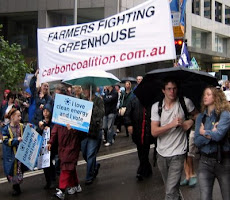
Carbon Farmers of Australia “Adopta Farmer Fighting Greenhouse”
Farm Gate Market
Voluntary
Retail/Consumer
CCX model
Fixed Price
“Sponsorship”
“Provisional” Offsets

Participants’ Consultation
Feedback on Trading Issues
Carbon Coalition strategies and activities
Other Issues

Sunday, January 24, 2010

Hocus Pocus - Decoding Scientific Reports

Scientists – when writing reports for non-scientists – are allowed to use some big words to sparkle-arkle the presentation. But some go further in their desire to convince the world that trading soil C is the AntiChrist. Was there ever a day when ‘scientist’ meant ‘truth’ and ‘objective’? Sadly the following – taken from a paper on grasslands management in Australia, submitted to an international workshop – proves that science has come a long way from that hazy ideal.

“While there is doubtless substantial technical potential to increase C-storage in grazed Australian ecosystems above- and below-ground, (WHILE WE CAN DRAW DOWN MILLIONS OF TONNES OF CO2 BY MANAGING GRASSLANDS, WE CAN’T DO IT FOR ALL THESE IMPORTANT-SOUNDING REASONS – PRODUCE DOVE OUT OF HANDKERCHIEF) an adequate information base for accurately quantifying that expected potential for any specific changed management regime does not exist.” (SLEIGHT OF HAND: ASSUME MODELS ARE THE ONLY SOLUTION) It is not yet clear that reduced animal production is always necessarily a concomitant to achieving increased soil C stocks, although that seems logical for most situations. (THREE CARD TRICK: LOGICAL ONLY TO A NON-FARMER – DOES ‘SEEMS LOGICAL’ QUALIFY AS A SCIENTIFIC OBSERVATION?) This poor state of the information-base will be inhibitory to the uptake of any market-based C-trading or GHG-trading system for grazing land based approaches. (SMOKE & MIRRORS: A SCIENTIST IS AN EXPERT ON EVERYTHING, INCLUDING MARKET ECONOMICS) There are numerous complicating factors that will need to be addressed and dealt with explicitly in any market-based GHG trading scheme that involves C-sequestration into grazed ecosystems. (THESE COMPLICATING FACTORS ARE ALL MAGICIANS’ TRICKS) These include, linked emission and/or uptake of methane and nitrous oxide associated with management changes for achieving changed C-sequestration, (OBVIOUSLY NOT) the impact on C-stocks of wildfire frequency and intensity, (ILLOGICAL KYOTO NONSENSE) compensatory non-domesticated animal grazing, (WE’LL HAVE TO SHOOT THE KANGAROOS) and large scale movement of high-C surface topsoil by flood and wind, (NO MENTION OF INCREASED GROUND COVER?) difficulties of defining baseline C-stocks and baseline GHG fluxes from each patch of land under consideration especially when the requisite baseline is in the past, (GIBBERISH) long time-frames (several decades) required and high expense for measuring change in C-stocks in each patch of land under a scheme, (THE OLD COST OF HUMUS TRICK) the high actual input-value or opportunity-value of the mineral elements associated with increased organic C stocks (ARE THERE NO FREE LIVING N –FIXING BACTERIA), the special status of any lands that have already been defined as “Kyoto Lands” by coming under Kyoto Protocol arrangements (SAW THE GIRL IN HALF), and the interaction of C-sequestration with other environmental externalities that are coming under different management policy arrangements such as interactions with hydrological and biodiversity policies (FALSE ASSUMPTION – ESCAPE HATCH) The existence of the above and other real-life complexities will render market-based C-trading schemes involving pastures, exposed to the risks of complicated, ill-conceived, ill-understood, poorly regulated financial instruments and arrangements that are replete with opportunity for fraudulent scams and inappropriate diversion of community wealth to the personal fortunes of scheme managers and traders, while not delivering the scheme objectives, reminiscent of those involved in the Global Financial Crisis of 2007-2009. (DISAPPEAR IN PUFF OF SMOKE).

Science or Politics: CSIRO compromised

There are two types of soil scientist: those who can grasp the urgent necessity of deploying soil carbon-increasing strategies and those who do not. Among the latter, I an told, there are climate change denialists and haters of market mechanisms.
It is easy to spot an anti-soil C trading scientist. They harp on about complexity, find lots of it, and make no attempt to simplify. They are so transparently fixed. Even their language in scientific papers is political. Here is an extreme example from a 2009 CSIRO paper:

“The existence of the above and other real-life complexities will render market-based C-trading schemes involving pastures, exposed to the risks of complicated, ill-conceived, ill-understood, poorly regulated financial instruments and arrangements that are replete with opportunity for fraudulent scams and inappropriate diversion of community wealth to the personal fortunes of scheme managers and traders, while not delivering the scheme objectives, reminiscent of those involved in the Global Financial Crisis of 2007-2009.”

As someone dedicated to seeing the market open as soon as possible, I find this language objectionable and wholly inappropriate coming from an institution that parades its “brand” as being based on the highest standards of science. Individually, its scientists might be denialists or paranoid about trade or afraid of losing control of farmers. But science is science, or it used to be. Has the scientific community got an opinion on this type of derogatory, defamatory language in scientific reports?

Friday, January 15, 2010

Why are the Climate Rednecks Revolting (and What Can Be Done)?

The Rebellion against Action on Climate Change is in full swing. The extreme right of politics is providing the firepower and media management skills in an attempt to rewind the plan shared by member countries of the United Nations to reduce emissions of Greenhouse Gases and shift to non-polluting energy platforms.
The Rebellion exploits the major weakness in its UN’s defences: Climate Change is a complex issue that few people understand. Inside this void a potent mixture of junk science, sloganeering and smear have been woven into conspiracy theories that play to the fears of the unsophisticated voter.
So far the Rebels have used politicised ‘scientists’ as an alternative authority to gain traction in the debate. Official science failed to respond to the challenge, simply dismissing the Denialists’ scientists’ output as “rubbish” which can’t be found in peer-reviewed journals. Common-sense folk have no idea what this means. The arrogance of the dismissal made common folk less-than-eager to find out.

IDEOLOGICAL ROOTS OF REBELLION
The mindset of the Rebels is a potent mix of the political, economic, religious and psychological.

From the longest view, The Rebellion is the next chapter in the battle for control of environmental policy. Rebels see Climate Change as a giant hoax – a Trojan Horse to give the Environmentalists control of public policy and put an end to the fossil fuel industry. The world’s largest fossil fuel company – Exxon Mobil – has bankrolled the Rebellion, and admits it. Some rebels see an even more sinister plot aimed at de-industrialising the West, sending mankind back to the Middle Ages.
The cause of this calamity will be the destruction of the economy when the cost of environmental damage is factored in to the price of goods and services. The economic irrationalists who believe this make no allowance for new technologies and new economic models which will emerge when the price on carbon unlocks the entrepreneurial spirit that drives innovation. They entertain no optimism, see only downside.

ECONOMIC ROOTS OF REBELLION
Economic Man’s motivation for joining the Rebellion can be explained by a theory called “The Circulation of Elites”. Described by Italian economist Vilfredo Pareto in the 19th century, the theory holds that the emergence of new industries and new economic models cause old money to lose top position to new money. Climate Change threatens the privileged existence of old technology leaders like Exxon-Mobil executives. Scratch any Rebel leader and you'll find a link to mining and fossil fuels.
Elites, however, can decide how they react to new economic structures. For example, BP (formerly British Petroleum) became Beyond Petroleum when the company took the new model head on to become a major manufacturer of solar panels. Peak oil put a cap on BP’s future anyway, while the coalminers report that they have 250 years of supply left to mine. “The cheapest form of energy”, coal will remain so unless a price is put on Carbon. Such a price is necessary to cover the cost of the damage* done by the pollutant*. Here, then, is the raw economic threat: the price of coal will rise dramatically should a new economic order based on the words asterixed above comes into existence. The fossil fuel industry has been free-riding on the taxpayer for the real cost of their operations, and they don't want to lose their unofficial subsidy, say environmentalists..

RELIGIOUS ROOTS OF REBELLION
The Third Element in the mix of forces driving the Rebellion is religion. Many extreme-right ideologues are fundamentalist in religion as well as politics. Many fundamentalists believe that God has sent Global Warming as part of the “End Times” spoken of in the Book of the Apocalypse. To resist it by taking action against Climate Change is to resist the will of God. A major influence in the USA, Australia also has many fundamentalists in politics.

CLIMATE CHANGE PSYCHOSIS
There is also a deep psychological foundation for the Rebellion. The language of the footsoldiers and commanders of the Rebellion is aggressive, dismissive and lampooning. Such behaviour indicates fear and anxiety and this can explain the Rebellion’s psychological dynamic. Despair is very common among country people, and denial is just that – denial, a standard means of coping with the overwhelming sense of powerlessness that Climate Change can induce. Farmers live everyday with the evidence of deteriorating climate conditions, yet they are the most likely to agree with Denialists. In Australia the Government and Opposition agreed on a package of Climate Change arrangements that is the most generous of any nation in the world. Yet the farm lobby says it is not enough. There are many who have not heard of the package. Denial means shutting information out and admitting only information that bolsters the Denial.
The Denialists live in hope that Climate Change is a hoax. It is their only chance. More than 2000 conventional scientists have had their integrity questioned and are accused of conspiring with the diplomates of the Intergovernmental Panel On Climate Change to ‘cook the books’. Their alleged motivation: jobs (for the scientists) and trips abroad and cocktail parties (for the diplomats). Those who oppose Denialism dismiss such charges as ‘rubbish’. But – as an ‘end of the world’ scenario hangs heavy in the air whenever Climate Change is mentioned – people who are prone to distrust institutions are also prone to find a cushion for their pain in the simplistic solutions of populist leaders.

MONOCULTURES LACK RESILIENCE
This confluence of political, economic, religious and psychological forces makes the task of winning the war for ‘the truth’ so much harder. The Rebellion has a unity about it. It is so much easier to be unified against something than for something which you must define. But this negative unity can be at once a strength and a weakness. It is a monoculture. A single contagious idea could wreck its unity and deflect its impulsion. The idea must be potent enough to break through the ideological screen and cause the Rebel footsoldiers to doubt.
The response to date to predictions of doom from establishment scientists proves that this appoach makes no impression. Images of IPCC scientists wringing their hands in the media contribute to the ‘alarmist’ tag the Rebels have so easily attached to them. The strategy for creating doubt in the minds of the Rebellion Footsoldiers must not enable their leadership to rebadge it as ‘alarmist’ propaganda. What makes a contention ‘alarmist’? When he hearer believes that here is nothing to be alarmed about.

WEDGING REBELS AND THEIR LEADERS
The concept of “Food Security” has most potential to wedge the Denialists and their followers. In recent years the world’s security forces have been preparing plans for the outbreak of conflicts and wars as “Climate Refugees” in prodigious numbers invade other countries in search of food and water. Several ‘hot spots’ have been identified and one of them is Australia. The Australian Defence Forces, the Australian Federal Police and several strategic military panels in the USA have pointed to the likelihood of flooding and crop failures causing famine and civil unrest in Indonesia and Southern China. A report to the Pentagon in 2003 predicted 40 million climate refugees could be on the move in our neighbourhood within 40 years if Climate Change is allowed to proceed unchecked. Australians are spooked by 78 Sri Lankans in a leaky boat arriving off the northern coastline. How would they react to credible reports that, if Climate Change is not tamed, Townsville will in all likelihood be an Asian city of 5 million by the time their grandchildren are their age.
To dissociate the message from the Climate Change establishment – which has no credibility with the Rebels - the message could be delivered by the Chief of the Defence Force, the Chief Commissioner of the Australian Federal Police could be asked to present their reports at a joint press conference, for maximum impact. At the same conference, the report by the US Armed Forces Panels could be referenced.
The wave of anxiety among those groups traditionally sensitive to these threats could cause them to question the Abbot/Joyce doctrine. They should be forced to ask themselves “What if Tony/Barnaby is wrong?"

POSTSCRIPT: THE LAND ETHIC

The father of the American conservation movement, Aldo Leopold, observed that the abolition of slavery was the “First Great Moral Advance for Humanity.” This advance took place when Western Society recognised that one human being cannot own another human being. They are members of the same community – the family of man –with rights and obligations.
The next great leap forward rests on the belief that man is not only a member of the human community, he is also a member of the broader community of living creatures – the Ecological Community. Each animal, plant, and microbe has a role to play in maintaining a liveable biosphere and each deserves protection and respect.
Aldo Leopold called it the “Land Ethic”. He wrote: “All ethics so far evolved rest on a single premise: that the individual is a member of a community of interdependent parts. His instincts prompt him to compete for his place in that community, but his ethics also prompt him to co-operate… The land ethic simply enlarges the boundaries of the community to include soils, waters, plants and animals or collectively, the land.”
This is the ultimate challenge for Humanity. Do we have the courage and confidence to accept a new discipline, the loss of a freedom enjoyed since the human race emerged a the top of the food chain and set out to ‘subdue the earth’ and lay waste to it with no thought for the future. God’s instructions were, according to King James version of the Bible, “replenish the Earth and subdue it”.

Wednesday, January 13, 2010

Carbon Farming "All Hype and Humbug," says Nuffield scholar.

"PUSHBACK" on Nuffield Scholarship?

"IT'S all hype and humbug" is David Drage's thoughts on carbon trading's potential for agriculture, after his three-month world study tour on the subject.' The Weekly Times reported. The Victorian mixed farmer visited the UK, Canada, New Zealand and the US last year on a Nuffield scholarship and brought home the following conclusions
• The capacity of Australian agriculture to help cut global emissions was insignificant. (This statement ignores the Federal Opposition’s claim that soil and vegetation can remove 150million tonne of CO2 from the atmosphere every year by 2020. Some scientists have put it as high as 1000 million tonnes, with the Queensland, Victoria and New South Wales Governments putting out similar reports. While our emissions may be negligible on a global scale, the landmass we have devoted to agriculture – hundreds of millions of hectares - makes us a major player in the global effort to ‘draw down’ CO2 via photosynthesis.)
• David warned farmers who locked themselves into carbon contracts could find themselves forced to repay their contracts. (If carbon markets worked that way, no farmer would get involved. The individual farmer is protected by the “Buffer Pool” or self-insurance system that operates. No farmer is left alone to sell direct. They can’t supply the 25,000 tonnes minimum trading unit. So they combine in pools of millions of units. Most systems put aside some tonnes for protection. The Chicago Climate Exchange requires that each farmer put aside 20% of what they deliver as a hedge. The Carbon Farmers of Australia system requires that for every 1 tonne traded that the grower put aside an additional tonne to cover the potential loss. These tonnes are spread across millions of units in the full range of climate zones and geographic regions. They are there to replace units lost for any reason. The President of the International Federation of Agricultural Producers (6 million members world wide) says buyers can rely upon the “Collective Persistence” of the pool that gives protection to the buyer and the grower.)
•"Many international investors I spoke to had no faith in the permanence of agricultural carbon sequestration," he said. (The issue of permanence is also resolved by this pool concept. It's not hard to find people who will bad mouth soil carbon anywhere in the world.)
• "And the science of measuring products like soil carbon is not sufficiently advanced to give them the confidence to invest." (Scientists have been measuring soil carbon for the purposes of scientific study for decades. Who is suggesting that the measurement of soil carbon for trade needs to be more accurate than measurement for science? Only someone with a vested interest in keeping soil carbon off the market or in being paid to chase the min-min light of accuracy beyond the needs of science. There are many such people. "Confidence to invest" is the right issue. Markets have a method of handling uncertainties in quantity or quality. It’s called “The Price Mechanism”. We have seen it working at the Chicago Climate Exchange where the low levels of measurement rigor has kept the price very low. This in turn encouraged the CCX to lift the bar in order to attract more farmers because the price was discouraging them.)
• "Australian agriculture can't offer much to the international efforts to reduce emissions, because we are already a highly efficient industry. (We may be an efficient industry from a cost management viewpoint, but we are not efficient when it comes to Greenhouse Gas Emissions. Opportunities to reduce emissions are everywhere: manure management and methane flaring, precision application of fertilizer, no-till cultivation, covering bare earth, feed supplements for cattle and sheep, biological soil treatments, grazing management, pasture cropping, cover cropping, and many more. Australian farmers have been offered the best emissions deal available to farmers anywhere in the world: Not taxes to cover methane and nitrogen emissions, but incentives to change the way we manage these gases. And we are free to trade our soil carbon.
If you believe that “it’s all hype” there is one fact that you should bear in mind: No one is forcing you to be involved. No farmer will be forced to trade their soil carbon. Or reduce their methane and nitrogen gas emissions.)

Friday, January 08, 2010

Why we support Prime Carbon

Sir Nicholas Stern estimated the cost of putting off effective action against Climate Change in the hundred of billions of dollars per year. The cost of the ACCC action against Prime Carbon is very high. While there are several excellent systems in development,the Prime Carbon operation is closest to launch. It's commencement was expected to be followed quickly by several others. The legal action could be seen as a major blow against the SOIL CARBON MOVEMENT - the only effective short term solution to Climate Change. We see it as part of the "PUSHBACK" campaign by anti-soil carbon elements that have conducted an ongoing campaign against us for the four years we have been campaigning. The ACCC claims that they have a complaint but won't tell us who it is. The language complained about was in a very early version of the literature. The whole scenario seems contrived. And the timing - with the program so close to launch - is very coincidental.

We stand by Ken Bellamy and his integrity is not diminished in any way by this action. Rather it is the ACCC's judgement which has been questioned of late.

Just as Peter Spencer is seeking by his hunger strike to draw attention to the robbing of rights under English Common Law, the ACCC's presumption of guilt and name/shame method of operating effectively robs us of the right called the presumption of innocence.

The Carbon Coalition stands by Prime Carbon and Ken Bellamy because of the importance of his work for the protection of the planet's inhabitants from deep, destructive Climate Change. Australia leads the world in "Carbon farming". The eyes of the world are on us at this moment. Which does the consumer need protection from most: marketing claims or cataclysmic climate disruption?

MEDIA RELEASE: ACCC action threatens urgent Climate Change solution

The ACCC is damaging Australia’s Climate Change response, according to the Carbon Coalition Against Global Warming – the soil carbon advocacy group.

The ACCC is putting at risk the launch of a system that could protect the world from the worst effects of Climate Change. The regulator is taking court action against an Australian soil carbon pioneer whose system could buy the time we need to make the change to renewable energy sources.

Prime Carbon’s Ken Bellamy is within 3 months of launching a trading system which – worldwide – has the potential to neutralize emissions by 50ppm by turning the vast stretches of farmland and other lands (such as schools and parks) into a carbon sink. Leading Australian scientists recently declared that we have left it too late to avoid a 2°C increase in average temperature, and that only by a system like Mr Bellamy’s will we gain the time we need to bring renewable energy to baseload capacity.* The world’s most respected soil carbon expert Professor Rattan Lal believes the world’s farmers can ‘draw down’ the equivalent of 50ppm (parts per million) CO2.** Prime Carbon’s system uses photosynthesis as the way to absorb CO2 and store it in soil.

The Government needs innovators like Ken Bellamy to develop trading systems that accord with the National Carbon Offset Standard, recently released by the Department of Climate Change & Water and give us Australian options for reliable offsets.

“Ken Bellamy has spent hundreds of thousands of dollars on technical development and due diligence on his system. He has also spent a small fortune on research for soil improvement which recently attracted a scientific peer review of his breakthrough paper on in-soil photosynthesis. Mr Bellamy also had a private meeting with the Prime Minister on the subject last month. These are not the actions of a fly-by-night operator,” says Mr Kiely. “He has engaged the local community in his system, building ‘business clusters’ to use local municipal wastes to make composts for enriching soils on local farms and from that to generate carbon credits to be shared between the farmers and urban communities.”

Prime Carbon is charged with making inappropriate references to other emerging industry organizations in its early marketing materials. Significantly, the charges do not refer to any of the core processes or to any current actions of Prime Carbon.

“Ken Bellamy has been completely transparent in this process, taking his solutions to the community, the ACCC and the Department of Climate Change for consultation and guidance,” says Michael Kiely. “The Carbon Coalition stands by Prime Carbon because it has taken the industry further and faster than anything else and we need the systems urgently.”

“The ACCC could do something truly heroic and invest some time studying soil carbon solution and the extraordinary opportunity it offers and balance that against the relative seriousness of the allegations and the damage already done to Prime Carbon by this unfortunate legal action.”


FOOTNOTES:
*“The science now tells us that it will be next to impossible for nations to achieve the scale of reductions required in sufficient time to avoid dangerous climate change unless we also remove carbon from the atmosphere and store it in vegetation and soils…The power of terrestrial carbon to contribute to the climate change solution is profound.”

- “Optimising Carbon in the Australian Landscape” - Wentworth Group of Concerned Scientists, October 2009

**‘The technical potential of carbon sequestration in world soils may be 2 billion to 3 billion mt per year for the next 50 years. Thus, the potential of carbon sequestration in soils and vegetation together is equivalent to a draw-down of about 50 parts per million of atmospheric CO2 by 2100.’

- Rattan Lal (lal.1@osu.edu) is Director of the Ohio State University’s Carbon Management and Sequestration Center and Professor of Soil Science in the School of Environment and Natural Resources.

ACCC institutes proceedings against Prime Carbon Pty Ltd

The Australian Competition and Consumer Commission has commenced legal proceedings in the Federal Court against Prime Carbon Pty Ltd.
Prime Carbon sells a 'soil carbon and sequestration program' to farmers which aims to sequester carbon from the atmosphere and store it in agricultural land. In signing farmers up to this program, Prime Carbon provides the following services:
1. design and facilitate carbon sequestration and other greenhouse gas abatement and offsetting projects for customers,
2. assist in the creation and management of specific amounts of carbon dioxide sequestered or abated from the environment (carbon credits), and
3. assist in the registration and marketing of those carbon credits.
The ACCC is alleging that Prime Carbon made false or misleading representations about the National Environment Registry (NER) and the National Stock Exchange of Australia Limited (NSX). Specifically, the ACCC alleges that Prime Carbon made representations to the effect that:
• the NER registry is the sole registry that meets the standards required of carbon credit registries by the Australian Government and the carbon credits listed on the registry, were specifically supervised or regulated by the Australian Government,
• the NER registry was the place where domestic and international buyers go to source carbon credits,
• the NER had a relationship with the Chicago Environment Registry which would assist NER-listed Australian carbon credits being traded on the international market,
• it was a broker and aggregator with the NSX, and
• enquiries about the purchase of carbon credits aggregated by Prime Carbon have been or are likely to be generated by or through the NSX,
when this was not the case.
The ACCC also alleges that Prime Carbon's sole director, Mr Ken Bellamy, was knowingly concerned in or a party to, some of Prime Carbon's contravening conduct.
The ACCC is seeking declarations, injunctions, corrective orders, trade practices compliance orders, findings of fact and costs.
A directions hearing has been set down for 23 February 2010 in the Federal Court, Brisbane, before Justice Spender.
Release # NR 001/10
Issued: 5th January 2010

Friday, January 01, 2010

Kyoto has failed - Meet "Pledge & Review"

By the ruthless demonstration of its ability to disrupt the Copenhagen Conference and its refusal to be part of an international system of audited emissions reductions to any time, China may have put the stake into Kyoto. This is how the Sierra Club reported it:
"Pledge and review... repeals any notion of a legally binding deal, allowing countries to instead pledge the level of ambition they deem fit – rather than that determined by climate science... It also breaches the Bali "firewall" – the differentiation between industrialized and developing countries that exempts the developing world from binding emissions reductions targets. Differentiation was agreed to... under the tenet of common but differentiated responsibility... The U.S. and Australia are pushing this system to address the problem of differentiation of advanced developing countries like China and India to ensure an international agreement that can be ratified by the Senate."

Weaknesses of the Kyoto Protocol

"The Kyoto Protocol embodies several concepts of distributional equity, but it boils down to this: the rich and responsible are expected to lead. In other words, it calls for action by those with higher per capita emissions and higher per capita contributions to the build up of anthropogenic greenhouse gases in the atmosphere, and it also targets those with a much greater ability to pay for emissions mitigation," said Joseph E. Aldy and Robert N. Stavins in their paper Climate Policy Architectures for the Post-Kyoto World. 'The downfall of this approach is that it has contributed to the Kyoto Protocol’s primary weakness: the agreement has failed to promote more substantial participation among the world’s largest emitters. Three of the five largest do not face binding emissions constraints, despite the fact that they have ratified the Kyoto Protocol: China and India do not have quantitative emissions targets, and Russia’s Kyoto commitment is so lax that it likely will not necessitate any abatement for Russian compliance. In addition, the largest greenhouse gas contributor, the United States, has not ratified the agreement. These four countries represented half of global CO2 emissions in 2004, and their share is expected to grow without efforts to limit their emissions."


Why Threats to the Kyoto Protocol Endangers Copenhagen & Our Climate
Posted by: Guay on November 4, 2009 at 11:59AM PST
By Justin Guay, apprentice for the Sierra Club Global Warming and Energy Team
http://connect.sierraclub.org/post/ClimateCrossroadsBlog/killing_me_softly_why_threats_to_the_kyoto_protocol_endange.html

Thursday, December 31, 2009

IT WAS THE YEAR OF SOIL CARBON

What A Year! It was the Year of Soil Carbon. The Gods played Spin The Bottle with our fates. Some great things happened. We started the year facing this situation: the Government was intending to give farmers a BILL for Methane, a BILL for N2O, and no way to OFFSET THESE BILLS with Soil C. At the end of the year we have all sides of politics (except the Nationals) support a “Special Status Arrangement” for Agriculture tht recognizes its unique capacity to be both a sink and a source of carbon emissions and its starring role in the twin global challenges of Climate Change and Food Security. The new arrangement is the complete reverse of the first draft: NO BILL for methane (incentives instead), NO BILL for N2O (incentives instead), and soil C OFFSETS to trade. What a Trifecta.

The Year started amid the atmosphere of the FAO’s slow, deliberate campaign to build a coalition around soil sequestration for food security that was supposed to crescendo at Copenhagen, and did - with 4 separate side events for land use and land use change. But the Chinese and Indians came looking for a fight – and the rest is history. The Kyoto Protocols might be dust-binned, replaced by a “Pledge & Review” system – it won’t matter. The Soil Carbon Solution will happen.

MODELS NEED REMODELLING
Here at home the year commenced with an historic announcement by Dr Peter Fisher that the soil carbon models would need to be recalibrated – Roth C could not digest the soil C results he was encountering. This confirmed Christine Jones’s findings – and was historic for that reason alone.

MALCOLM FOUGHT TO THE DEATH

The next blessing appeared in the shape of Malcolm Turnbull who discovered Green Carbon, thanks again to Christine’s efforts in Parliament House. We eyeballed Greg Hunt to see how deeply he had ‘got religion’ and he passed muster. Greg’s role is acknowledged in an earlier post. It shouldn’t be forgotten that Malcolm fought to the death for a farmer-friendly ETS that Ian MacFarlane managed to charm out of Penny Wong.

WHO ‘GOT IT’ IN 2009?

A lot of important people ‘got it’ in 2009: Tim Flannery finally ‘got it’ and said so in his book Now Or Never. The Wentworth Group of Concerned Scientists “came out” for the Soil Carbon Solution. (Are there any ‘unconcerned scientists’?) Al Gore finally got it. Paul Gilding, ex-Executive Director of Greenpeace International gets it. The EU gets it. The World Bank gets it. The Ministry for Agriculture gets it. Minister Tony Burke gets it. Former Governor General Major General Michael Jeffrey got it and picked up the ball and is running with it, as Chairman of Outcomes Australia. Sadly the Soil Carbon Mythbusters don’t get it. Even sadder, the Climate Institute doesn’t get it, by their recent comments on farmers ‘pulling their weight’.

HOW BAD DOES IT HAVE TO GET?

What’s to be got? This: If the immediate climate disasters are caused by the historic load of CO2 and farmers have the only means of extracting it from the atmosphere at the volumes required, in the time necessary, it becomes a matter of negotiation, not command from on high about moral obligations. Farmers won’t take any old deal. Not too many people ‘get’ this. The question is: how bad does Climate Change have to get before decision-makers are so desperate that they will call on the farmers of the world to commence carbon farming in earnest? Shift their mindset from "The Mitigation Solution Must Fit The Accounting System" to "The Accounting System Must Serve The Mitigation Solution".

COLLABORATIVE SCIENCE IS “GO”

Hurrah for Tony Burke. He listened to our petition on collaborative science. Congratulations to all those who ‘signed’ our petition. See how powerful you are! While governments wait the obligatory 3 to 5 years for science to confirm the unconfirmable – ie. take all the risk out of decisions – the climate deteriorates at an accelerating pace and the cost of each year lost is $500billion, according to Sir Nicholas Stern. Someone soon must stand up and say: “Stuff it! Let’s just do it.” The Government has done this by introducing “Collaborative” Science in its latest round of research funding. Teaming scientists with farmers, food processors, and policy professionals, the Government hopes to ‘achieve outcomes that make a difference’ and that ‘commercial realities are taken into account’ to see the outcomes are likely to be adopted by farmers.

ASTONISHING

Finally the moment of the year for mine was hearing a scientist remark, just as the conference rose for lunch after hearing Ken Bellamy present his paper on in soil photosynthesis and the role of autotrophs and phototrophs, “Astonishing. That was amazing.”

THANK YOU

To everyone who did the smallest thing and those who moved the Heavens for the cause, you know who you are – and so does Mother Nature. In 2006, DR Lal described the Coalition’s Mission as “your noble cause”. And we now know that it is the people who support the cause that make it ‘noble’ by being there.