"Pastures can support rich growth of carbon credits," says the headline on the University of New England "NEWS" site (http://www.une.edu.au/news/archives/000710.html)
Then came the welcome news: "University of New England researchers have backed calls from the NSW Farmers Association for the introduction of a carbon credit trading scheme." The scientist 'outing' himself in this instance is Dr Wal Whalley, an Honorary Fellow in Botany at UNE. But even this was going a bit too far, and he qualified it with the old scientists' chestnut: "... scientific and economic know-how is not quite ready for the widespread use of such a scheme." Won't he get a surprise when we start trading next week without all that scientific palaver?
He says: "more work is needed on the details of measuring and trading these offsets to carbon emissions for the benefit of farmers." This in effect means nothing will ever happen. Why?
Because the more they learn about soil carbon the harder it becomes to pin it down scientifically. (The latest news from the laboratory comes to us via a senior soil scientist in the DNR who played a key role in the AGO work.) We know it's there. We just can't say how much right at this moment. It's a question of flux. Soil C is mercurial. It dances in and out. But we know there's lots there. And we also know a lot of other things about it, such as what the ground cover looks like, what the soil smells like, how it reacts to large downfalls of rain, and to no rain, what the bug life is like in the first 10 cms, what the general biodiversity situaiton is like, etc.
The Carbon Coalition says hair-splitting scientific accuracy is not required. What we need is a simple basis for trade - an agreement between two people as to what something is worth.
"It amazes me that we are still at this kindergarten stage with the science. Trying to find more accurate ways to measure is not the path to success," says Michael Kiely, Convenor of the Coalition. "The answer lies in estimates and indicators and averaging such as is done with everything else. Read the AGO's technical reports upon which all generalisations about Australian soils are based. They are full of surmises and estimations to bridge knowledge gaps."
Dr. Whalley was made a Member of the Order of Australia (AM) on Australia Day this year for his work on native grasses and grassland ecology. He says it is a "myth" that carbon credit trading schemes merely involve the "locking up" of forests. "Grasslands – and using grasslands for grazing – can provide more effective soil carbon storage than trees, as grasses have small, fibrous roots and quickly put carbon back into the soil," he said. "Through modern methods of grazing management and/or pasture cropping you can quickly increase the amount of organic matter in the soil. This is good for the grazing animals, the pasture and the soil."
"If the carbon credit trading scheme devised is simply with trees," he explained, "the science is easier because the estimation of the amount of carbon tied up in forests per year is relatively easy and commonly accepted. We don't know much about the measurement and forms of carbon increases in soils and grasslands, but our vast pastures and grasslands can probably lock up much more carbon than all our forests or plantations."
"Without standardised measurements of carbon increases, a widespread carbon credit trading scheme cannot exist, as there wouldn't be a fair way to work out the compensation amount*. I hope that research will yield results within the next few years." Can the world wait that long? Stern says we have 9 years, and many others agree with him. The polar bears. Keep your mind on the job. Their Arctic home is melting at 3 times the rate the experts thought. A lot of people care about polar bears.
In the same report we have news of further delaying tactics. One of Wal's colleagues "said that the other area in need of considerable research was an understanding of the nature of offsets, the potential products, and how to value and trade them across markets." When you see the words "considerable research' read "lots of time and money". Gentlemen, the enemy is at the city walls.
Markets do not need research studies or governments to tell them how to form. Free enterprise is just that. Two parties doing a deal. All that is needed is sufficient information to satisfy the buyer. Capitalism. Transactions based on perceived value.
"There is not a clear understanding as to exactly how these contracts would be entered into." Piffle. The market for the commodity already exists. This product would sit alongside them. And they would find their place by trial and error. There is scope for 'gourmet' bundles for the voluntary market. There is a world wide shortage of tradable carbon. Everyone in the business knows that. You have to get down off your camel to find these things out, though.
Well done, Wal. You supported us during the dark days. Now get down off that camel and help us make a market.
FOOTNOTE; *For those of you actively applying your minds to this conundrum, there is a line of enquiry you can follow that has yet to be exhausted. For what purpose do people buy carbon credits? There are many uses. But one of them is not to speculate in their value increasing, as you would with shares. (Who decides the value of shares and how?) In many cases it is to offset emissions which themselves are a vague estimation. EG> The methodology (widely used) put forward by the World Resources Institute enables the auditor to estimate the annual power usage of an office-based business by a formula based on floorspace. I don't get it. We've got to be 150% accurate with soil carbon but not with that end of the transaction process that decides how much soil carbon you need to buy to do the job. I don't get it. When I hear that a major energy company applies a margin of error to its estimates of fugitive emissions (go and look it up) of between -50% and +100% in order to operate in the real world, I can't help thinking there is a conspiracy against soil carbon. First among the soil carbon sceptics (we will never let them forget it) and then among the believers who cursed us with best wishes in the search for an accurate solution. But back to the speculation about motivation for buying carbon credits. Polar bears is one reason.
PS> UNE PRO Jim Scanlon wrote the original report that I have liberally plundered for this post. Thanks Jim.
Sunday, March 04, 2007


Thursday, February 22, 2007
Tim Flannery supports soil carbon credits
ABC TV LANDLINE
Interview with Professor Tim Flannery
Reporter: Sally Sara
First Published: 11/02/2007
SALLY SARA: we've had a lot of talk in the past week about carbon trading, what sort of opportunities do you see there for farmers in Australia?
PROFESSOR TIM FLANNERY: Carbon trading represents one of the great opportunities for farmers in Australia. But what we really need in order to maximise that opportunity is some good government policy. We also need a proper accounting system for carbon. One of the great opportunities in Australia is sequestering or storing carbon in the soil, and unfortunately that carbon is not so readily visible and measurable. It would be a great help if the Federal Government put some effort into trying to develop a proper accountable scheme for measuring that carbon so we could take an opportunity for trade, because without that accountability no-one's going to pay to have their carbon sequestered.
SALLY SARA: Using the bush for carbon credits, does that mean locking up land? Some people fear that’s what it will mean.
PROFESSOR TIM FLANNERY: Not at all. What it means is a creation of a carbon bank on your farm, and that carbon bank may be in the soil. You may decide to sequester it through better management practice that enhances the fertility of your soil and the carbon that is locked up within it. You may decide to grow perennial vegetation rather than annual grasses that again sequester carbon in the longer term. But as the land owner you're in charge of that carbon bank and if you decide you want to fell some trees and sell the timber, that's fine you can do that but there will be less money in your carbon bank.
SALLY SARA: How do you go about storing the carbon underground?
PROFESSOR TIM FLANNERY: There's a number of ways that this can be done but essentially it's all to do with good management of your soil. If you're practising zero till or something like that where you're not disturbing the soil and now allowing any oxygen in get in to release the carbon, you’re storing carbon in the soil. Having deep-rooted plants helps restore carbon in the soil. If you're dealing with a forested situation, the leaf fall and then rots away again stores carbon in the soil. There is a number of ways of doing this, but the big problem is quantifying that. If I'm someone who wants to sequester my carbon in your soil, I want to know how much is being sequestered per hectare before I pay, and we need some basic research work done around that to enable us to quantify that and to make the whole system fully accountable, and that really is a role for Government.
SALLY SARA: Could that be a serious mainstream industry or part of industry?
PROFESSOR TIM FLANNERY: I think it will be a major industry world wide in future and whoever has access to broad acres will be very advantaged in that. The broad figures are that we can store enough carbon in the living biosphere, particularly in the tropics of our planet, to offset all of the carbon emissions since the beginning of the industrial revolution. So that's a significant opportunity. It's very clear that we already have too much carbon in the air for climate stability, so I think in the future people will be looking increasingly to carbon storage in the biosphere and in our soils in order to deal with this emerging problem.
SALLY SARA: Professor Tim Flannery and Australian of the Year, thank you very much for joining us on Landline.
PROFESSOR TIM FLANNERY: Thank you.
Interview with Professor Tim Flannery
Reporter: Sally Sara
First Published: 11/02/2007
SALLY SARA: we've had a lot of talk in the past week about carbon trading, what sort of opportunities do you see there for farmers in Australia?
PROFESSOR TIM FLANNERY: Carbon trading represents one of the great opportunities for farmers in Australia. But what we really need in order to maximise that opportunity is some good government policy. We also need a proper accounting system for carbon. One of the great opportunities in Australia is sequestering or storing carbon in the soil, and unfortunately that carbon is not so readily visible and measurable. It would be a great help if the Federal Government put some effort into trying to develop a proper accountable scheme for measuring that carbon so we could take an opportunity for trade, because without that accountability no-one's going to pay to have their carbon sequestered.
SALLY SARA: Using the bush for carbon credits, does that mean locking up land? Some people fear that’s what it will mean.
PROFESSOR TIM FLANNERY: Not at all. What it means is a creation of a carbon bank on your farm, and that carbon bank may be in the soil. You may decide to sequester it through better management practice that enhances the fertility of your soil and the carbon that is locked up within it. You may decide to grow perennial vegetation rather than annual grasses that again sequester carbon in the longer term. But as the land owner you're in charge of that carbon bank and if you decide you want to fell some trees and sell the timber, that's fine you can do that but there will be less money in your carbon bank.
SALLY SARA: How do you go about storing the carbon underground?
PROFESSOR TIM FLANNERY: There's a number of ways that this can be done but essentially it's all to do with good management of your soil. If you're practising zero till or something like that where you're not disturbing the soil and now allowing any oxygen in get in to release the carbon, you’re storing carbon in the soil. Having deep-rooted plants helps restore carbon in the soil. If you're dealing with a forested situation, the leaf fall and then rots away again stores carbon in the soil. There is a number of ways of doing this, but the big problem is quantifying that. If I'm someone who wants to sequester my carbon in your soil, I want to know how much is being sequestered per hectare before I pay, and we need some basic research work done around that to enable us to quantify that and to make the whole system fully accountable, and that really is a role for Government.
SALLY SARA: Could that be a serious mainstream industry or part of industry?
PROFESSOR TIM FLANNERY: I think it will be a major industry world wide in future and whoever has access to broad acres will be very advantaged in that. The broad figures are that we can store enough carbon in the living biosphere, particularly in the tropics of our planet, to offset all of the carbon emissions since the beginning of the industrial revolution. So that's a significant opportunity. It's very clear that we already have too much carbon in the air for climate stability, so I think in the future people will be looking increasingly to carbon storage in the biosphere and in our soils in order to deal with this emerging problem.
SALLY SARA: Professor Tim Flannery and Australian of the Year, thank you very much for joining us on Landline.
PROFESSOR TIM FLANNERY: Thank you.
Monday, February 19, 2007
The Soil C Data Gap?
Why is the NSW DPI is conducting studies of soil carbon take up by soils under a range of pasture management practices? Why is the $246,000 project now seeking farmers who have paddocks with a known history suitable for inclusion in the study? We have a complete suite of Australian Greenhouse Office Technical Reports covering soil carbon uptake under different land management practices. Why are there several trials underway in different states, testing different combinations? The Australian Greenhouse Office is on record as saying: "Typically Australian soils have a poor capacity to store large quantities of carbon." Watch the word "typically".
NSW Farmers' ask the right question
NSW Farmers’ Association President Jock Laurie says the environment is shaping up to be the leading issue for the 2007 State Election and voters must know where the two major parties stand on carbon trading.
“The Association is calling on the Government to establish a carbon market that rewards farmers for using cropping, grazing and vegetation management practices that enhance carbon storage,” Mr Laurie said.
“Farmers can help Australia by storing carbon on their land, essentially pulling carbon from the atmosphere and storing carbon in the soil and in vegetation,” Mr Laurie said.
“Agriculture is the only sector to have made a significant contribution to reducing Australia’s greenhouse gas emissions, with more than 40% reductions from 1990 levels. We would like to see the entire community support these and further reductions,” Mr Laurie said.
“We are calling for a carbon trading scheme with rules that encourage the major greenhouse polluters to purchase carbon credits from farmers. We want to see soil carbon included as a tradable carbon store at state, national and international levels,” Mr Laurie said.
“The Association is calling on the Government to establish a carbon market that rewards farmers for using cropping, grazing and vegetation management practices that enhance carbon storage,” Mr Laurie said.
“Farmers can help Australia by storing carbon on their land, essentially pulling carbon from the atmosphere and storing carbon in the soil and in vegetation,” Mr Laurie said.
“Agriculture is the only sector to have made a significant contribution to reducing Australia’s greenhouse gas emissions, with more than 40% reductions from 1990 levels. We would like to see the entire community support these and further reductions,” Mr Laurie said.
“We are calling for a carbon trading scheme with rules that encourage the major greenhouse polluters to purchase carbon credits from farmers. We want to see soil carbon included as a tradable carbon store at state, national and international levels,” Mr Laurie said.
Sunday, February 18, 2007
"What everybody knows"
"A new idea is first condemned as ridiculous, and then dismissed as trivial until it finally becomes what everybody knows." So said William James.
Soil Carbon Credits is quickly becoming what everybody knows. The subject started as the private obsession of a few fringe lunatics, including Dr Christine Jones ("The Carbon Goddess") and John Lawrie (Soils Officer with the Central West Catchment Management Authority). They infected a small group of"carbon farmers" in the central west who launched the Carbon Coalition Against Global Warming and published The Soil Carbon Manifesto in February 2006.
The Manifesto stated:
Carbon Coalition is a group of concerned Australians who believe the globe is facing a crisis of CO2 overload leading to Global Warming and that one of the most effective strategies for locking up carbon in our atmosphere is to be found in fostering deep-rooted plant species on land used for agriculture.
We urge governments and the business community to acknowledge the role that agricultural soils can play in addressing the Global Warming crisis. Farmers can play a central role in sequestering carbon in their soils by fostering deep-rooted perennial plant species that have significant biomass in their root systems.
Soil biomass is a natural carbon sink and should be used to create carbon credits which can be traded alongside those currently traded for forests.
That was 12 months ago. Despite being ignored by the media and treated with suspicion by many - and large1y shunned by the scientific community - the cracks are appearing in the walls of Jerico:
The Cracks:
1. John Williams, Commissioner for Natural Resources in NSW, announces on ABC TV NSW Statewide (9/2/07) - see transcript on ABC site - that farmers should be paid $25/tonne for soil carbon.
2. After two separate breifing sessions with the C arbon CVoalition, 6 months apart, Jock Laurie (NSW Farmers) calls for the same thing on the same program. (These are the first public statements in support of our position.)
3. The Conservation Agriculture Association of Australia and NZ (covering all the no tillfarmers' associations) have been invited to sign an MOU with wholesaler/retailer Carbon Planet by their South Australian members.
4. The NSW CMAs plan to become soil carbon pool managers and brokers. It turns out the NSW DPI has been studying the potential since September 2006. (See point 2 under "NSW Government invests $2.5million in climate research" (21 September 2006) at http://www.dpi.nsw.gov.au/aboutus/news/recent-news/agriculture-news-releases/
5. Landcare signed a deal with Carbon Traders to broker remnant vegetation on farms, and this will naturally morph into a soil carbon relationship.
6. The Carbon Coalition was consulted by Andrew Fraser, NSW National MP, shadow minister for forests etc. re soil carbon and he indicated his party would be taking it into the election as party platform.
7. The federal government is taking the time to attack us. (Always a good sign)
8. There is a race on between up to 10 project groups trying to crack the secret to measurement/monitoring/verification of soil C for trading.
9. The NSW DPI announced a $246,000 study of the role of pastures in locking up carbon under a range of management practices in central and southern NSW.
We have come a long way in 12 months, but we still have a long way to go.
A big thank you to all those people in positions of influence who stuck their necks out for a fair go for soil carbon credits. It's too early to identify you. You know who you are.
Soil Carbon Credits is quickly becoming what everybody knows. The subject started as the private obsession of a few fringe lunatics, including Dr Christine Jones ("The Carbon Goddess") and John Lawrie (Soils Officer with the Central West Catchment Management Authority). They infected a small group of"carbon farmers" in the central west who launched the Carbon Coalition Against Global Warming and published The Soil Carbon Manifesto in February 2006.
The Manifesto stated:
Carbon Coalition is a group of concerned Australians who believe the globe is facing a crisis of CO2 overload leading to Global Warming and that one of the most effective strategies for locking up carbon in our atmosphere is to be found in fostering deep-rooted plant species on land used for agriculture.
We urge governments and the business community to acknowledge the role that agricultural soils can play in addressing the Global Warming crisis. Farmers can play a central role in sequestering carbon in their soils by fostering deep-rooted perennial plant species that have significant biomass in their root systems.
Soil biomass is a natural carbon sink and should be used to create carbon credits which can be traded alongside those currently traded for forests.
That was 12 months ago. Despite being ignored by the media and treated with suspicion by many - and large1y shunned by the scientific community - the cracks are appearing in the walls of Jerico:
The Cracks:
1. John Williams, Commissioner for Natural Resources in NSW, announces on ABC TV NSW Statewide (9/2/07) - see transcript on ABC site - that farmers should be paid $25/tonne for soil carbon.
2. After two separate breifing sessions with the C arbon CVoalition, 6 months apart, Jock Laurie (NSW Farmers) calls for the same thing on the same program. (These are the first public statements in support of our position.)
3. The Conservation Agriculture Association of Australia and NZ (covering all the no tillfarmers' associations) have been invited to sign an MOU with wholesaler/retailer Carbon Planet by their South Australian members.
4. The NSW CMAs plan to become soil carbon pool managers and brokers. It turns out the NSW DPI has been studying the potential since September 2006. (See point 2 under "NSW Government invests $2.5million in climate research" (21 September 2006) at http://www.dpi.nsw.gov.au/aboutus/news/recent-news/agriculture-news-releases/
5. Landcare signed a deal with Carbon Traders to broker remnant vegetation on farms, and this will naturally morph into a soil carbon relationship.
6. The Carbon Coalition was consulted by Andrew Fraser, NSW National MP, shadow minister for forests etc. re soil carbon and he indicated his party would be taking it into the election as party platform.
7. The federal government is taking the time to attack us. (Always a good sign)
8. There is a race on between up to 10 project groups trying to crack the secret to measurement/monitoring/verification of soil C for trading.
9. The NSW DPI announced a $246,000 study of the role of pastures in locking up carbon under a range of management practices in central and southern NSW.
We have come a long way in 12 months, but we still have a long way to go.
A big thank you to all those people in positions of influence who stuck their necks out for a fair go for soil carbon credits. It's too early to identify you. You know who you are.
Saturday, February 17, 2007
HAPPY BIRTHDAY CARBON COALITION
Carbon Coalition Against Global Warming
Activity Report
February 2006-February 2007
The following represents our attempts to put soil carbon credits on the naitonal agenda and protect the interests of farmers:
February, 2006 - Launched Carbon Coalition at Central West Conservation Farmers’ Association conference.
Established blog site carboncoalitionoz.blogspot.com – posted 127 reports in 365 days
Established web site – carboncoalition.com.au – collected 600 email contacts in 12 months
April, 2006 - Recruited Coalition Council members as advisory board: David Marsh, Rick Maurice, Col Seis, Angus Maurice.
Reguler press releases to national and rural media. Interviews with media.
April, 2006 - Gain support from Tim Flannery, Author, The Weather Makers
Add extensive “Library” of scientific papers and links to website and blogsite.
26 May, 2006 – Form alliance with Peter Andrews, Natural Sequence Farming
27 May, 2006 - Make presentation at Manning Landcare event, Gloucester NSW
2 June, 2006 - Brief NSW Farmers’ Association, Jock Laurie and David Ayrs, Sydney NSW
Write “Open Letter to Soil Scientists” for Australian Farm Journal
5 July, 2006 – Brief Central West delegation to NSW Farmers’ Association Conference, Wellington NSW
14 July, 2006 – Presentation for CWCMA at Mudgee Small Farm Field Day
19 July, 2006 – Make presentation to Baradine Landcare Group, Baradine, NSW
July, 2006 - Make presentation to Land Management Workshop, Cobar Field Day
15 August, 2006 - Brief National Farmers’ Federation, David Crombie and Dr Vanessa Findlay, Canberra ACT
2 September, 2006 – Make presentation to Gulgong Anglican Church Men’s Meeting, Gulgong NSW
USA 3 week fact finding mission
18/19 September: Washington DC – attend 2006 Global CO2 Cap-And-Trade Forum
21/22 September: Bozeman, Montana - Big Sky Carbon Sequestration Partnership Phase 2 Project Management Plan Workshop
25 September: College Station, Texas - Professor Bruce McCarl, Department of Agricultural Economics, Texas A&M University
27 September: Albuquerque, New Mexico - Peter Holter, Holistic Management International
28 September: Albuquerque, New Mexico - Southwest Carbon Sequestration Partnership Phase 2 Project Management Plan Workshop
29 September: Swanton, Vermont - Address Farmers' gathering organised by Coalition member Abe Collins from Vermont.
1 October: Columbus, Ohio - Professor Rattan Lal (or colleague), Ohio State University
3 October: Chicago, Illinois – Mike Walsh, SVP, Chicago Climate Exchange
Susan Capalbo, Director, Big Sky Carbon Sequestration Partnership.
Pamela Tomski is Associate Director responsible for outreach and education, Big Sky Carbon Sequestration Partnership.
Dave Brown, Technical Lead, Terrestrial Sequestration with Big Sky.
Michael Bowman, Director, 25:25, a movement that aims to have 25% of America's fuel needs supplied by farmers in 25 years.
Ted Dodge, Director, National Carbon Offsets Coalition which brokered the first carbon credits paid to US farmers In Montana and Kansas.
Professor Bruce McCarl of Texas A&M University, climate economist on the Inter-Governmental Panel on Climate Change.
Dr Rattan Lal, author of a small library of books and papers, co-author of many others, Professor of Soil Physics at the School of Natural Resources at Ohio State University, Columbus Ohio.
Dr Klause Lorenz, Senior Research Fellow, the School of Natural Resources at Ohio State University, Columbus Ohio.
Launched Carbon Coalition in USA - Abe Collins, Carbon Farmer and Convenor, Swanton, Vermont.
Attended and addressed 2 day Phase 2 Workshop in Albuqurque, New Mexico of the Southwest Regional Partnership.
Met with Head of Partnership, Dr Brian McPherson, from the New Mexico Institute of Technology in Socorro.
Met with Dr Joel Brown and Dr Jay Angerer, the 'soil carbon sequestration' experts with the Southwest Partnership.
Met with Peter Holter, Holistic Management International.
Secured first order for 25,000 acres Australian soil (till to no till) from CCX.
23 October, 2006 – Make presentation to Kingaroy Carbon Forum, Kingaroy QLD
Submission to Commonwealth Minister for Environment, Sen. Ian Campbell via Parliamentary Secretary Greg Hunt, MP.
Coordinated 8-farm application for CWCMA Round 5 funding for carbon farming soil trials.
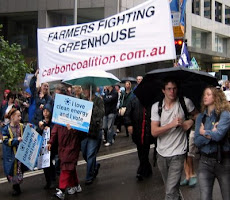
4 November, 2006 - Attended the “WALK AGAINST WARMING”, the International Day of Action on Climate Change on Saturday, Sydney NSW
4 November, 2006 - Briefed Federal Shadow Minister for Environment, Anthony Albanese MP
13 November, 2006 – meet with NSW President Soil Science Society re peer reviewed data for CCX and Summit of scientists and Practitioners
25 November, 2006 – Make presentation to Cobar/Nyngan Landcare group
11 December, 2006 – attend National Emissions Trading Summit, Sydney NSW
29 December, 2006 - Submissions (2) to National Emissions Trading Scheme Inquiry, Sydney NSW
Second Submission to Commonwealth Minister for Environment, Sen. Ian Campbell
22/23 November, 2006 - Speak at 2006 National Carbon Forum Canberra ACT
Organising Summit between Soil Scientists and Practitioners (March 2007)
Briefed Tony Windsor, MP, Canberra ACT (subsequently asks PM a question in Parliament)
13 December, 2006 - Briefed NSW Premier’s Advisory Panel on Climate Change, Sydney NSW
19 December, 2006 - Briefed NSW Farmers’ Asociation’s Jock Laurie. Subsequently calls for soil carbon credits.
Briefed NSW National Party MPs responsible for natural resources management election platform, Sydney NSW
Stand for NSW Legislative Council elections for Climate Change Coalition as soil carbon advocate.
Presented at Managing Under Changed Climactic Conditions Conference, Bathurst NSW
9 February, 2007 - Address South Australian No Till Farmers’ Association, Tanunda, SA
13 February, 2007 – Met with Peter Holter and Judy Earl, Holistic Management International
14 February, 2007 - Briefed NSW Department of Primary Industries Farm Management Climate Change Risk Management Steering Committee, Orange NSW
Activity Report
February 2006-February 2007
The following represents our attempts to put soil carbon credits on the naitonal agenda and protect the interests of farmers:
February, 2006 - Launched Carbon Coalition at Central West Conservation Farmers’ Association conference.
Established blog site carboncoalitionoz.blogspot.com – posted 127 reports in 365 days
Established web site – carboncoalition.com.au – collected 600 email contacts in 12 months
April, 2006 - Recruited Coalition Council members as advisory board: David Marsh, Rick Maurice, Col Seis, Angus Maurice.
Reguler press releases to national and rural media. Interviews with media.
April, 2006 - Gain support from Tim Flannery, Author, The Weather Makers
Add extensive “Library” of scientific papers and links to website and blogsite.
26 May, 2006 – Form alliance with Peter Andrews, Natural Sequence Farming
27 May, 2006 - Make presentation at Manning Landcare event, Gloucester NSW
2 June, 2006 - Brief NSW Farmers’ Association, Jock Laurie and David Ayrs, Sydney NSW
Write “Open Letter to Soil Scientists” for Australian Farm Journal
5 July, 2006 – Brief Central West delegation to NSW Farmers’ Association Conference, Wellington NSW
14 July, 2006 – Presentation for CWCMA at Mudgee Small Farm Field Day
19 July, 2006 – Make presentation to Baradine Landcare Group, Baradine, NSW
July, 2006 - Make presentation to Land Management Workshop, Cobar Field Day
15 August, 2006 - Brief National Farmers’ Federation, David Crombie and Dr Vanessa Findlay, Canberra ACT
2 September, 2006 – Make presentation to Gulgong Anglican Church Men’s Meeting, Gulgong NSW
USA 3 week fact finding mission
18/19 September: Washington DC – attend 2006 Global CO2 Cap-And-Trade Forum
21/22 September: Bozeman, Montana - Big Sky Carbon Sequestration Partnership Phase 2 Project Management Plan Workshop
25 September: College Station, Texas - Professor Bruce McCarl, Department of Agricultural Economics, Texas A&M University
27 September: Albuquerque, New Mexico - Peter Holter, Holistic Management International
28 September: Albuquerque, New Mexico - Southwest Carbon Sequestration Partnership Phase 2 Project Management Plan Workshop
29 September: Swanton, Vermont - Address Farmers' gathering organised by Coalition member Abe Collins from Vermont.
1 October: Columbus, Ohio - Professor Rattan Lal (or colleague), Ohio State University
3 October: Chicago, Illinois – Mike Walsh, SVP, Chicago Climate Exchange
Susan Capalbo, Director, Big Sky Carbon Sequestration Partnership.
Pamela Tomski is Associate Director responsible for outreach and education, Big Sky Carbon Sequestration Partnership.
Dave Brown, Technical Lead, Terrestrial Sequestration with Big Sky.
Michael Bowman, Director, 25:25, a movement that aims to have 25% of America's fuel needs supplied by farmers in 25 years.
Ted Dodge, Director, National Carbon Offsets Coalition which brokered the first carbon credits paid to US farmers In Montana and Kansas.
Professor Bruce McCarl of Texas A&M University, climate economist on the Inter-Governmental Panel on Climate Change.
Dr Rattan Lal, author of a small library of books and papers, co-author of many others, Professor of Soil Physics at the School of Natural Resources at Ohio State University, Columbus Ohio.
Dr Klause Lorenz, Senior Research Fellow, the School of Natural Resources at Ohio State University, Columbus Ohio.
Launched Carbon Coalition in USA - Abe Collins, Carbon Farmer and Convenor, Swanton, Vermont.
Attended and addressed 2 day Phase 2 Workshop in Albuqurque, New Mexico of the Southwest Regional Partnership.
Met with Head of Partnership, Dr Brian McPherson, from the New Mexico Institute of Technology in Socorro.
Met with Dr Joel Brown and Dr Jay Angerer, the 'soil carbon sequestration' experts with the Southwest Partnership.
Met with Peter Holter, Holistic Management International.
Secured first order for 25,000 acres Australian soil (till to no till) from CCX.
23 October, 2006 – Make presentation to Kingaroy Carbon Forum, Kingaroy QLD
Submission to Commonwealth Minister for Environment, Sen. Ian Campbell via Parliamentary Secretary Greg Hunt, MP.
Coordinated 8-farm application for CWCMA Round 5 funding for carbon farming soil trials.
4 November, 2006 - Attended the “WALK AGAINST WARMING”, the International Day of Action on Climate Change on Saturday, Sydney NSW
4 November, 2006 - Briefed Federal Shadow Minister for Environment, Anthony Albanese MP
13 November, 2006 – meet with NSW President Soil Science Society re peer reviewed data for CCX and Summit of scientists and Practitioners
25 November, 2006 – Make presentation to Cobar/Nyngan Landcare group
11 December, 2006 – attend National Emissions Trading Summit, Sydney NSW
29 December, 2006 - Submissions (2) to National Emissions Trading Scheme Inquiry, Sydney NSW
Second Submission to Commonwealth Minister for Environment, Sen. Ian Campbell
22/23 November, 2006 - Speak at 2006 National Carbon Forum Canberra ACT
Organising Summit between Soil Scientists and Practitioners (March 2007)
Briefed Tony Windsor, MP, Canberra ACT (subsequently asks PM a question in Parliament)
13 December, 2006 - Briefed NSW Premier’s Advisory Panel on Climate Change, Sydney NSW
19 December, 2006 - Briefed NSW Farmers’ Asociation’s Jock Laurie. Subsequently calls for soil carbon credits.
Briefed NSW National Party MPs responsible for natural resources management election platform, Sydney NSW
Stand for NSW Legislative Council elections for Climate Change Coalition as soil carbon advocate.
Presented at Managing Under Changed Climactic Conditions Conference, Bathurst NSW
9 February, 2007 - Address South Australian No Till Farmers’ Association, Tanunda, SA
13 February, 2007 – Met with Peter Holter and Judy Earl, Holistic Management International
14 February, 2007 - Briefed NSW Department of Primary Industries Farm Management Climate Change Risk Management Steering Committee, Orange NSW
Monday, February 12, 2007
The Carbon Coalition to launch a farmers' soil carbon trading arm
We believe farmers who grow soil carbon should get full value for their work. That's why we are structuring a company which will buy and sell Soil Carbon Credits on the voluntary and mandatory, wholesale and retail markets to corporates and consumers. It will also trade in other carbon offsets such as renewable energy projects,. etc. This will not be a vehicle for wealthy investors and merchant bankers, but the shareholders will be the farmers selling and the corporates and consumers buying the SCCs. This gives the people who made the market possible the opportunity to be rewarded for that. As well, it gives them access to trading on the broader market, something most farmers wouldn't normally do. This will build a legacy for them when soil carbon saturates on their land. The Carbon Coalition set out to achieve a market to change the fortunes of the family farm. Now the time is near. Carbon Farmers™, the future is yours. The time to sign up is now. Please register as a grower or buyer at www.carboncoalition.com.au.
Soil Carbon Credits at $25, says NSW Commissioner NR
On 9/2/07 ABC TV's Stateline program broadcast a dramatic breakthrough for the cause of soil carbon credits for Australian farmers.
Statelikne anchorman Quentin Dempster announced the following: "Carbon trading can provide a new long term revenue stream for rural landholders and represents a paradigm shift for agriculture and land management here and globally. Instead of fighting the environment movement, the farmers and landowners could earn $25 per tonne for carbon dioxide stored in soil, plants and trees, native vegetation and sustainable cropping techniques, and that is a conservative estimate, according to former CSIRO chief scientist, Dr John Williams, who is now the Commissioner for Natural Resources in New South Wales. John Williams is the Commissioner for Natural Resources in New South Wales."
Dr WIlliams said this: "Agriculture is able, through photosynthesis, the taking of carbon out of the air and fixing it in a plant, and the plant root depositing it in the soil, along with the soil organisms over time - can build up quite large stores of carbon. In fact, 75 per cent of the carbon stored on land is stored in soil. Now, farmers can manage the storage of carbon not only in the soil but also in the vegetation, in the managing native vegetation or other forms of vegetation - can store carbon, which is an important part of managing our way forward in climate change. So farmers have a great opportunity.
"The way they can get an income from this is because, if we go, as believe we will, to a carbon trading or carbon tax system, it means that someone who is emitting carbon into the atmosphere can actually buy from the farmer carbon that is stored, to make up for the carbon they have emitted.
"It is [a new paradigm], when we look at farmers who are trading in decreasing terms of trade, that is, they’re paying more for the inputs for their product and getting less for their product. Yet, society is expecting from them to maintain, beyond their duty of care, the vegetation and the soils and the land that we all benefit from functioning properly as an ecosystem. So we have moved to a stage of saying, “Well, those ecosystem services, all the things that farmers do that we, you and I, benefit from, are currently taken but not paid for.”
Jock Laurie, President of the NSW Farmers' Association, came out publicly in support of the Coalition's position:
"The opportunity for us to sequest carbon, to put it into soil, to store it for the future is exactly what we're talking about. We have got the ability to do it... We want [state and national governments] to be very aware that we are and will be a major component in any trading system when it comes to carbon trading, and it is vitally important that we are involved in the whole process and they acknowledge what we are doing and obviously get paid for what we are doing.
"Certainly around the world there are cabin trading systems being looked and put in place at the moment. Agriculture and the massive land mass that Australia has - in New South Wales, which is about 80 per cent of the state - we look after, agriculture look after, so the opportunities there are absolutely fantastic and ourselves as an industry would be silly just to sit back now and not take advantage of that."
Then there followed this interchange:
QUENTIN DEMPSTER: All the farmers watching this will want to know how much.
JOHN WILLIAMS: Well, how much is the issue and it is just emerging, but at the moment the current price for a tonne of carbon is about $25, and the EEC system – we’ll have to trade carbon internationally, not just nationally. A tonne of carbon can be fixed over a 10 15 year period quite readily in current ago agricultural methodology in Australia.
QUENTIN DEMPSTER: That is potentially $25 per tonne of stored carbon, the equivalent of one or two hectares of vegetated land per 10 year period. So we are talking about a consistent revenue stream.
JOHN WILLIAMS: A consistent revenue stream for managing soil and the soil carbon and the vegetation carbon, so that we can actually address the climate change problem.
QUENTIN DEMPSTER: Up about $25 per tonne over a 10 year period?
JOHN WILLIAMS: That's right. That's a minimalist figure, but, until we know more, that's at least not raising hopes beyond what is realistic.
QUENTIN DEMPSTER: So it is a conservative estimate but it should be fixed in everybody's mind that that is what the future holds?
JOHN WILLIAMS: That’s what the future holds and, I think, as we go on in future, we’ll find an ability to – as farmers are very innovative, we will find ways in Australian circumstances of increasing the amount of carbon they can store in soil and managing it that way. At the same time I think the price for carbon will increase over time.
JOCK LAURIE: Certainly in this position I have become very aware of it over the last 12 to 18 months, but, prior to that, working on the land and being involved on the land about 30 years myself, I think we all spend so much time working with soils, making sure that we keep good soil strength, good soil textures there available and good grass cover. And what we didn’t realise in lots of ways, I think, was that we are actually doing what people are talking about, we’re actually storing carbon, but we have the ability to actually do better than that by changing some of the work practices, some of the farming practices that people are using, to be able to store more carbon.
That’s the issue we’re at now. We are asking people to do something in the community. Let's develop this system, and, once we develop the system, then we can really start getting some money back into the areas it needs to be.
QUENTIN DEMPSTER: Even though the United States has not signed the Kyoto Protocol, Dr Williams says some North American farmers are already trading their ecosystem, or carbon storage services, on a Chicago exchange. Here, Landcare and Greening Australia are rapidly moving to organise a trading exchange for carbon farming in Australia.
JOHN WILLIAMS: We need to be alert to it, that the Americans are on the front foot, and we need to be in the game.
Statelikne anchorman Quentin Dempster announced the following: "Carbon trading can provide a new long term revenue stream for rural landholders and represents a paradigm shift for agriculture and land management here and globally. Instead of fighting the environment movement, the farmers and landowners could earn $25 per tonne for carbon dioxide stored in soil, plants and trees, native vegetation and sustainable cropping techniques, and that is a conservative estimate, according to former CSIRO chief scientist, Dr John Williams, who is now the Commissioner for Natural Resources in New South Wales. John Williams is the Commissioner for Natural Resources in New South Wales."
Dr WIlliams said this: "Agriculture is able, through photosynthesis, the taking of carbon out of the air and fixing it in a plant, and the plant root depositing it in the soil, along with the soil organisms over time - can build up quite large stores of carbon. In fact, 75 per cent of the carbon stored on land is stored in soil. Now, farmers can manage the storage of carbon not only in the soil but also in the vegetation, in the managing native vegetation or other forms of vegetation - can store carbon, which is an important part of managing our way forward in climate change. So farmers have a great opportunity.
"The way they can get an income from this is because, if we go, as believe we will, to a carbon trading or carbon tax system, it means that someone who is emitting carbon into the atmosphere can actually buy from the farmer carbon that is stored, to make up for the carbon they have emitted.
"It is [a new paradigm], when we look at farmers who are trading in decreasing terms of trade, that is, they’re paying more for the inputs for their product and getting less for their product. Yet, society is expecting from them to maintain, beyond their duty of care, the vegetation and the soils and the land that we all benefit from functioning properly as an ecosystem. So we have moved to a stage of saying, “Well, those ecosystem services, all the things that farmers do that we, you and I, benefit from, are currently taken but not paid for.”
Jock Laurie, President of the NSW Farmers' Association, came out publicly in support of the Coalition's position:
"The opportunity for us to sequest carbon, to put it into soil, to store it for the future is exactly what we're talking about. We have got the ability to do it... We want [state and national governments] to be very aware that we are and will be a major component in any trading system when it comes to carbon trading, and it is vitally important that we are involved in the whole process and they acknowledge what we are doing and obviously get paid for what we are doing.
"Certainly around the world there are cabin trading systems being looked and put in place at the moment. Agriculture and the massive land mass that Australia has - in New South Wales, which is about 80 per cent of the state - we look after, agriculture look after, so the opportunities there are absolutely fantastic and ourselves as an industry would be silly just to sit back now and not take advantage of that."
Then there followed this interchange:
QUENTIN DEMPSTER: All the farmers watching this will want to know how much.
JOHN WILLIAMS: Well, how much is the issue and it is just emerging, but at the moment the current price for a tonne of carbon is about $25, and the EEC system – we’ll have to trade carbon internationally, not just nationally. A tonne of carbon can be fixed over a 10 15 year period quite readily in current ago agricultural methodology in Australia.
QUENTIN DEMPSTER: That is potentially $25 per tonne of stored carbon, the equivalent of one or two hectares of vegetated land per 10 year period. So we are talking about a consistent revenue stream.
JOHN WILLIAMS: A consistent revenue stream for managing soil and the soil carbon and the vegetation carbon, so that we can actually address the climate change problem.
QUENTIN DEMPSTER: Up about $25 per tonne over a 10 year period?
JOHN WILLIAMS: That's right. That's a minimalist figure, but, until we know more, that's at least not raising hopes beyond what is realistic.
QUENTIN DEMPSTER: So it is a conservative estimate but it should be fixed in everybody's mind that that is what the future holds?
JOHN WILLIAMS: That’s what the future holds and, I think, as we go on in future, we’ll find an ability to – as farmers are very innovative, we will find ways in Australian circumstances of increasing the amount of carbon they can store in soil and managing it that way. At the same time I think the price for carbon will increase over time.
JOCK LAURIE: Certainly in this position I have become very aware of it over the last 12 to 18 months, but, prior to that, working on the land and being involved on the land about 30 years myself, I think we all spend so much time working with soils, making sure that we keep good soil strength, good soil textures there available and good grass cover. And what we didn’t realise in lots of ways, I think, was that we are actually doing what people are talking about, we’re actually storing carbon, but we have the ability to actually do better than that by changing some of the work practices, some of the farming practices that people are using, to be able to store more carbon.
That’s the issue we’re at now. We are asking people to do something in the community. Let's develop this system, and, once we develop the system, then we can really start getting some money back into the areas it needs to be.
QUENTIN DEMPSTER: Even though the United States has not signed the Kyoto Protocol, Dr Williams says some North American farmers are already trading their ecosystem, or carbon storage services, on a Chicago exchange. Here, Landcare and Greening Australia are rapidly moving to organise a trading exchange for carbon farming in Australia.
JOHN WILLIAMS: We need to be alert to it, that the Americans are on the front foot, and we need to be in the game.
Sunday, February 11, 2007
SANTFA's brave plan for new climate
The South Australian No Till Farmers' Association has come up with an innovative plan for policing standards for soil carbon credits and other "environmental" payments and finance. Brainchild on SANTFA's recently-appointed Research & Development Manager Greg Butler, the scheme links together auditing for carbon credits, government environmental incentives, and favourable finance terms from banks. The plan will cover all Australian farmers and will be conducted by the Conservation Agricultural Association of Australia and New Zealand, the peak body of the Australasian no till cropping movement. The Carbon Coalition applauds Greg's vision and endorses such an industry-wide approach. SANTFA's plan was developed after consultations with the Carbon Coalition. We will report more details of this exciting development as they come to hand.
What is the potential value of soil carbon to farmers?
Soil carbon credits represent a big additional re venue opportunity for some farmers, according to this exerpt from
Dr Christine Jones' paper "Aggregate or aggravate? Creating soil carbon" (YLAD Living Soils Seminars: Eurongilly - 14 February, Young - 15 February 2006)
CALCUATING SOIL CARBON
Soil carbon content is usually expressed as either a concentration (%) or a stock (t/ha). Unless the depth of measurement and soil bulk density parameters are known, it is not possible to accurately convert from one unit of measurement to the other.
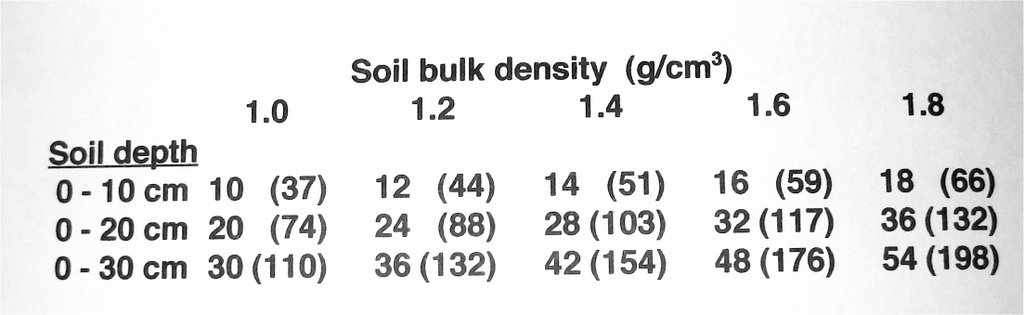
For the sake of illustration however, some simple assumptions can be made. Changes in the stock of soil carbon (t/ha) for each 1% change in measured organic carbon (OC) status for a range of soil bulk densities and measurement depths are shown in Table 1. Numbers in brackets represent tCO2 equivalent. An explanation of these terms follows.
Soil bulk density (g/cm3) is the dry weight (g) of one cubic centimetre (cm3) of soil. The higher the bulk density the more compact the soil. Generally, soils of low bulk density are well structured and have ‘more space than stuff’. The lower the bulk density the more room for air and water and the better the conditions for soil life and nutrient cycling. Bulk density usually increases with soil depth. To simplify the table it was assumed that soil bulk density did not change with depth
CO2 equivalent. Every tonne of carbon lost from soil adds 3.67 tonnes of carbon dioxide (CO2) gas to the atmosphere. Conversely, every 1 t/ha increase in soil organic carbon represents 3.67 tonnes of CO2 sequestered from the atmosphere and removed from the greenhouse gas equation.
For example, from TABLE 1 we can see that a 1% increase in organic carbon in the top 20 cm of soil with a bulk density of 1.2 g/cm3 represents a 24 t/ha increase in soil OC which equates to 88 t/ha of CO2 sequestered.
TABLE 1. Changes in the stock of soil carbon (tC/ha) for each 1% change in measured organic carbon (OC) status for a range of soil bulk densities and measurement depths. Numbers in brackets represent tCO2 equivalent.
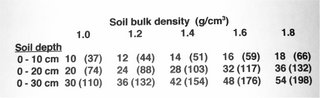
Value of soil carbon. Sequestered carbon is a tradeable commodity. It has different values in different markets and the price is subject to market fluctuation. If the CO2 equivalent in the above example was worth $15/t, the value of sequestered soil carbon in ‘carbon credits’ would be $1,056/ha. If the soil carbon concentration was increased by 1% to a depth of 30cm rather than to 20 cm, this would represent 132 t/ha sequestered CO2 at a value of $1,980/ha.
If organic carbon concentrations were increased by 2% to a depth of 30 cm in the same example, this would represent $3,960/ha, that is, almost $400,000 in ‘carbon credits’ per 100 ha of regenerated land. These levels of increase in soil carbon are achievable, and have already been achieved, by landholders practicing regenerative cropping and grazing practices.
Even if organic carbon levels were only increased by 0.5% in the top 10 cm of soil this would represent 22 t/ha sequestered CO2 valued at $33,000 per 100 ha regenerated land (assuming a soil bulk density of 1.2 g/cm3 and a price of $15/t CO2 equivalent).
Carbon credits for sequestered carbon are not an annual payment. In order to receive further credits, the level of soil carbon would need to be further increased. It is also important that the OC level for which payment was received is maintained.
This is not difficult with regenerative regimes in which new topsoil is being formed. Biological activity is concentrated in the top 10cm of most agricultural soils, but regenerative practices rapidly expand this activity zone to 30 cm and deeper. Many benefits in addition to potential carbon credits accrue to increased root biomass and increased levels of biological activity in soil.
The majority of Australian soils have lost enormous quantities of organic carbon and this process needs to be reversed. What has gone up must come down. Soils, plants, animals and people will benefit when we take ‘recycle and re-use’ to the next logical step and recycle the excess carbon currently in the atmosphere.
Dr Christine Jones' paper "Aggregate or aggravate? Creating soil carbon" (YLAD Living Soils Seminars: Eurongilly - 14 February, Young - 15 February 2006)
CALCUATING SOIL CARBON
Soil carbon content is usually expressed as either a concentration (%) or a stock (t/ha). Unless the depth of measurement and soil bulk density parameters are known, it is not possible to accurately convert from one unit of measurement to the other.
For the sake of illustration however, some simple assumptions can be made. Changes in the stock of soil carbon (t/ha) for each 1% change in measured organic carbon (OC) status for a range of soil bulk densities and measurement depths are shown in Table 1. Numbers in brackets represent tCO2 equivalent. An explanation of these terms follows.
Soil bulk density (g/cm3) is the dry weight (g) of one cubic centimetre (cm3) of soil. The higher the bulk density the more compact the soil. Generally, soils of low bulk density are well structured and have ‘more space than stuff’. The lower the bulk density the more room for air and water and the better the conditions for soil life and nutrient cycling. Bulk density usually increases with soil depth. To simplify the table it was assumed that soil bulk density did not change with depth
CO2 equivalent. Every tonne of carbon lost from soil adds 3.67 tonnes of carbon dioxide (CO2) gas to the atmosphere. Conversely, every 1 t/ha increase in soil organic carbon represents 3.67 tonnes of CO2 sequestered from the atmosphere and removed from the greenhouse gas equation.
For example, from TABLE 1 we can see that a 1% increase in organic carbon in the top 20 cm of soil with a bulk density of 1.2 g/cm3 represents a 24 t/ha increase in soil OC which equates to 88 t/ha of CO2 sequestered.
TABLE 1. Changes in the stock of soil carbon (tC/ha) for each 1% change in measured organic carbon (OC) status for a range of soil bulk densities and measurement depths. Numbers in brackets represent tCO2 equivalent.
Value of soil carbon. Sequestered carbon is a tradeable commodity. It has different values in different markets and the price is subject to market fluctuation. If the CO2 equivalent in the above example was worth $15/t, the value of sequestered soil carbon in ‘carbon credits’ would be $1,056/ha. If the soil carbon concentration was increased by 1% to a depth of 30cm rather than to 20 cm, this would represent 132 t/ha sequestered CO2 at a value of $1,980/ha.
If organic carbon concentrations were increased by 2% to a depth of 30 cm in the same example, this would represent $3,960/ha, that is, almost $400,000 in ‘carbon credits’ per 100 ha of regenerated land. These levels of increase in soil carbon are achievable, and have already been achieved, by landholders practicing regenerative cropping and grazing practices.
Even if organic carbon levels were only increased by 0.5% in the top 10 cm of soil this would represent 22 t/ha sequestered CO2 valued at $33,000 per 100 ha regenerated land (assuming a soil bulk density of 1.2 g/cm3 and a price of $15/t CO2 equivalent).
Carbon credits for sequestered carbon are not an annual payment. In order to receive further credits, the level of soil carbon would need to be further increased. It is also important that the OC level for which payment was received is maintained.
This is not difficult with regenerative regimes in which new topsoil is being formed. Biological activity is concentrated in the top 10cm of most agricultural soils, but regenerative practices rapidly expand this activity zone to 30 cm and deeper. Many benefits in addition to potential carbon credits accrue to increased root biomass and increased levels of biological activity in soil.
The majority of Australian soils have lost enormous quantities of organic carbon and this process needs to be reversed. What has gone up must come down. Soils, plants, animals and people will benefit when we take ‘recycle and re-use’ to the next logical step and recycle the excess carbon currently in the atmosphere.
Farmers to be robbed again?
Australian farmers have been robbed of carbon credits to the tune of AUD$10.8 billion to date and it looks like the Commonwealth Government is set to rob them of billions more, says Carbon Coalition Against Global Warming convenor Michael Kiely.
Australia’s National Greenhouse Gas Accounts show that farmers, by reducing land clearing rates since 1990, offset significant increases in greenhouse gas emissions, the conservative value of these reductions is $10.8 billion in credits, according to the Australasian Emissions Trading Forum. “But Federal Government policy prevented farmers converting these reductions into tradable credits.”
And there’s more to come. “The words Peter McGauran used recently are ominous, when he was hosing down farmers’ expectations of getting paid for storing carbon in their soil,” says Mr Kiely. “The fix is on.”
“Farmers will be locked out of the upside of emissions trading, but they’ll be given a seat at the table when it comes time to pay, no doubt.” Farmers are big emitters of greenhouse gases, emitting CO2 when they plough or lime a paddock, nitrous oxide when they spread super, and methane from livestock.
“Agriculture is the second biggest emitter and the biggest emitter, the power companies, are demanding that agriculture be included when the big stick comes out.”
“Under such a system farmers will have to pay to plough, pay to fertilise, pay to graze.”
Farm Online reported on 7/2/2007: "The push for the Federal Government to set up a carbon emissions trading scheme is unlikely to help farmers earn an extra dollar." The Government's discussion paper on the potential for Australia’s participation in a carbon trading scheme.
The pape does not specifically address agriculture’s needs has brought criticism from National Farmers Federation president, David Crombie. "We're not impressed that we weren't involved - agriculture has earned a seat at the table,” Mr Crombie said. Deputy Prime Minister, Mark Vaile, "reassured" the rural sector that their interests will be taken care of by the Government.
We now know what being 'taken care of' means: Agriculture Minister, Peter McGauran, warns that farmers should not expect much from a carbon emissions trading scheme. "There's considerable hope in the sector at the moment that there could be money for farmers trading greenhouse credits – the value of carbon stored on their properties. We've currently got a trial going with Landcare to see how effective it might be. But the likelihood is it's not going to be massive. It's difficult to measure carbon stored at farm levels."
The tell tale sign that farmers are going to be robbed is the old chestnut ‘soil carbon is difficult to measure’. It’s quite the reverse. Scientists can measure it so well they insist on degrees of precision that make it impossible to proceed. The amounts of carbon held in trees is estimated on broad averages, but not soil carbon. America’s senior soil scientists are speaking out against this.
The second tell tale sign is the other chestnut: Australia’s soils can’t sequester much carbon. This has become holy writ among scientists who advise the government, and a huge joke among their peers. To make such generalizations about our soils is astonishing.
The levels of ignorance within the current government are to be understood against the background that its members have not had to deal with carbon issues, Australia having been excluded from the field by its own choice.
The ignorance of soil carbon dynamics under regenerative land management methods is plain for all to see. No Til cropping gets a mention, but it is a relatively low level carbon technique on its own. No Til largely stops the emission of CO2 from turning over the soil. It’s ability to increase soil carbon significantly on its own is limited.
Carbon farmers use a whole suite of techniques to get biological activity going in the topsoil, which is the engine-room of carbon manufacturing. Carbon farming has never been put to the test by scientists. It faces the same skepticism that Peter Andrews Natural sequence Farming faced until recently.
The fixation of the Federal Government on “Clean Coal” and Nuclear solutions and the fixation of the Greens on solar and wind proves few on either side understand the reality of climate change. None of these solutions will remove one tonne of the existing load of CO2 that is driving the world’s temperature up through the critical levels.”
Only soil and trees can do that. And there is not enough space on earth to plant enough trees to do the job in the time we have left to avoid the worst. Agricultural soils cover 65% of the earth’s landmass. It’s available, economical, and easy to mobilize… all it takes is for farmers to change their way of farming. And why should they do that? Soil carbon credits.
CARBON FARMING BASICS
Carbon Farming is not a new practice. It is a new way to describe a collection of techniques which can increase soil organic carbon in agricultural land.
There are many benefits linked to increases in soil carbon:
• Higher fertility and production of vegetation
• More secure soil structure
• Better usage of available water
• Reduced levels of evaporation
• Reduced hard panning of surface
• Reduced salination (salt scalding)
• Reduced loss of top soil to erosion
• Reduced silting on waterways
• Higher species diversity
• Higher ecological resistance to disease
Greenhouse Gas Emissions
Increased soil carbon also has the effect of absorbing CO2 from the atmosphere. Soil can absord vast amounts of carbon. It has been estimated by soil carbon specialists that close to many tonnes of CO2 can be absorbed in a single hectare with only a 1% increase in soil carbon in the top 30cm. An increase of 2% would double the amount of CO2 absorbed. “These levels of increase in soil carbon are achievable, and have already been achieved, by landholders practicing regenerative cropping and grazing practices,” says Dr Christine Jones.
The key to increasing soil carbon is biological activity in top soil. Soil carbon is created by bugs and microbes living and dying. They do a lot of living and dying when there is a lot of root action in the soil – vigorous growth and regular decaying of rootmass. Roots that are continually reaching down deep into the soil and then dying back and retreating. Their rotting remnants feed the microbes which produce the soil organic carbon.
Land management practices that encourage biological activity in soil include the following:
100% groundcover 100% of the time - This is a Carbon Farmer’s goal. Soil covered by plants cannot be blown or washed away. It is cooler and more attractive to microbes than if it was exposed to the sun. Therefore over-grazing (“flogging the land”, in Australian parlance) and burning grasses and stubble and ploughing are anti-carbon growing actions. In fact, they release tonnes of carbon into the atmosphere. These practices, along with clearing native vegetation, have put Agriculture in 2nd place, behind coal-burning power stations, as the biggest source of Australia’s Greenhouse Gas emissions.
Grazing management – Stock are concentrated in small paddocks for short periods (days) so that they graze evenly and at the same time ‘til’ the soil with their hooves, stomping old grass and manure into it. The plants are then left to grow a full head of foliage so that their roots go down as far as possible into the soil. When they are grazed, the roots die back upwards in proportion to how much of the foliage was eaten. Overgrazing can cause the roots to shrink so short they struggle to get started again. So short grazing periods and long periods of rest are best.
No til cropping – Ploughing disturbs the microbes and dries out the soil. It also releases tonnes of CO2 per hectare. ‘No til’ techniques sow the seed in the top soil without tearing off the existing foliage or applying herbicides which are also bad for microbes. There are several no til techniques, including “Pasture Cropping” and “Advanced Sowing”. The one ‘direct drills’ the seed into pasture while the other slices a line through the pasture and inserts the seed. The crop grows up above the pasture and can be harvested or grazed. The pasture usually thickens and grows more vigorously after such treatment.
Mulching – This takes two forms: 1. Covering bare earth with hay or dead vegetation. This protects the soil from the sun, cools it, and attracts soil-producing microbes. It also holds water where it can be used instead of letting it run off immediately. 2. Cutting down and dessicating tall, dead plants and thistles to form a layer of litter on the soil and allow the sun to penetrate and foster plant growth. Gardeners know the value of mulching.
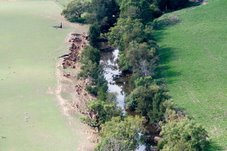
Water management systems – Water is essential to the carbon growing process. Several systems have emerged for maximising us of water that falls on a farm. Two names are prominent: Natural Sequence Farming (NSF) and Yeoman’s Keyline System. NSF slows the flow of water through the landscape by returning enroded gulleys and creeks to swampy meadows and chains of ponds that they were when white settlers arrived. The water stays long enough to make more grass and plants grow, rather than rushing down widening gullies carrying the topsoil away. NSF is based on the natural topography of the land. So is Keyline planning. It uses the shape of the land to determine the layout and position of farm dams, irrigation areas, roads, fences, farm buildings and tree lines. Both methods increase soil fertility and carbon.
Biodynamics – This is a method of treating soil, based on the theories of mystic and theorist Rudolf Steiner. He postulated that vital forces or energies flowed throughout the universe and that these can be harnessed to increase plant growth. Biodynamics adopts a homeopathic approach to preparing natural fertiliser and times activities to align with cycles of the moon and the stars. Many ordinary, sober farmers report great results with biodynamic preparations.
Biological Farming – This is the umbrella term for the use of natural compounds to stimulate biological activity in the soil. These compounds range from compost teas (concocted after an analysis of the soil for deficiencies), worm ‘juice’ (active enzymes created from worm castings), Biosolids (human effluent which needs to be plowed into the soil for hygene and odour reasons - not a favourite of carbon farmers), Nitrohumus (treated human effluent, needs no ploughing) etc.
Composting - This largely involves breaking down manure into a rich humus ready to spread on the fields. There is also a growing movement for recycling green wastes from cities for use on agricultural lands.
Trees – Trees scattered across grasslands provide shelter for stock and wildlife and also have the effect of causing the soil adjacent to be richer in carbon. They can also assist in the management of water movement.
Rules of Carbon Farming
The following are the ‘rules’ of carbon farming:
1. There are no rules. Every farm is different. Ever farmer is different. Whatever path you take to increasing soil carbon is right, because it increases soil carbon.
2. There can only be suggestions.
Australia’s National Greenhouse Gas Accounts show that farmers, by reducing land clearing rates since 1990, offset significant increases in greenhouse gas emissions, the conservative value of these reductions is $10.8 billion in credits, according to the Australasian Emissions Trading Forum. “But Federal Government policy prevented farmers converting these reductions into tradable credits.”
And there’s more to come. “The words Peter McGauran used recently are ominous, when he was hosing down farmers’ expectations of getting paid for storing carbon in their soil,” says Mr Kiely. “The fix is on.”
“Farmers will be locked out of the upside of emissions trading, but they’ll be given a seat at the table when it comes time to pay, no doubt.” Farmers are big emitters of greenhouse gases, emitting CO2 when they plough or lime a paddock, nitrous oxide when they spread super, and methane from livestock.
“Agriculture is the second biggest emitter and the biggest emitter, the power companies, are demanding that agriculture be included when the big stick comes out.”
“Under such a system farmers will have to pay to plough, pay to fertilise, pay to graze.”
Farm Online reported on 7/2/2007: "The push for the Federal Government to set up a carbon emissions trading scheme is unlikely to help farmers earn an extra dollar." The Government's discussion paper on the potential for Australia’s participation in a carbon trading scheme.
The pape does not specifically address agriculture’s needs has brought criticism from National Farmers Federation president, David Crombie. "We're not impressed that we weren't involved - agriculture has earned a seat at the table,” Mr Crombie said. Deputy Prime Minister, Mark Vaile, "reassured" the rural sector that their interests will be taken care of by the Government.
We now know what being 'taken care of' means: Agriculture Minister, Peter McGauran, warns that farmers should not expect much from a carbon emissions trading scheme. "There's considerable hope in the sector at the moment that there could be money for farmers trading greenhouse credits – the value of carbon stored on their properties. We've currently got a trial going with Landcare to see how effective it might be. But the likelihood is it's not going to be massive. It's difficult to measure carbon stored at farm levels."
The tell tale sign that farmers are going to be robbed is the old chestnut ‘soil carbon is difficult to measure’. It’s quite the reverse. Scientists can measure it so well they insist on degrees of precision that make it impossible to proceed. The amounts of carbon held in trees is estimated on broad averages, but not soil carbon. America’s senior soil scientists are speaking out against this.
The second tell tale sign is the other chestnut: Australia’s soils can’t sequester much carbon. This has become holy writ among scientists who advise the government, and a huge joke among their peers. To make such generalizations about our soils is astonishing.
The levels of ignorance within the current government are to be understood against the background that its members have not had to deal with carbon issues, Australia having been excluded from the field by its own choice.
The ignorance of soil carbon dynamics under regenerative land management methods is plain for all to see. No Til cropping gets a mention, but it is a relatively low level carbon technique on its own. No Til largely stops the emission of CO2 from turning over the soil. It’s ability to increase soil carbon significantly on its own is limited.
Carbon farmers use a whole suite of techniques to get biological activity going in the topsoil, which is the engine-room of carbon manufacturing. Carbon farming has never been put to the test by scientists. It faces the same skepticism that Peter Andrews Natural sequence Farming faced until recently.
The fixation of the Federal Government on “Clean Coal” and Nuclear solutions and the fixation of the Greens on solar and wind proves few on either side understand the reality of climate change. None of these solutions will remove one tonne of the existing load of CO2 that is driving the world’s temperature up through the critical levels.”
Only soil and trees can do that. And there is not enough space on earth to plant enough trees to do the job in the time we have left to avoid the worst. Agricultural soils cover 65% of the earth’s landmass. It’s available, economical, and easy to mobilize… all it takes is for farmers to change their way of farming. And why should they do that? Soil carbon credits.
CARBON FARMING BASICS
Carbon Farming is not a new practice. It is a new way to describe a collection of techniques which can increase soil organic carbon in agricultural land.
There are many benefits linked to increases in soil carbon:
• Higher fertility and production of vegetation
• More secure soil structure
• Better usage of available water
• Reduced levels of evaporation
• Reduced hard panning of surface
• Reduced salination (salt scalding)
• Reduced loss of top soil to erosion
• Reduced silting on waterways
• Higher species diversity
• Higher ecological resistance to disease
Greenhouse Gas Emissions
Increased soil carbon also has the effect of absorbing CO2 from the atmosphere. Soil can absord vast amounts of carbon. It has been estimated by soil carbon specialists that close to many tonnes of CO2 can be absorbed in a single hectare with only a 1% increase in soil carbon in the top 30cm. An increase of 2% would double the amount of CO2 absorbed. “These levels of increase in soil carbon are achievable, and have already been achieved, by landholders practicing regenerative cropping and grazing practices,” says Dr Christine Jones.
The key to increasing soil carbon is biological activity in top soil. Soil carbon is created by bugs and microbes living and dying. They do a lot of living and dying when there is a lot of root action in the soil – vigorous growth and regular decaying of rootmass. Roots that are continually reaching down deep into the soil and then dying back and retreating. Their rotting remnants feed the microbes which produce the soil organic carbon.
Land management practices that encourage biological activity in soil include the following:
100% groundcover 100% of the time - This is a Carbon Farmer’s goal. Soil covered by plants cannot be blown or washed away. It is cooler and more attractive to microbes than if it was exposed to the sun. Therefore over-grazing (“flogging the land”, in Australian parlance) and burning grasses and stubble and ploughing are anti-carbon growing actions. In fact, they release tonnes of carbon into the atmosphere. These practices, along with clearing native vegetation, have put Agriculture in 2nd place, behind coal-burning power stations, as the biggest source of Australia’s Greenhouse Gas emissions.
Grazing management – Stock are concentrated in small paddocks for short periods (days) so that they graze evenly and at the same time ‘til’ the soil with their hooves, stomping old grass and manure into it. The plants are then left to grow a full head of foliage so that their roots go down as far as possible into the soil. When they are grazed, the roots die back upwards in proportion to how much of the foliage was eaten. Overgrazing can cause the roots to shrink so short they struggle to get started again. So short grazing periods and long periods of rest are best.
No til cropping – Ploughing disturbs the microbes and dries out the soil. It also releases tonnes of CO2 per hectare. ‘No til’ techniques sow the seed in the top soil without tearing off the existing foliage or applying herbicides which are also bad for microbes. There are several no til techniques, including “Pasture Cropping” and “Advanced Sowing”. The one ‘direct drills’ the seed into pasture while the other slices a line through the pasture and inserts the seed. The crop grows up above the pasture and can be harvested or grazed. The pasture usually thickens and grows more vigorously after such treatment.
Mulching – This takes two forms: 1. Covering bare earth with hay or dead vegetation. This protects the soil from the sun, cools it, and attracts soil-producing microbes. It also holds water where it can be used instead of letting it run off immediately. 2. Cutting down and dessicating tall, dead plants and thistles to form a layer of litter on the soil and allow the sun to penetrate and foster plant growth. Gardeners know the value of mulching.
Water management systems – Water is essential to the carbon growing process. Several systems have emerged for maximising us of water that falls on a farm. Two names are prominent: Natural Sequence Farming (NSF) and Yeoman’s Keyline System. NSF slows the flow of water through the landscape by returning enroded gulleys and creeks to swampy meadows and chains of ponds that they were when white settlers arrived. The water stays long enough to make more grass and plants grow, rather than rushing down widening gullies carrying the topsoil away. NSF is based on the natural topography of the land. So is Keyline planning. It uses the shape of the land to determine the layout and position of farm dams, irrigation areas, roads, fences, farm buildings and tree lines. Both methods increase soil fertility and carbon.
Biodynamics – This is a method of treating soil, based on the theories of mystic and theorist Rudolf Steiner. He postulated that vital forces or energies flowed throughout the universe and that these can be harnessed to increase plant growth. Biodynamics adopts a homeopathic approach to preparing natural fertiliser and times activities to align with cycles of the moon and the stars. Many ordinary, sober farmers report great results with biodynamic preparations.
Biological Farming – This is the umbrella term for the use of natural compounds to stimulate biological activity in the soil. These compounds range from compost teas (concocted after an analysis of the soil for deficiencies), worm ‘juice’ (active enzymes created from worm castings), Biosolids (human effluent which needs to be plowed into the soil for hygene and odour reasons - not a favourite of carbon farmers), Nitrohumus (treated human effluent, needs no ploughing) etc.
Composting - This largely involves breaking down manure into a rich humus ready to spread on the fields. There is also a growing movement for recycling green wastes from cities for use on agricultural lands.
Trees – Trees scattered across grasslands provide shelter for stock and wildlife and also have the effect of causing the soil adjacent to be richer in carbon. They can also assist in the management of water movement.
Rules of Carbon Farming
The following are the ‘rules’ of carbon farming:
1. There are no rules. Every farm is different. Ever farmer is different. Whatever path you take to increasing soil carbon is right, because it increases soil carbon.
2. There can only be suggestions.
Saturday, February 03, 2007
10 Fundamental Facts About Climate Change Politicians and Media Don’t Understand
10 Fundamental Facts About Climate Change Politicians and Media Don’t Understand
MICHAEL KIELY, Woolgrower and Carbon Consultant, and Candidate for CLIMATE CHANGE COALITION in NSW Elections for Legislative Council says there are 10 Fundamental Facts About Climate Change which are not understood by politicians or the media:
1. Most of the responses to Climate Change being considered will not stop the global mean temperature rising through the critical levels.
2. If we stopped emitting greenhouse gases today there is already enough CO2 in the atmosphere to cause climate chaos. It is the ‘legacy load’ of 200 years of industrial emissions.
3. The Prime Minister’s favoured options of “Clean Coal” and nuclear power cannot capture existing CO2 in the atmosphere. They can only prevent future emissions.
4. The Greens’ favoured options of solar and wind power cannot capture existing CO2 in the atmosphere. They can only prevent future emissions.
5. Forests can absorb legacy load CO2, but there is not enough space on earth to plant enough trees to absorb the world’s emissions. We would need 7 planets.
6. Soil is the largest carbon “sink” over which we have control. It holds twice as much carbon as the atmosphere and twice as much as all the vegetation on earth, including forests.
7. 60% of the earth’s surface is used for agriculture. This soil can remove more CO2 from the atmosphere faster, sooner, and more economically than trees or any other method.
8. Simple changes in land management can immediately start the process of CO2 removal. These changes can be made immediately if farmers are paid carbon credits at the prices traded on the European Climate Exchange.
9. A 1% increase in soil carbon in 10% of Australia’s agricultural soils would remove 10 years’ legacy load of the nation’s emissions.
10. The land management tools for increasing soil carbon also restore the land, prevent erosion and salination, improve biodiversity, and increase productivity. They are also the most effective means of coping with reduced rainfall and higher temperatures due to Climate Change.
Protecting the Family Farm – Soil Carbon Credits
Michael Kiely says: “I am not a politician. I didn’t enter this fight to save the environment. I stand for the Australian family farm. It is a key source of community. It is an important source of what it means to be Australian. It is a foundation stone of our national identity.
“Soil Carbon Credits offer farm families a revenue stream that will last long enough to restore the natural resource base on which their livelihood depends.
“Soil Carbon Credits protects rural communities from the reduction of demand for local services when adjacent family farms are bought up by city-based investors in CO2 ‘tree farm plantations’ (aka. Forests) and families are removed from local schools, medical servicse, retail outlets, etc.
““Soil Carbon Credits will give the much maligned farm sector a lead role in the global climate crisis.
“They are one way that city people can help country people. Better than a hand out or a government payment for environmental services, which farmers see as little more than work for the dole.”
WHO IS MICHAEL KIELY?
Michael Kiely is a woolgrower from the Wellington district of NSW and Convenor of the Carbon Coalition Against Global Warming, a farmers’ and citizens’ movement which aims to have soil carbon recognised as a major solution to Climate Change. He is also the principal of CarbonCredited™Brands, a service which helps corporations become carbon neutral while taking their stakeholders on the journey. He is also principal of Carbon•Farmers™, a company that aggregates and sells soil carbon credits. These companies provide funding for Carbon Coalition operations. Michael has been a regular speaker at the “Managing The Carbon Cycle” Forums around Australia which started in 2005. He has been a delegate at many high level symposia in Australia and the USA. He led a fact-finding delegation to the USA on behalf of Australian farmers in 2006. While there, he negotiated the first order for soil carbon credits from the Chicago Climate Exchange. He attended workshops, briefing sessions and meetings with members of 3 of President George W. Bush’s 7 ‘regional partnerships’ of states whose senior scientists are preparing the USA’s geologic and land management sequestration strategies. He recently appeared as an expert witness before the NSW Premier’s Greenhouse Advisory Panel and the NSW Department of Primary Industries Climate Risk Management Project. He is a member of the Australian Business Council for Sustainable Energy.
MICHAEL KIELY, Woolgrower and Carbon Consultant, and Candidate for CLIMATE CHANGE COALITION in NSW Elections for Legislative Council says there are 10 Fundamental Facts About Climate Change which are not understood by politicians or the media:
1. Most of the responses to Climate Change being considered will not stop the global mean temperature rising through the critical levels.
2. If we stopped emitting greenhouse gases today there is already enough CO2 in the atmosphere to cause climate chaos. It is the ‘legacy load’ of 200 years of industrial emissions.
3. The Prime Minister’s favoured options of “Clean Coal” and nuclear power cannot capture existing CO2 in the atmosphere. They can only prevent future emissions.
4. The Greens’ favoured options of solar and wind power cannot capture existing CO2 in the atmosphere. They can only prevent future emissions.
5. Forests can absorb legacy load CO2, but there is not enough space on earth to plant enough trees to absorb the world’s emissions. We would need 7 planets.
6. Soil is the largest carbon “sink” over which we have control. It holds twice as much carbon as the atmosphere and twice as much as all the vegetation on earth, including forests.
7. 60% of the earth’s surface is used for agriculture. This soil can remove more CO2 from the atmosphere faster, sooner, and more economically than trees or any other method.
8. Simple changes in land management can immediately start the process of CO2 removal. These changes can be made immediately if farmers are paid carbon credits at the prices traded on the European Climate Exchange.
9. A 1% increase in soil carbon in 10% of Australia’s agricultural soils would remove 10 years’ legacy load of the nation’s emissions.
10. The land management tools for increasing soil carbon also restore the land, prevent erosion and salination, improve biodiversity, and increase productivity. They are also the most effective means of coping with reduced rainfall and higher temperatures due to Climate Change.
Protecting the Family Farm – Soil Carbon Credits
Michael Kiely says: “I am not a politician. I didn’t enter this fight to save the environment. I stand for the Australian family farm. It is a key source of community. It is an important source of what it means to be Australian. It is a foundation stone of our national identity.
“Soil Carbon Credits offer farm families a revenue stream that will last long enough to restore the natural resource base on which their livelihood depends.
“Soil Carbon Credits protects rural communities from the reduction of demand for local services when adjacent family farms are bought up by city-based investors in CO2 ‘tree farm plantations’ (aka. Forests) and families are removed from local schools, medical servicse, retail outlets, etc.
““Soil Carbon Credits will give the much maligned farm sector a lead role in the global climate crisis.
“They are one way that city people can help country people. Better than a hand out or a government payment for environmental services, which farmers see as little more than work for the dole.”
WHO IS MICHAEL KIELY?
Michael Kiely is a woolgrower from the Wellington district of NSW and Convenor of the Carbon Coalition Against Global Warming, a farmers’ and citizens’ movement which aims to have soil carbon recognised as a major solution to Climate Change. He is also the principal of CarbonCredited™Brands, a service which helps corporations become carbon neutral while taking their stakeholders on the journey. He is also principal of Carbon•Farmers™, a company that aggregates and sells soil carbon credits. These companies provide funding for Carbon Coalition operations. Michael has been a regular speaker at the “Managing The Carbon Cycle” Forums around Australia which started in 2005. He has been a delegate at many high level symposia in Australia and the USA. He led a fact-finding delegation to the USA on behalf of Australian farmers in 2006. While there, he negotiated the first order for soil carbon credits from the Chicago Climate Exchange. He attended workshops, briefing sessions and meetings with members of 3 of President George W. Bush’s 7 ‘regional partnerships’ of states whose senior scientists are preparing the USA’s geologic and land management sequestration strategies. He recently appeared as an expert witness before the NSW Premier’s Greenhouse Advisory Panel and the NSW Department of Primary Industries Climate Risk Management Project. He is a member of the Australian Business Council for Sustainable Energy.
Sunday, January 28, 2007
"If we stopped emitting Co2 now...."
The leaked report from the authoritative Intergovernmental Panel on Climate Change that appeared on 27th January, contains one chilling observation: “"Twenty-first century anthropogenic (human) carbon dioxide emissions will contribute to warming and sea level rise for more than a millennium, due to the timescales required for removal of this gas.”
In other words, even if we stopped emitting right now, it will take 1000 years for the CO2 levels to return to ‘normal’. The danger lies in the legacy load of CO2, the volumes we released over the past 200 years, that are likely to push the median world temperature past the critical 2°C mark and take us into climate chaos. And it is this CO2 that cannot be captured by “clean coal” technology and immobilized by geosequestration or buried in deep ocean trenches, the solutions favoured by President Bush and John Howard. Nor is it the CO2 that won’t be released when power is generated by solar or wind turbines. It is the CO2 that is out there and can’t be captured at source or substituted.
It has to be sequestered by the only means possible: by the natural processes that lock carbon up in trees and soils.
Many scientists have recognized the dilemma of the “legacy load”. “The carbon dioxide that’s in our atmosphere today – even if we were to stop emitting it tomorrow – would live for many decades, centuries and beyond,” said Dr Susan Solomon, senior scientist of the of the Global Monitoring Division of the U.S. National Oceanic and Atmospheric Administration. “A fraction of the carbon dioxide that we’ve put into the atmosphere today due to human activity would still be there in 1,000 years.”
Britain’s Chief Scientist Sir David King said that, “even if humanity were to stop emitting carbon dioxide today, temperatures will keep rising and the impacts keep changing for 25 years.”
Neither governments and scientists have plans to deal with the legacy load that will create the havoc. Instead, they focus entirely on future emissions. When they finally do focus on the problem, they will seek to back a winner. The obvious candidate is forest plantings. But these have inherent weaknesses.
"Most 'forests' sold as carbon sinks are plantations or tree farms which are less secure than natural forests. Tree farms start their life emitting tonnes of carbon because they tear up the vegetation that covers the soil, releasing CO2 into the atmosphere," says Carbon Coalition Against Global Warming convenor Michael Kiely. "Then herbicides are used to kill off other plant species that the birds and other wildlife rely on. The result is a biodiversity desert. Not an Australian forest."
Typically a tree farm will be a 'monoculture' - a one species environment - which lacks the 'resilience' to resist parasite and insect attack. This makes them susceptible to fire, which would release tonnes of CO2 into the atmosphere.
Tree farms are also a bad investment when it comes to storing carbon, when compared to the natural forest: A study reported in New Forests concluded that: "An area covered with a plantation managed for maximum volume yield will normally contain substantially less carbon than the same area of unmanaged forest". A similar study in Oregon found that a 450-year-old natural forest stored 2.2 to 2.3 times more carbon than a 60-year-old douglas fir plantation on a comparable site.
Tree farms are good for city-based investors and tree farming executives, but bad for rural communities. When a large industrial-sized operation buys up 10 neighbouring farms and puts them all under trees, the plantation pulls 10 families out of the local schools, 10 incomes out of the local economy. In most small districts this would mean the end of soclai infratructure like local medical and banking services as well as a deterioration of the community’s ability to support each other.
“A forest isn't the safest place to lock up your carbon if the climate scientists are right when they say Australia will have more bushfires of the type that have been ravaging forests all summer, " says Mr Kiely.
Trees cannot lock up CO2 for 100 years, as promised, because they start emitting CO2 as soon as they drop limbs and leaves which decay. Trees stop ‘sequestering’ carbon when they reach maturity.
Pro-forest green groups Greenpeace, WWF and Friends of the Earth have given tree farms the thumbs down.
Finally, trees aren’t going to save the world. We can’t plant enough of them in the time we have left, and not all soils are suitable. The UK Department of Energy estimates that to offset the UK’s total carbon dioxide emissions would require the planting of a new area of tropical forest about 1.5 times the size of the UK. "We don't have enough land to make up for all our emissions; you would need seven planets," say Tim Cadman, a PhD candidate at the University of Tasmania who has spent years researching the forestry industry and government forest policy.
The World Rainforest Movement claims that to compensate for the eight gigatonnes of carbon we currently release into the atmosphere every year would require planting four times the area of the United States with trees, never letting these trees die and decay thereafter. Millions of hectares of land would have to be taken over for carbon sequestration to have even a small impact on overall emissions.
But farmers can provide a solution. Given that 60% of the earth’s surface is grazing land, farmers have critical mass. They can sequester carbon at rates higher than tree farms using a combination of native perennial grasslands, foregone clearing of native forest, and regrowth of native vegetation as part of their farm plan. Australian farmers have done precisely this, enabling Prime Minister John Howard to boast that Australia has met its obligations under Kyoto 1, despite refusing to ratify the treaty. Not a cent was paid to the farmers who generated the ‘credits’.
So when you are buying carbon credits, insist on genuine, all-natural true forests and soil carbon credits – and vote 1 for ecology and the family farm.
……………………
In other words, even if we stopped emitting right now, it will take 1000 years for the CO2 levels to return to ‘normal’. The danger lies in the legacy load of CO2, the volumes we released over the past 200 years, that are likely to push the median world temperature past the critical 2°C mark and take us into climate chaos. And it is this CO2 that cannot be captured by “clean coal” technology and immobilized by geosequestration or buried in deep ocean trenches, the solutions favoured by President Bush and John Howard. Nor is it the CO2 that won’t be released when power is generated by solar or wind turbines. It is the CO2 that is out there and can’t be captured at source or substituted.
It has to be sequestered by the only means possible: by the natural processes that lock carbon up in trees and soils.
Many scientists have recognized the dilemma of the “legacy load”. “The carbon dioxide that’s in our atmosphere today – even if we were to stop emitting it tomorrow – would live for many decades, centuries and beyond,” said Dr Susan Solomon, senior scientist of the of the Global Monitoring Division of the U.S. National Oceanic and Atmospheric Administration. “A fraction of the carbon dioxide that we’ve put into the atmosphere today due to human activity would still be there in 1,000 years.”
Britain’s Chief Scientist Sir David King said that, “even if humanity were to stop emitting carbon dioxide today, temperatures will keep rising and the impacts keep changing for 25 years.”
Neither governments and scientists have plans to deal with the legacy load that will create the havoc. Instead, they focus entirely on future emissions. When they finally do focus on the problem, they will seek to back a winner. The obvious candidate is forest plantings. But these have inherent weaknesses.
"Most 'forests' sold as carbon sinks are plantations or tree farms which are less secure than natural forests. Tree farms start their life emitting tonnes of carbon because they tear up the vegetation that covers the soil, releasing CO2 into the atmosphere," says Carbon Coalition Against Global Warming convenor Michael Kiely. "Then herbicides are used to kill off other plant species that the birds and other wildlife rely on. The result is a biodiversity desert. Not an Australian forest."
Typically a tree farm will be a 'monoculture' - a one species environment - which lacks the 'resilience' to resist parasite and insect attack. This makes them susceptible to fire, which would release tonnes of CO2 into the atmosphere.
Tree farms are also a bad investment when it comes to storing carbon, when compared to the natural forest: A study reported in New Forests concluded that: "An area covered with a plantation managed for maximum volume yield will normally contain substantially less carbon than the same area of unmanaged forest". A similar study in Oregon found that a 450-year-old natural forest stored 2.2 to 2.3 times more carbon than a 60-year-old douglas fir plantation on a comparable site.
Tree farms are good for city-based investors and tree farming executives, but bad for rural communities. When a large industrial-sized operation buys up 10 neighbouring farms and puts them all under trees, the plantation pulls 10 families out of the local schools, 10 incomes out of the local economy. In most small districts this would mean the end of soclai infratructure like local medical and banking services as well as a deterioration of the community’s ability to support each other.
“A forest isn't the safest place to lock up your carbon if the climate scientists are right when they say Australia will have more bushfires of the type that have been ravaging forests all summer, " says Mr Kiely.
Trees cannot lock up CO2 for 100 years, as promised, because they start emitting CO2 as soon as they drop limbs and leaves which decay. Trees stop ‘sequestering’ carbon when they reach maturity.
Pro-forest green groups Greenpeace, WWF and Friends of the Earth have given tree farms the thumbs down.
Finally, trees aren’t going to save the world. We can’t plant enough of them in the time we have left, and not all soils are suitable. The UK Department of Energy estimates that to offset the UK’s total carbon dioxide emissions would require the planting of a new area of tropical forest about 1.5 times the size of the UK. "We don't have enough land to make up for all our emissions; you would need seven planets," say Tim Cadman, a PhD candidate at the University of Tasmania who has spent years researching the forestry industry and government forest policy.
The World Rainforest Movement claims that to compensate for the eight gigatonnes of carbon we currently release into the atmosphere every year would require planting four times the area of the United States with trees, never letting these trees die and decay thereafter. Millions of hectares of land would have to be taken over for carbon sequestration to have even a small impact on overall emissions.
But farmers can provide a solution. Given that 60% of the earth’s surface is grazing land, farmers have critical mass. They can sequester carbon at rates higher than tree farms using a combination of native perennial grasslands, foregone clearing of native forest, and regrowth of native vegetation as part of their farm plan. Australian farmers have done precisely this, enabling Prime Minister John Howard to boast that Australia has met its obligations under Kyoto 1, despite refusing to ratify the treaty. Not a cent was paid to the farmers who generated the ‘credits’.
So when you are buying carbon credits, insist on genuine, all-natural true forests and soil carbon credits – and vote 1 for ecology and the family farm.
……………………
Monday, January 22, 2007
VOTE [1] The Carbon Coalition On 24th March

The Carbon Coalition has been invited to provide a candidate to stand as part of the Climate Change Coalition (CCC) in the next election for the NSW Legislative Council. Convenor Michael Kiely says he agreed to stand in the coalition of independents solely to give soil carbon credits a platform for greater awareness in the community and in government circles. For instance, in its press release headed "10 things the NSW Government can do now", number 10 is "Promote the sequestering of carbon in soil and foster a start up industry for the rural sector"
The CCC is fielding a full ticket, headed by Patrice Newell, prominent Hunter Valley grazier and olive industry figure.

YOU CAN HELP:
Members of the Carbon Coalition can help us by registering to hand out 'how to vote' forms at their local polling booth for part of the day on 24th March, the election day.
The following is an introduction to the CCC:
We've formed the Climate Change Coalition to accelerate action by politicians from all parties on the most urgent and important issue in human history.
While the Coalition is not itself a political party it supports many Independent candidates who are committed to its platform.
Climate change is no abstract scientific or environmental issue. It impacts on every part of our daily lives. It is personal, local, national and global.
The time for denial is over. The political posturing and games must end. We must unite to ensure urgent action so that our children and grandchildren can have a sustainable future.
While we might be divided by ideology, religion, geography, history, class or self interest, we must come together to ensure the survival of our planet.
It is vital that the Climate Change Coalition’s values be represented in the New South Wales Parliament. All legislation needs to be assessed and scrutinized to evaluate its impact on climate change.
Members of Parliament who support the Climate Change Coalition are committed to asking two key questions about each piece of legislation that comes into the New South Wales Parliament. Does the proposed law address climate change? How can it be amended to make it better?
We recognise that there are MP's on all sides of NSW's politics intent on doing the right thing. They are often prevented from speaking out by party policy or pressure groups. We will work with them to get a freer debate - to produce the dynamics of the "conscience vote" across the legislative spectrum.
Further, the Climate Change Coalition will work with any group, organization, or individual to form alliances and encourage political creativity. There is no guide book to what must be done. There is no precendent for this crisis. It requires entirely new scientific, communal and political approaches.
Whatever our differences on other issues, whether we're left wing or right wing or middle of the road, is irrelevent. We must work together. Now.
Patrice Newell
Wednesday, January 17, 2007
Buy Soil Carbon Credits from Carbon•Farmers™
Buy Soil Carbon Credits from Carbon•Farmers™
We have dived right in the deep end and are offering soil carbon credits to the consumer market (see http://buycarboncredits.blogspot.com), targetting baby boomer grandparents concerned about climate change and the way the world will be when they aren't there to look after their grandchildren. We are using the trading name Carbon•Farmers™
Why did we do it?
To raise funds for the Carbon Coalition and enable our work to continue.
To raise awareness of the opportunity soils offer in the climate change crisis.
And to break the cycle of fiddling while Rome burns favoured by bureaucrats and scientists.
Politicians and scientists want to argue about the precise dimensions of the lifeboats on the Titanic - subjecting soil carbon to 4 years of trialling before giving it the go ahead, when Stern and others give us only 10 years to make a dent in the legacy load of CO2 in the atmosphere and soil is the only solution with the existing capacity to sequester legacy load in the time we have left. Forests will cost too much to plant on the scale required, take too long to plant, and too long to sequester. Every other solution is aimed at preventing new emissions, not dealing with legacy load. We have got to get cash flowing into the pockets of land managers who to encourage changes in soil management to sequester more carbon. If we managed to increase soil C by 1% in 10% of Australia's agricultural soils, we estimate we could sequester 10 years worth of our emissions. Can you sense the urgency? We are also - concurrently - seeking funding for trials of 'carbon farming techniques' and seeking to build bridges with scientists, trying to find one or two willing to operate in the real world and not this absurd Alice In Wonderland world where you can measure everything but you can't do anything. Given the extraordinary degree of estimation and averaging in calculating C sequestered in trees and C released by power stations, the death of a thousand core samples inflicted on soil carbon amounts - in context of climate change chaos - either to conspiracy to prevent farmers access to the carbon market, or criminal negligence on the part of those who would rather find reasons why it can't happen than look for ways of making it happen. We live by the words, "Lead, follow or get out of the way." We may fail, but it won't be for want of trying.
We have dived right in the deep end and are offering soil carbon credits to the consumer market (see http://buycarboncredits.blogspot.com), targetting baby boomer grandparents concerned about climate change and the way the world will be when they aren't there to look after their grandchildren. We are using the trading name Carbon•Farmers™
Why did we do it?
To raise funds for the Carbon Coalition and enable our work to continue.
To raise awareness of the opportunity soils offer in the climate change crisis.
And to break the cycle of fiddling while Rome burns favoured by bureaucrats and scientists.
Politicians and scientists want to argue about the precise dimensions of the lifeboats on the Titanic - subjecting soil carbon to 4 years of trialling before giving it the go ahead, when Stern and others give us only 10 years to make a dent in the legacy load of CO2 in the atmosphere and soil is the only solution with the existing capacity to sequester legacy load in the time we have left. Forests will cost too much to plant on the scale required, take too long to plant, and too long to sequester. Every other solution is aimed at preventing new emissions, not dealing with legacy load. We have got to get cash flowing into the pockets of land managers who to encourage changes in soil management to sequester more carbon. If we managed to increase soil C by 1% in 10% of Australia's agricultural soils, we estimate we could sequester 10 years worth of our emissions. Can you sense the urgency? We are also - concurrently - seeking funding for trials of 'carbon farming techniques' and seeking to build bridges with scientists, trying to find one or two willing to operate in the real world and not this absurd Alice In Wonderland world where you can measure everything but you can't do anything. Given the extraordinary degree of estimation and averaging in calculating C sequestered in trees and C released by power stations, the death of a thousand core samples inflicted on soil carbon amounts - in context of climate change chaos - either to conspiracy to prevent farmers access to the carbon market, or criminal negligence on the part of those who would rather find reasons why it can't happen than look for ways of making it happen. We live by the words, "Lead, follow or get out of the way." We may fail, but it won't be for want of trying.
Saturday, January 06, 2007
Only one MP 'gets it'

The Member for New England, Tony Windsor, is the only politician who 'gets' the carbon credits for soils issue. That's because he listens and he is not forced to toe the party line. His press release which reported his question in the House of Representatives in November, after he attended the National Carbon Forum in Canberra, is the most well-informed comment made by a public figure about soil carbon.
His release included the following: "Mr Windsor believes that the potential to use carbon credits to reward agricultural practices could not only improve Australia's soils, but also store carbon in the soil rather than the atmosphere and could be one of the solutions that the Federal Government is looking for.
"'With appropriate changes to land management, agricultural soils have the capacity to sequester and store large volumes of carbon, thus improving microbial contact, biological activity, fertility, soil structure, stability, resistance to erosion and ultimately biodiversity, productivity and profitability.
'Increasing soil carbon can significantly reduce the impact of dryland salinity, reduce sedimentation rates in rivers and streams, improve water quality, improve air quality, and decrease the impact of the Greenhouse Effect, global warming and climate change."
Tony was a farmer before his parliamentary career. He has defeated National Party candidates for the State seat of Tamworth and the Federal seat of New England. His hold on these seats is such that former Deputy Prime Minister John Anderson approached him through business identity Greg Maguire with the offer of a diplomatic post if he would surrender his seat. The Honourable John Anderson denied the allegation.
Tony can be reached at Tony.Windsor.MP@aph.gov.au with information and support.
Yes, Prime Minister? No, Prime Minister...

The Carbon Coalition was lucky enough to do a personal pesentation to Independent MP for the federal seat of New England, Tony Windsor during the lunch break at Christine Jones's National Carbon Forum in Novermber 2006. Tony was the only federal politician to attend. He was only there for half a day, but he's a fast learner. A week later he asked the Prime Minister a question in the House wwhich put soil carbon credits on the National agenda.
On the 27th November, 2006, Tony Windsor asked the following question:
"Prime Minister... given that the black soils in question have potential under appropriate land use management to be a natural carbon sink, could you include the farm sector in the carbon task force recently announced?"
The PM replied:
"... This joint task force is to look at the potential shape of a world emission rtrading system. Whilst the farm sector has an interest in that, I do not think the interest is as great sa, say, the resources sector. I will consider it."
The request has not been agreed to.
The PM's oblique reference to the resources sector masks the fact that he is referring to the coal industry, whose members dominate the task force. This has two implications: 1. The findings of the enquiry are already decided. 2. The coal industry's desires will be incorporated in the Government's carbon strategy. (The coal industry is still arguing that climate change is a myth.) The ability of the coal industry to actually write government policy was reveals in an ABCTV 4Corners program. The transcript of the program is available in our Library under "Carbon Conspiracies: Greenhouse Mafia".
Friday, January 05, 2007
Setback for our baselining trials
The Carbon Coalition made a Round 5 application to the Central West CMA for funding for soil carbon trials on 8 properties to prove that accelerated sequestration techniques such as time controlled grazing, pasture cropping, biological farming, biodynamics and compost teas can raise soil C scores rapidly. We were encouraged by the CMA to make it and were very confident - and worked on the assumption that the baselining trials would be starting soon. But we were unsuccessful. It was our second knockback on soil carbon, as we made a submission in Round 4 as well. We now understand why. The CMA's brief does not include fighting global warmingor figthing for carbon credit for agricultural soils. So they can't be criticised for sticking to a strict, narrow and conventional reading of their role. Instead we will seek the research funding we need from the private sector and fundraising.
What a difference when we presented to the NSW Premier's Expert Panel on CLimate Change 3 weeks ago and received a fantastic response. Adam Spencer (ABC Science and radio person) asked "What could you do with $650 million?" The DPI representative Annette Cowie gave us the thumbs up when asked "Does the science on this check out?" The presentation was arranged by Tony Lovell, a HM trainer from the Gold Coast who we met at the Carbon Forum at Kingaroy, and was attended by Bruce Ward, HM trainer from Sydney. Tony did a magnificent job presenting. Stunning.
We have since been contacted by the DPI team working on Greenhouse Response Options for landholders. We get to do another presentation.
We are moving ahead with our 25 000 acres pilot trade with Chicago Climate Exchange on no-till farming land. WE are at the stage of finding the 'peer reviewed' data that they need. We are looking for a soil scientist to help us pull the data together.
We're interested in forming alliance with scientists. We have a group of scientists willing to help us FIND WAYS to show that
our soils can sequester C. We are up against the establishment view that Australian soils can't sequester much carbon. We are planning to have a one day forum between scientists who want to help, and practitioners - narrow the gap between the two and forge alliances to move forward. This could happen in February.
You should also know that Patrice Newell (a HM and BD practitioner) has asked Michael to stand on her ticket (Climate Change Coalition) for the NSW Legislative Council elections in March. The CCC is a coalition of independents and it gives us a platform to promote the Carbon Coalition and SOil Carbon Credits because we are helping develop their policy on carbon trading and renewables. Patrice is a high profile beef and olive grower in the Hunter. We'll see how this goes, then consider the Senate Elections in November 07. Hopefully by then we wont need to. We need volunteers to person the booth. Please email me if you can help.
Don't forget - we need anecdotal data/evidence for soil carbon. And I give you this tip. If there's a farmed-out and buggered property nearby, keep yoru eye on it. The day we announce soil carbon credits there will be a land rush that will make the squatters land grab in the late 18th/early19th century look like an egg and spoon race. People who know about soil carbon and how to grow it and can identify low hanging fruit will prosper.
What a difference when we presented to the NSW Premier's Expert Panel on CLimate Change 3 weeks ago and received a fantastic response. Adam Spencer (ABC Science and radio person) asked "What could you do with $650 million?" The DPI representative Annette Cowie gave us the thumbs up when asked "Does the science on this check out?" The presentation was arranged by Tony Lovell, a HM trainer from the Gold Coast who we met at the Carbon Forum at Kingaroy, and was attended by Bruce Ward, HM trainer from Sydney. Tony did a magnificent job presenting. Stunning.
We have since been contacted by the DPI team working on Greenhouse Response Options for landholders. We get to do another presentation.
We are moving ahead with our 25 000 acres pilot trade with Chicago Climate Exchange on no-till farming land. WE are at the stage of finding the 'peer reviewed' data that they need. We are looking for a soil scientist to help us pull the data together.
We're interested in forming alliance with scientists. We have a group of scientists willing to help us FIND WAYS to show that
our soils can sequester C. We are up against the establishment view that Australian soils can't sequester much carbon. We are planning to have a one day forum between scientists who want to help, and practitioners - narrow the gap between the two and forge alliances to move forward. This could happen in February.
You should also know that Patrice Newell (a HM and BD practitioner) has asked Michael to stand on her ticket (Climate Change Coalition) for the NSW Legislative Council elections in March. The CCC is a coalition of independents and it gives us a platform to promote the Carbon Coalition and SOil Carbon Credits because we are helping develop their policy on carbon trading and renewables. Patrice is a high profile beef and olive grower in the Hunter. We'll see how this goes, then consider the Senate Elections in November 07. Hopefully by then we wont need to. We need volunteers to person the booth. Please email me if you can help.
Don't forget - we need anecdotal data/evidence for soil carbon. And I give you this tip. If there's a farmed-out and buggered property nearby, keep yoru eye on it. The day we announce soil carbon credits there will be a land rush that will make the squatters land grab in the late 18th/early19th century look like an egg and spoon race. People who know about soil carbon and how to grow it and can identify low hanging fruit will prosper.
Thursday, November 30, 2006
"101 Reasons Why Soil Carbon Can Never Be Traded"
The Australian Farm Institute included in its most recent Roundtable Summit a paper by Dr John Carter's called "Potential for trading carbon in agriculture" which could have been entitled "101 Reasons Why Soil Carbon Can Never Be Traded." Dr Carter, Principal Scientist with the Queensland Department of Natural Resources and Water.
He nailed the target to the wall in the form of this statement:
"In practice, the following attributes of trading schemes make soil carbon accounting a difficult task:
• inclusion of all gases, all pools
• gross-net or net-net accounting
• time periods for locking up carbon in
commercial contracts (up to 125 years)
• avoidance of leakage
• accounting for future risk and measurement uncertainty
• need for auditing, certification and verification."
It's up to us to score a bullseye, one by one. We will be dealing with each issue raised in Dr Carter's paper in turn. It could take some time and resources, but we must do it if we are to achieve our goal. And we thank Dr Carter for setting the target for us so clearly. If we can answer each of his points, we don't deserve to succeed.
* Australian Greenhouse Office, Developing a Strategic Framework for Greenhouse and Agriculture. An Issues Paper, 2002
He nailed the target to the wall in the form of this statement:
"In practice, the following attributes of trading schemes make soil carbon accounting a difficult task:
• inclusion of all gases, all pools
• gross-net or net-net accounting
• time periods for locking up carbon in
commercial contracts (up to 125 years)
• avoidance of leakage
• accounting for future risk and measurement uncertainty
• need for auditing, certification and verification."
It's up to us to score a bullseye, one by one. We will be dealing with each issue raised in Dr Carter's paper in turn. It could take some time and resources, but we must do it if we are to achieve our goal. And we thank Dr Carter for setting the target for us so clearly. If we can answer each of his points, we don't deserve to succeed.
* Australian Greenhouse Office, Developing a Strategic Framework for Greenhouse and Agriculture. An Issues Paper, 2002
Who said this? "Australian soils can't store carbon"
"The bulk of Australian farms may not operate as carbon sinks, due to the age of the soils."
That was the Executive Director of a very significant independent research organisation.
Here's another one:
"Typically Australian soils have a poor capacity to store large quantities of carbon."
This one is from one of the most important government advisors on greenhouse issues.
These are the type of comments the Ministerial Enquiry into Soil Carbon Sequestration are going to hear from "expert witnesses".
Yet, when told of the first comment, the head of the department of soil science at a leading university laughed out loud: "What a curious thing to say." His colleagues agreed. Soil age is irrelevant.
When told of the second comment, the president of an important scientific association working in the field said: "There are many myths out there." One of his colleagues remarked: "The people who make these remarks don't get around enough to know what's going on."
These men then rattled off a long list of soils and regions that can sequester oodles of carbon. That such august bodies should harbour such ignorance is tragic. The damage they can do is immense.
That was the Executive Director of a very significant independent research organisation.
Here's another one:
"Typically Australian soils have a poor capacity to store large quantities of carbon."
This one is from one of the most important government advisors on greenhouse issues.
These are the type of comments the Ministerial Enquiry into Soil Carbon Sequestration are going to hear from "expert witnesses".
Yet, when told of the first comment, the head of the department of soil science at a leading university laughed out loud: "What a curious thing to say." His colleagues agreed. Soil age is irrelevant.
When told of the second comment, the president of an important scientific association working in the field said: "There are many myths out there." One of his colleagues remarked: "The people who make these remarks don't get around enough to know what's going on."
These men then rattled off a long list of soils and regions that can sequester oodles of carbon. That such august bodies should harbour such ignorance is tragic. The damage they can do is immense.
Federal Government announces an enquiry into soil carbon
The Carbon Coalition sent Senator Ian Campbell (Environment Minister) the information below and the same day he announces an enquiry. (If Only it was that simple.) The Australian Newspaper announced that the Government had a budget of $100,000 for a "project" which will bring together US and Australian researchers to work on tools to measure the amount of carbon stored. (We can tell the Minister from bitter experience that a hundred grand doesn't get much methodology testing.)
SOILS ARE THE ONLY SHORT TERM SOLUTION TO GLOBAL WARMING
The experts agree: only soils can sequester significant amounts of atmospheric Carbon in the next 30 years. Every other solution will take 30 years to start shifting meaningful volumes.
“It buys us time…”
“C Sequestration in soil and vegetation is a bridge to the future. It buys us time while alternatives to fossil fuel take effect.”
Dr Rattan Lal
Director, Carbon Management and Sequestration Center
Ohio State University, Columbus, Ohio
Professor of Soil Science, College of Food, Agricultural, and Environmental Sciences, School of Natural Resources
Ohio State University
Liebig Applied Soil Science Award, World Congress of Soil Science 2006
“Unlike others… it is immediate…”
"Unlike many other technologies to offset fossil fuel emissions, land management for soil C sequestration can be implemented immediately, provided there are incentives to do so. An immediate offset of CO2 emissions provides a significant delay in the rise of atmospheric CO2 concentration. By the time that land management C sequestration begins to saturate the soil’s capacity to store additional C, other methods of reducing emissions or sequestering carbon may be available or already in use.”
Professor Bruce McCarl, Agricultural Economist and Economist, Climate Change, Texas A&M University
Member of the Intergovernmental Panel on Climate Change
“Available… low cost…”
"Terrestrial C sequestration could have an immediate application in climate change mitigation due to its availability, relatively low cost, and associated environmental benefits."
R.W. Izaurrable and C.W.Rice, "Methods and Tools for Designing a Pilot Soil Carbon Sequestration Project", in Carbon Sequestration in Soils of Latin America, Lal et al. eds, 2006
“It’s here… now…”
“Terrestrial sequestration is here and now. It’s user friendly. It’s the Mom’s Apple Pie of sequestration.”
Dr. John Antle,
Professor of Agricultural Economics and Economics at Montana State University
Technical Leader, Economics, BigSky Carbon Sequestration Partnership
FACT: “Carbon scrubbing” at source does not reduce the existing CO2 burden in the atmosphere
FACT: “Geosequestation” (burial beneath deep cap rock formations and exhausted oil wells) does not reduce the existing CO2 burden and researchers say it will take 100 years to determine if it is effective
FACT: Forests can be net emitters in their early stages and take many years to reach their sequestration potential
SOILS ARE THE ONLY SHORT TERM SOLUTION TO GLOBAL WARMING
The experts agree: only soils can sequester significant amounts of atmospheric Carbon in the next 30 years. Every other solution will take 30 years to start shifting meaningful volumes.
“It buys us time…”
“C Sequestration in soil and vegetation is a bridge to the future. It buys us time while alternatives to fossil fuel take effect.”
Dr Rattan Lal
Director, Carbon Management and Sequestration Center
Ohio State University, Columbus, Ohio
Professor of Soil Science, College of Food, Agricultural, and Environmental Sciences, School of Natural Resources
Ohio State University
Liebig Applied Soil Science Award, World Congress of Soil Science 2006
“Unlike others… it is immediate…”
"Unlike many other technologies to offset fossil fuel emissions, land management for soil C sequestration can be implemented immediately, provided there are incentives to do so. An immediate offset of CO2 emissions provides a significant delay in the rise of atmospheric CO2 concentration. By the time that land management C sequestration begins to saturate the soil’s capacity to store additional C, other methods of reducing emissions or sequestering carbon may be available or already in use.”
Professor Bruce McCarl, Agricultural Economist and Economist, Climate Change, Texas A&M University
Member of the Intergovernmental Panel on Climate Change
“Available… low cost…”
"Terrestrial C sequestration could have an immediate application in climate change mitigation due to its availability, relatively low cost, and associated environmental benefits."
R.W. Izaurrable and C.W.Rice, "Methods and Tools for Designing a Pilot Soil Carbon Sequestration Project", in Carbon Sequestration in Soils of Latin America, Lal et al. eds, 2006
“It’s here… now…”
“Terrestrial sequestration is here and now. It’s user friendly. It’s the Mom’s Apple Pie of sequestration.”
Dr. John Antle,
Professor of Agricultural Economics and Economics at Montana State University
Technical Leader, Economics, BigSky Carbon Sequestration Partnership
FACT: “Carbon scrubbing” at source does not reduce the existing CO2 burden in the atmosphere
FACT: “Geosequestation” (burial beneath deep cap rock formations and exhausted oil wells) does not reduce the existing CO2 burden and researchers say it will take 100 years to determine if it is effective
FACT: Forests can be net emitters in their early stages and take many years to reach their sequestration potential
Sunday, November 12, 2006
HOWARD CRACKS ON CARBON AFTER BUSH FALLS
The Australian Government finally waved the white flag on Kyoto. Australia will introduce a "Carbon Tax" and begin trading carbon credits in the next round of Kyoto.
Treasurer Peter Costello said what PM Howard couldn't bring himself to say: "As the world moves towards a carbon trading system, Australia obviously can't stand out against the rest of the world." What? Australia was happy to stand out against the world alongside the other climate sceptic George W. Bush. Less than a week after the collapse of President Bush's ascendency, Mr Costello was frank: "I think the ground is changing," he told ABC television today.
"From Australia's point of view if the world starts moving towards a carbon trading system, we can't be left out of that." What? The world has a carbon trading system. Only we're not in it.
Treasurer Peter Costello said what PM Howard couldn't bring himself to say: "As the world moves towards a carbon trading system, Australia obviously can't stand out against the rest of the world." What? Australia was happy to stand out against the world alongside the other climate sceptic George W. Bush. Less than a week after the collapse of President Bush's ascendency, Mr Costello was frank: "I think the ground is changing," he told ABC television today.
"From Australia's point of view if the world starts moving towards a carbon trading system, we can't be left out of that." What? The world has a carbon trading system. Only we're not in it.
Thursday, November 09, 2006
Soils: A Radical View by a CSIRO Scientist
The following is an extract* from a paper published in the CSIRO Newsletter "Sustainability" No. 61
“Soil Fertility Management – Towards Sustainable Farming Systems and Landscapes” by Dr Maarten Stapper CSIRO
In a nutshell: Soil fertility is the capacity to receive, store and transmit energy to support plant growth. These processes require healthy soils – living, self-organising systems with physical, chemical and biological components all functioning and in balance. Continuous use of acidic or salty synthetic fertilisers, insecticides, fungicides and herbicides disrupts this delicate balance. Organic Farming has recognised this, but needs to follow its leaders to active soil fertility management. Carbon, in particular, is of critical importance and needs to be maximised through capture with solar energy through photosynthesis by green plants, and optimum storage and use in the soil. Before we can hope to improve systems, however, we need to understand (1) why they are the way they are, and then (2) how science and practice can help to actively manage soil biology to improve and maintain soil fertility, and achieve more sustainable, healthy and productive farming systems – even on our fragile Australian soils in a highly variable and changing climate.
..........
The road to sustainability: In most districts today, there are properties applying sustainable practices as outlined above. These practices have been achieved with persistence by the manager – through trial and error, under financial pressure, and on fragile soils in our highly variable climate. It is now the task of science, using participatory research, to connect up these ‘dots’ in the landscape using appropriate concepts and principles. A typical agricultural manager is both time poor and cash poor – thereby, of necessity, readily following advise from (trusted) outsiders. Action research is needed to develop indicators that conceptualise farmer knowledge of natural resource management. This, in turn, will feed the required information-exchange networks, allowing knowledge to be transferred in time and space to achieve and maintain soil health, optimise production and minimise risk to achieving profitable farms in sustainable rural communities.
*The full paper can be found in the LIBRARY section of this Blog, titled "Stapper on Soil Fertility"
“Soil Fertility Management – Towards Sustainable Farming Systems and Landscapes” by Dr Maarten Stapper CSIRO
In a nutshell: Soil fertility is the capacity to receive, store and transmit energy to support plant growth. These processes require healthy soils – living, self-organising systems with physical, chemical and biological components all functioning and in balance. Continuous use of acidic or salty synthetic fertilisers, insecticides, fungicides and herbicides disrupts this delicate balance. Organic Farming has recognised this, but needs to follow its leaders to active soil fertility management. Carbon, in particular, is of critical importance and needs to be maximised through capture with solar energy through photosynthesis by green plants, and optimum storage and use in the soil. Before we can hope to improve systems, however, we need to understand (1) why they are the way they are, and then (2) how science and practice can help to actively manage soil biology to improve and maintain soil fertility, and achieve more sustainable, healthy and productive farming systems – even on our fragile Australian soils in a highly variable and changing climate.
..........
The road to sustainability: In most districts today, there are properties applying sustainable practices as outlined above. These practices have been achieved with persistence by the manager – through trial and error, under financial pressure, and on fragile soils in our highly variable climate. It is now the task of science, using participatory research, to connect up these ‘dots’ in the landscape using appropriate concepts and principles. A typical agricultural manager is both time poor and cash poor – thereby, of necessity, readily following advise from (trusted) outsiders. Action research is needed to develop indicators that conceptualise farmer knowledge of natural resource management. This, in turn, will feed the required information-exchange networks, allowing knowledge to be transferred in time and space to achieve and maintain soil health, optimise production and minimise risk to achieving profitable farms in sustainable rural communities.
*The full paper can be found in the LIBRARY section of this Blog, titled "Stapper on Soil Fertility"
Monday, November 06, 2006
SOILS ARE THE ONLY SHORT TERM SOLUTION TO GLOBAL WARMING
The experts agree: only soils can sequester significant amounts of atmospheric Carbon in the next 30 years. Every other solution will take 30 years to start shifting meaningful volumes.
“C Sequestration in soil and vegetation is a bridge to the future. It buys us time while alternatives to fossil fuel take effect.”
Dr Rattan Lal
Director, Carbon Management and Sequestration Center
Ohio State University, Columbus, Ohio
Professor of Soil Science, College of Food, Agricultural, and Environmental Sciences, School of Natural Resources
Ohio State University
Liebig Applied Soil Science Award, World Congress of Soil Science 2006
"Unlike many other technologies to offset fossil fuel emissions, land management for soil C sequestration can be implemented immediately, provided there are incentives to do so. An immediate offset of CO2 emissions provides a significant delay in the rise of atmospheric CO2 concentration. By the time that land management C sequestration begins to saturate the soil’s capacity to store additional C, other methods of reducing emissions or sequestering carbon may be available or already in use.”
Professor Bruce McCarl, Agricultural Economist and Economist, Climate Change, Texas A&M University
Member of the Intergovernmental Panel on Climate Change
"Terrestrial C sequestration could have an immediate application in climate change mitigation due to its availability, relatively low cost, and associated environmental benefits."
R.W. Izaurrable and C.W.Rice, "Methods and Tools for Designing a Pilot Soil Carbon Sequestration Project", in Carbon Sequestration in Soils of Latin America, Lal et al. eds, 2006
“Terrestrial sequestration is here and now. It’s user friendly. It’s the Mom’s Apple Pie of sequestration.”
Dr. John Antle, Professor of Agricultural Economics and Economics at Montana State University
Technical Leader, Economics, BigSky Carbon Sequestration Partnership
FACT: “Carbon scrubbing” at source does not reduce the existing CO2 burden in the atmosphere
FACT: “Geosequestation” (burial beneath deep cap rock formations and exhausted oil wells) does not reduce the existing CO2 burden and researchers say it will take 100 years to determine if it is effective
FACT: Forests can be net emitters in their early stages and take many years to reach their sequestration potential
WHY DO SCIENTISTS SAY SOILS CAN’T BE TRADED?
The Case for Averaging Soil C Sample Values to Enable Trading
Flux and soil variability are thrown in our faces whenever we ask for trading units of soil carbon. But one important US scientist has broken ranks with his colleagues to argue for sanity to prevail: "It is often pointed out that soils have a large amount of variability, but with knowledge of soil sciences and landscapes, variability can be described and sampling protocols can be developed to deal with this," writes Dr John Kimble in a paper published this year*. "One reason I feel people say that soils vary and SOC cannot be measured is that we soil scientists focus on showing variability, not on showing what we know about the variability. In soils we can go to a 100m2 field and sample every square meter and look at the differences we find. But if you sample every tree in a large area you would see a similar variability." Dr Kimble works for the US Department of Agriculture, National Resources Conservation Service, National Soil Survey Centre, Lincoln, Nebraska. "We too often focus on this [variability], worry about laboratory precision and field variation and do not look at the real world where most things are based on averages and estimated data. We tend to focus on finding variation and not on using our knowledge of soil science to describe what we know. All systems vary, but in soils we focus on a level of precision and accuracy that may not have any relevance to the real world because we can take so many samples and look at the variation."
*Kimble, J., "Advances In Models To Measure Soil Carbon: Can Soil Carbon Really Be Measured?", in Lal, R., Cerri, C., Bernoux, M., Etchevers, J., and Cerri, E., eds., Carbon Sequestration in Soils in Latin America, Food Products Press, Birmingham, NY, 2006
“C Sequestration in soil and vegetation is a bridge to the future. It buys us time while alternatives to fossil fuel take effect.”
Dr Rattan Lal
Director, Carbon Management and Sequestration Center
Ohio State University, Columbus, Ohio
Professor of Soil Science, College of Food, Agricultural, and Environmental Sciences, School of Natural Resources
Ohio State University
Liebig Applied Soil Science Award, World Congress of Soil Science 2006
"Unlike many other technologies to offset fossil fuel emissions, land management for soil C sequestration can be implemented immediately, provided there are incentives to do so. An immediate offset of CO2 emissions provides a significant delay in the rise of atmospheric CO2 concentration. By the time that land management C sequestration begins to saturate the soil’s capacity to store additional C, other methods of reducing emissions or sequestering carbon may be available or already in use.”
Professor Bruce McCarl, Agricultural Economist and Economist, Climate Change, Texas A&M University
Member of the Intergovernmental Panel on Climate Change
"Terrestrial C sequestration could have an immediate application in climate change mitigation due to its availability, relatively low cost, and associated environmental benefits."
R.W. Izaurrable and C.W.Rice, "Methods and Tools for Designing a Pilot Soil Carbon Sequestration Project", in Carbon Sequestration in Soils of Latin America, Lal et al. eds, 2006
“Terrestrial sequestration is here and now. It’s user friendly. It’s the Mom’s Apple Pie of sequestration.”
Dr. John Antle, Professor of Agricultural Economics and Economics at Montana State University
Technical Leader, Economics, BigSky Carbon Sequestration Partnership
FACT: “Carbon scrubbing” at source does not reduce the existing CO2 burden in the atmosphere
FACT: “Geosequestation” (burial beneath deep cap rock formations and exhausted oil wells) does not reduce the existing CO2 burden and researchers say it will take 100 years to determine if it is effective
FACT: Forests can be net emitters in their early stages and take many years to reach their sequestration potential
WHY DO SCIENTISTS SAY SOILS CAN’T BE TRADED?
The Case for Averaging Soil C Sample Values to Enable Trading
Flux and soil variability are thrown in our faces whenever we ask for trading units of soil carbon. But one important US scientist has broken ranks with his colleagues to argue for sanity to prevail: "It is often pointed out that soils have a large amount of variability, but with knowledge of soil sciences and landscapes, variability can be described and sampling protocols can be developed to deal with this," writes Dr John Kimble in a paper published this year*. "One reason I feel people say that soils vary and SOC cannot be measured is that we soil scientists focus on showing variability, not on showing what we know about the variability. In soils we can go to a 100m2 field and sample every square meter and look at the differences we find. But if you sample every tree in a large area you would see a similar variability." Dr Kimble works for the US Department of Agriculture, National Resources Conservation Service, National Soil Survey Centre, Lincoln, Nebraska. "We too often focus on this [variability], worry about laboratory precision and field variation and do not look at the real world where most things are based on averages and estimated data. We tend to focus on finding variation and not on using our knowledge of soil science to describe what we know. All systems vary, but in soils we focus on a level of precision and accuracy that may not have any relevance to the real world because we can take so many samples and look at the variation."
*Kimble, J., "Advances In Models To Measure Soil Carbon: Can Soil Carbon Really Be Measured?", in Lal, R., Cerri, C., Bernoux, M., Etchevers, J., and Cerri, E., eds., Carbon Sequestration in Soils in Latin America, Food Products Press, Birmingham, NY, 2006
Saturday, November 04, 2006
Coalition Walks Against Warming
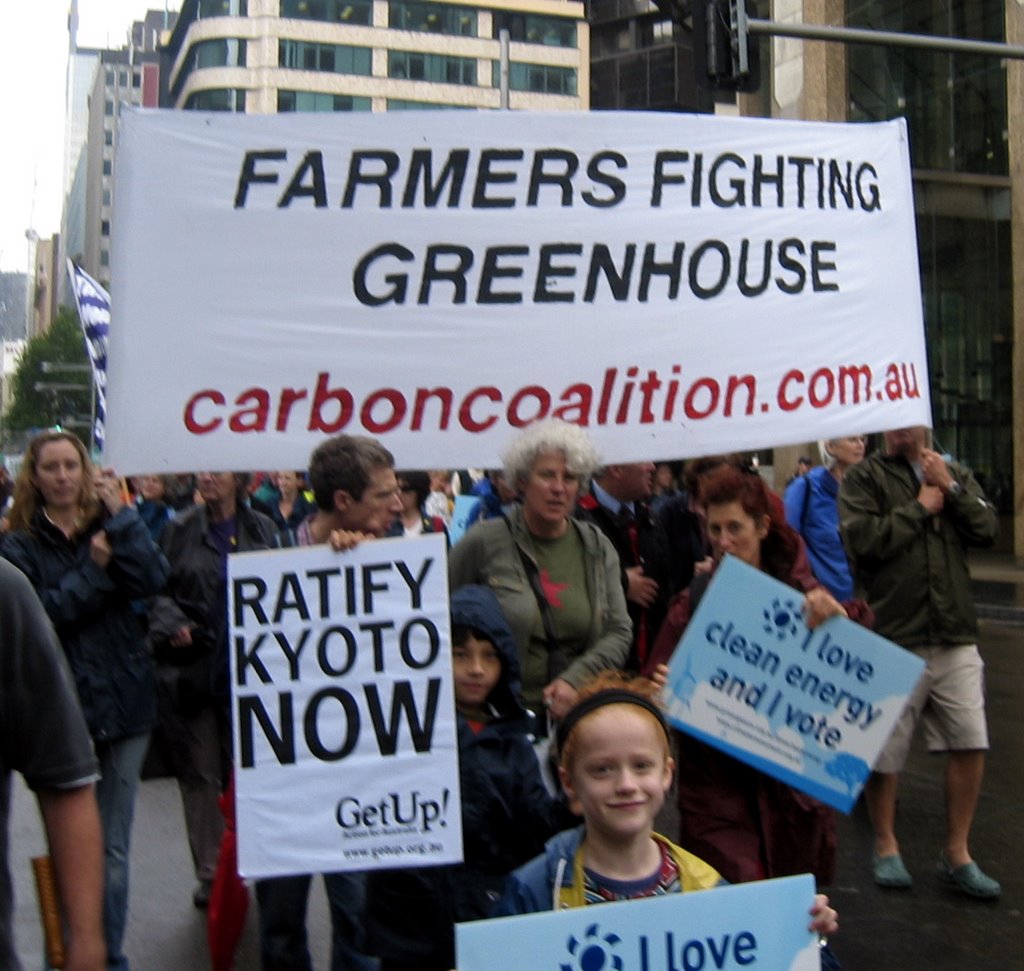
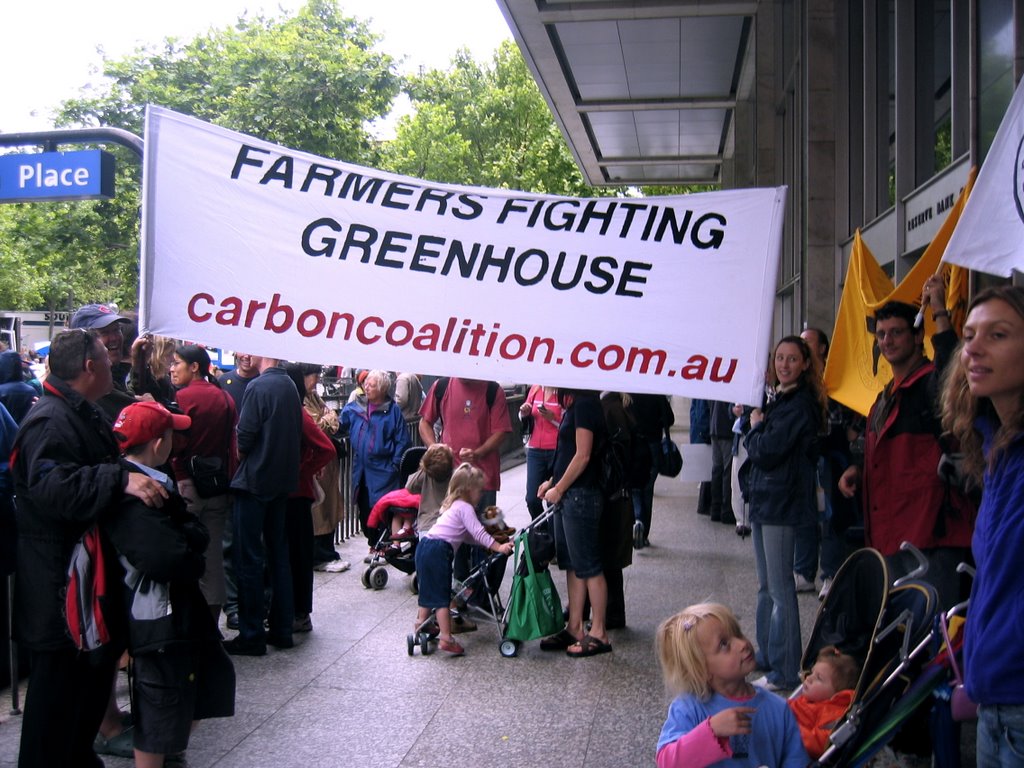
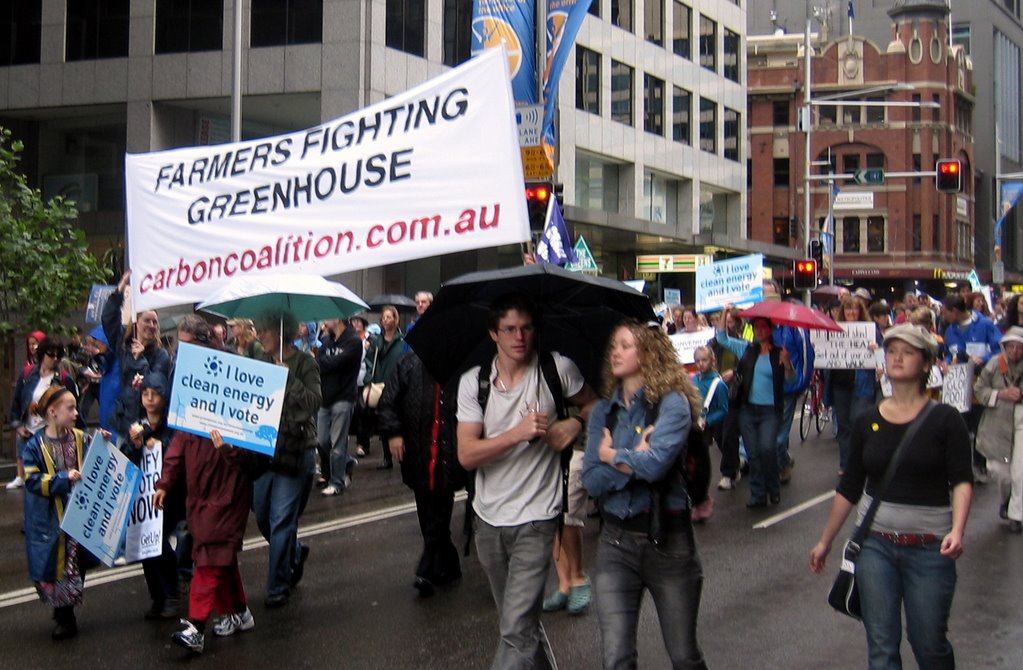
It was a small band of brave souls who held the Carbon Coalition banner high and carried it through the streets of Sydney on 4th November during the "Walk Against Warming". Sydney-based members Shane Press (and his son Brendon), Kevin and Leisel James, Jeff Sanders, and Jessica Kiely joined Goolma-based member Michael Kiely to walk with at least 100,000 people. Kevin made the banner, Jessica wrote the slogan, and Jeff manhandled it against the wind. We were interviewed by a TV crew from the Weather Channel. many people came up to us and congratulated us and mentioned that their sympathies are with people in the bush. The Commonwealth Shadow Minister For The Environment Anthony ALbanese spoke for 10 minutes with us, and now understands the importace of soils and asked to be sent more information for a white paper he is preparing on the environment and water policy. Many more people asked for our briefing sheet. It was a successful day. BIG THANKS go to Kevin and Marc Pop for making the banner and to those who walked. Unforturnately this is the only way the media will hear our message.
Saturday, October 28, 2006
2006 National Carbon Forum Canberra 22/23 November
CARBON FORUMS: Christine Jones's 'Managing the Carbon Cycle' Kingaroy Forum was a huge success with around 90 people attending and some very good papers presented. Surely the best lineup of theoretical and practical talent on this topic. Areas covered included Terra Preta soils, regenerative grazing, pasture cropping, biodynamics, carbon farming, and soil biological processes. The National Forum in Canberra is on 22nd and 23rd November, 2006 (see www.amazingcarbon.com)
Coalition expanding its operations
REGIONAL ORGANISERS: We are inviting members to get more involved after a couple of people at Kingaroy offered to do something locally for us. Appeal reads: "Would you like to be a "Regional Organiser" for the Carbon Coalition? The role would not be very onerous. 1. Helping us to recruit new members in your locale, district or region. 2. Occasionally sending your local members an email about an event, etc. 3. Reporting to us any 'carbon' activity in your area - eg. scientific trials, new technologies introduced, etc."
MEGA-WEBSITE "SOIL-C-CENTRAL": We are floating a Global Web site dedicated to Soil Carbon. It aims to promote the benefits of Soil Carbon; To attract new members to the soil carbon community; To speed the uptake of new information throughout the community; To increase the influence of the community; Build closer links between environmentalists, farmers and scientists; Build closer links between students of soil carbon on different continents. WE need you to send us soft copies of research and academic papers, links to websites, and any news you find. This project will be as good as we make it. Content will include News: Upcoming events, conferences and courses; New research findings and papers; New research studies and timetables; New websites; New newsletters and publications. There will be a Library featuring Bibliographies - lists of publications, Academic papers, Articles, Interviews, and a YouTube video library. Links to other Websites and Blogs. There wilL also be Profiles of Members (voluntary), Notice Boards, Chat room, Online events and “Webinars”.
PRACTITIONER PROFILES: Rod Rush announced a great idea at the Kingaroy Carbon Forum: profiles and case studies on people like you or whom you know, who are doing things differently and getting results. These stories will be posted on the website. You will be sent a template for reporting to the Practitioner Profiler.
PUBLICITY OPPORTUNITY: The “WALK AGAINST WARMING” – the International Day of Action on Climate Change on Saturday, Nov 4th 2006 – offers the Carbon Coalition a BIG OPPORTUNITY. IT is a community event promoted by Channel 7’s Sunrise Program. It will be on in Sydney - 11am Martin Place (walk to Tarpeian Way next to Botanic Gardens) - and other cities (see www.walkagainstwarming.org) Our opportunity is to take advantage of the media coverage of the Walk Against Warming to put Soil Carbon on the screen. We need to make the Media, Government, Govt. Agencies, Corporates and Potential Donors aware that we exist because they can help us achieve our goals. It is also an opportunity to register the Ecological Benefits of Soil Carbon Credits, change the image of the farming community, and to recruit new members. The plan we are suggesting is that we use this family-friendly event to capture the attention of people who can help us. By carrying placards on poles, above the heads of the crowd, our message will be televised to the world for FREE (we can afford that). The messages suggested by members for the banners include the following:
Farmers Fighting Greenhouse”Carbon Credits For Soils Now”
carboncoalition.com.au
“Carbon Coalition Against Global Warming”
“Soils Can Save The World
“Soil Carbon Credits Save Soils”
“Soil Carbon Credits Restore Ecology”
“Soil Carbon Credits Save The Family Farm”
“Soil Carbon Credits Save Water”
“Soil Carbon Credits Stop Erosion”
“Soil Carbon Credits Stop Salination”
“Soils: short term CO2 solution”
The more banners we can have made (professionally) the better. We need carriers, so we need to recruit as many supporters and city-based members of the Coalition as possible. We’d like to have everyone wearing Akubra hats to signal the connection with the Land.
Would you be interested in carrying a banner and walking with us?
Cheers!
MEGA-WEBSITE "SOIL-C-CENTRAL": We are floating a Global Web site dedicated to Soil Carbon. It aims to promote the benefits of Soil Carbon; To attract new members to the soil carbon community; To speed the uptake of new information throughout the community; To increase the influence of the community; Build closer links between environmentalists, farmers and scientists; Build closer links between students of soil carbon on different continents. WE need you to send us soft copies of research and academic papers, links to websites, and any news you find. This project will be as good as we make it. Content will include News: Upcoming events, conferences and courses; New research findings and papers; New research studies and timetables; New websites; New newsletters and publications. There will be a Library featuring Bibliographies - lists of publications, Academic papers, Articles, Interviews, and a YouTube video library. Links to other Websites and Blogs. There wilL also be Profiles of Members (voluntary), Notice Boards, Chat room, Online events and “Webinars”.
PRACTITIONER PROFILES: Rod Rush announced a great idea at the Kingaroy Carbon Forum: profiles and case studies on people like you or whom you know, who are doing things differently and getting results. These stories will be posted on the website. You will be sent a template for reporting to the Practitioner Profiler.
PUBLICITY OPPORTUNITY: The “WALK AGAINST WARMING” – the International Day of Action on Climate Change on Saturday, Nov 4th 2006 – offers the Carbon Coalition a BIG OPPORTUNITY. IT is a community event promoted by Channel 7’s Sunrise Program. It will be on in Sydney - 11am Martin Place (walk to Tarpeian Way next to Botanic Gardens) - and other cities (see www.walkagainstwarming.org) Our opportunity is to take advantage of the media coverage of the Walk Against Warming to put Soil Carbon on the screen. We need to make the Media, Government, Govt. Agencies, Corporates and Potential Donors aware that we exist because they can help us achieve our goals. It is also an opportunity to register the Ecological Benefits of Soil Carbon Credits, change the image of the farming community, and to recruit new members. The plan we are suggesting is that we use this family-friendly event to capture the attention of people who can help us. By carrying placards on poles, above the heads of the crowd, our message will be televised to the world for FREE (we can afford that). The messages suggested by members for the banners include the following:
Farmers Fighting Greenhouse”Carbon Credits For Soils Now”
carboncoalition.com.au
“Carbon Coalition Against Global Warming”
“Soils Can Save The World
“Soil Carbon Credits Save Soils”
“Soil Carbon Credits Restore Ecology”
“Soil Carbon Credits Save The Family Farm”
“Soil Carbon Credits Save Water”
“Soil Carbon Credits Stop Erosion”
“Soil Carbon Credits Stop Salination”
“Soils: short term CO2 solution”
The more banners we can have made (professionally) the better. We need carriers, so we need to recruit as many supporters and city-based members of the Coalition as possible. We’d like to have everyone wearing Akubra hats to signal the connection with the Land.
Would you be interested in carrying a banner and walking with us?
Cheers!
BREAKTHROUGH WITH SCIENTISTS
Flux and soil variability are thrown in our faces whenever we ask for trading units of soil carbon. But one important US scientist has broken ranks with his colleagues to argue for sanity to prevail: "It is often pointed out that soils have a large amount of variability, but with knowledge of soil sciences and landscapes, variability can be described and sampling protocols can be developed to deal with this," writes Dr John Kimble in a paper published this year*. "One reason I feel people say that soils vary and SOC cannot be measured is that we soil scientists focus on showing variability, not on showing what we know about the variability. In soils we can go to a 100m2 field and sample every square meter and look at the differences we find. But if you sample every tree in a large area you would see a similar variability." Dr Kimble works for the US Department of Agriculture, National Resources Conservation Service, National Soil Survey Centre, Lincoln, Nebraska. "We too often focus on this [variability], worry about laboratory precision and field variation and do not look at the real world where most things are based on averages and estimated data. We tend to focus on finding variation and not on using our knowledge of soil science to describe what we know. All systems vary, but in soils we focus on a level of precision and accuracy that may not have any relevance to the real world because we can take so many samples and look at the variation." We need a half dozen more like this.
*Kimble, J., "Advances In Models To Measure Soil Carbon: Can Soil Carbon Really Be Measured?", in Lal, R., Cerri, C., Bernoux, M., Etchevers, J., and Cerri, E., eds., Carbon Sequestration in Soils in Latin America, Food Products Press, Birmingham, NY, 2006
*Kimble, J., "Advances In Models To Measure Soil Carbon: Can Soil Carbon Really Be Measured?", in Lal, R., Cerri, C., Bernoux, M., Etchevers, J., and Cerri, E., eds., Carbon Sequestration in Soils in Latin America, Food Products Press, Birmingham, NY, 2006
SoilS are for early sequestration
"Terrestrial C sequestration could have an immediate application in climate change mitigation due to its availability, relatively low cost, and associated environmental benefits." Said R.W. Izaurrable anbd C.W.Rice, "Methods and Tools for Designing a Pilot Soil Carbon Sequestraton Project", in Carbon Sequestration in Soils of Latin America, Lal et al. eds, 2006
Thursday, October 12, 2006
Climate change brings invasive trees

The Green movement say Australia was largely covered by forest when white man arrived, and that we should let it return to forest. But palentologists say things are a little more complicated. Global warming could be the cause of the rapid expansion of woody weeds and trees, according to Brian Fagan's study The Long Summer: How Climate Changed Civilisation. After the last Ice Age, during the long warming, open grasslands were invaded by trees at a rapid rate. Pollen records reveal that the grasslands that covered much of Europe during the last Ice Age became denser and more productive - then the trees came! Within 500 years birch forests covered much of England and Europe. "Experts believe that trees such as birch, pine, alder and hazel could advance at a rate of 1 to 2 kilometers a year over periods of five hundred to two thousand years," says Fagan. "In New Zealand, the southern beech was confined to a few sheltered locations during the late ice Age, whewn grassland and scrub covered most of the land. But the rapid warming at the end of the Ice Age had beeches completely replacing the open vegetation of earlier time within a mere three hundred years." The Green Movement now has a dilemma. Which past state of natural balance should we return to? Pre firestick farming, back before Cromagnon Man started using fire to encourage grasslands to grow sweet new shoots to attract grazing animals? Pre white arrival, before iron axes made clearing the trees easier? Fagan floats the idea of man-managed landscape 13 millenia ago: "Combine the nut harvest with systematic burning of brush and grasses to stimulate new growth and attract game and you have the elements of a carefully managed landscape." Does man have a place in Nature?
...........
The Americans are asking themselves the same question.
The following is from Forest Landowner / Jan-Feb 1999 (found at http://home.flash.net/~falline/ocrPrimeval.htm)
...........
What did North America look like before Europeans arrived? One of our most popular, strongly held images is that of the “forest primeval.” We imagine a blanket of ancient forest, which nature maintained in equilibrium with the environment.
We also imagine native people who lived in the forests and on the plains without changing either ecosystem. Thus, another popular image is that of the ecologically invisible American Indian.
In fact, enormous areas of the continent’s forests and grasslands were very much cultural landscapes, shaped profoundly by human action.
At the time of European contact, many Indians were farmers. In the East and Southwest they raised maize, beans, pumpkins and squash to provide at least half their subsistence. Agriculture in the Americas originated more than 5,000 years ago. By 1500, indigenous people had cleared millions of acres for crops. Everywhere in the Americas they also regularly set fire to hundreds of millions of acres to improve game habitat, facilitate travel, reduce insect pests, remove cover for potential enemies, enhance conditions for berries and drive game.
Vast areas of the forest landscape in both the West and East were open, park-like stands shaped by frequent, low-intensity fires. In New England, Indians burned the woods twice a year. Roger Williams wrote that “this burning of the Wood to them they count a Benefit, both for destroying of vermin, and keeping downe the Weeds and thickets.” John Smith commented that in the forests around Jamestown, Virginia, “a man may gallop a horse amongst these woods any waie, but where the creeks and Rivers shall hinder.”
In many cases frequent forest burning created grasslands where forests otherwise would have existed. Prairies extended into Ohio, western Pennsylvania and western New York. In Virginia the vast prairie of the Shenandoah Valley covered more than 1,000 square miles. Ecologist R.C. Anderson writes that the eastern prairies and grasslands “would mostly have disappeared if it had not been for the nearly annual burning of these grasslands by the North American Indians.”
Wednesday, October 04, 2006
Carbon Coalition Against Global Warming launched in USA

The Carbon Coalition Against Global Warming was launched in the USA last week (on last Friday night) at "Maplewood Farm", Highgate, Vermont. Present for the inaugural meeting were (from left to right) Ted Yandall of "Cimarron Farm", Stanton, Vermont, Abe Collins, Eric Nowel of "Maplewood Farm", Louisa and Michael Kiely, Ridgeway Shinn or Bakewell Reproductive Centre of Massachusetts, and Gerald Fry, grassfed beef geneticist of Arkansas. This marks the internationalisation of the Coalition and the next stage of the grassroots campaign to have soil carbon credits become a reality.
The Coalition now has the outline of a trading strategy which will be discussed with the Council in Australia prior to a launch towards the end of the year. (More on that later.)
Subscribe to:
Posts (Atom)